Qualifications for live-in carers UK

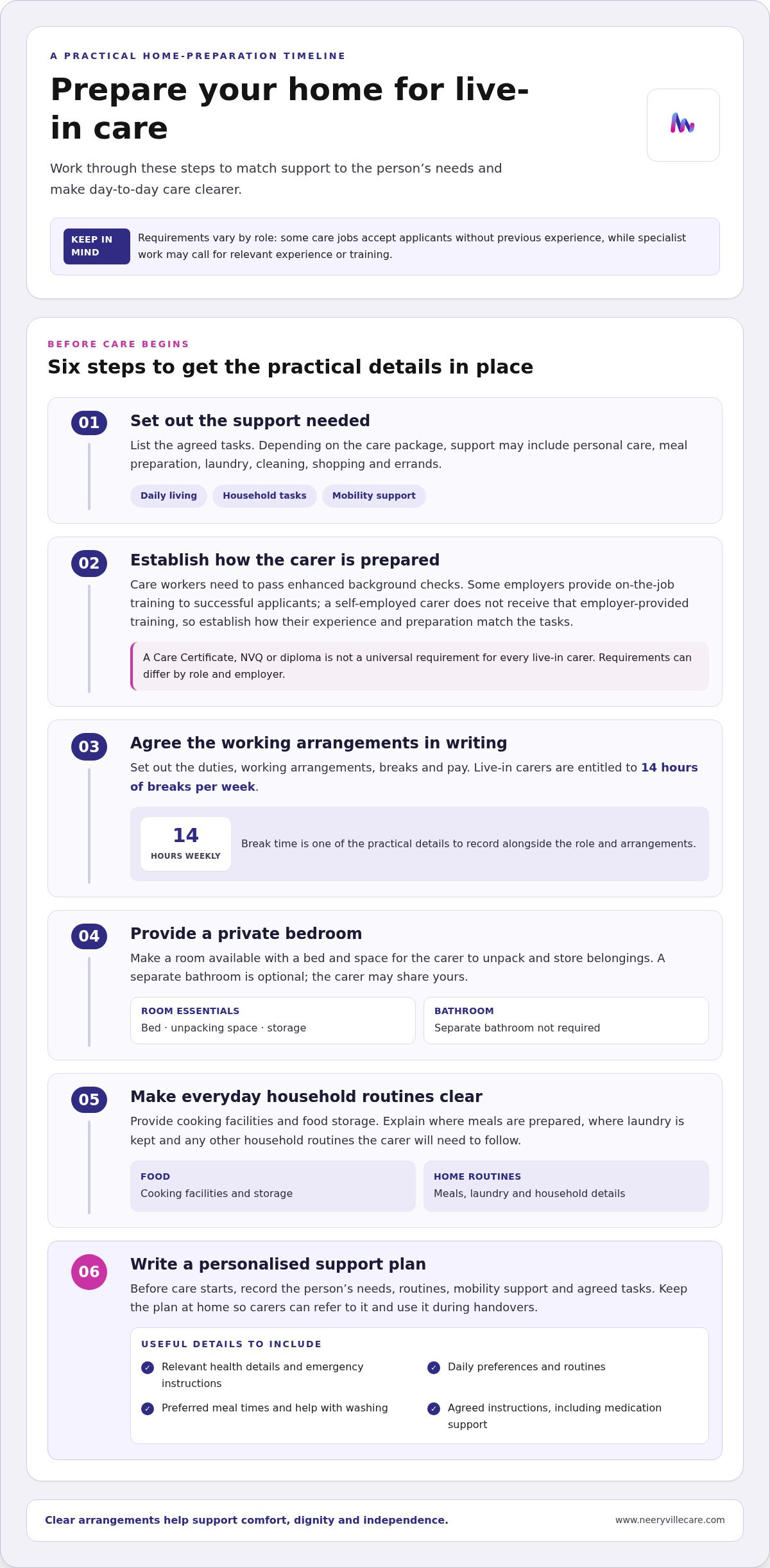
A live-in carer’s qualifications aren’t the only thing your home needs to be ready for. The qualifications for live-in carers in the UK vary by role: some care jobs are open to applicants without previous experience, while some employers may require GCSEs in English and maths at grades 9 to 4 (A* to C), or equivalent. Care workers also need to pass enhanced background checks.
It’s understandable to want reassurance about the person coming into your home and the practical arrangements they’ll need. This guide explains how education, training and screening relate to a live-in carer’s suitability, and what to prepare at home, including a private bedroom, cooking facilities and a personalised support plan.
You’ll also learn how specialist experience and further training can matter for particular care needs. The aim is to clarify the essentials, so you can feel prepared and focus on safe, individual support in familiar surroundings.
Table of Contents
What do I need to provide for my live in carer?
Prepare a private bedroom, cooking facilities, food storage and a personalised support plan. These practical arrangements help a live-in carer provide consistent support in your home.
Some care roles accept applicants without previous experience, while specialist work may call for relevant experience or training. The qualifications for live-in carers in the UK therefore depend on the duties and the person’s needs.
Care experience and personal qualities
Care experience means practical or personal involvement in supporting someone with daily living. Some care jobs are open to applicants without prior experience, while specialist roles may require specific qualifications and experience.
Patience, respect and clear communication help carers protect independence and dignity. For example, a carer supporting someone with personal care should respect their preferences and explain each step. A good level of fitness can be useful when a role involves helping someone move.
Depending on the care package, live-in support can include personal care, meal preparation, laundry, cleaning, shopping and errands. A driving licence can help if a role involves travelling between clients, although live-in care takes place in the person’s home.
Qualifications for employed and self-employed carers
Employment status describes whether a carer works for an employer or works on a self-employed basis. Some UK employers may require GCSEs in English and maths at grades 9 to 4 (A* to C), or equivalent; others may accept applicants without prior experience.
Care workers can apply directly for roles, with successful applicants receiving on-the-job training from their employer. A self-employed carer is not receiving that employer-provided training, so families should establish how the carer’s experience and preparation match the agreed tasks.
A live-in arrangement does not itself grant immigration permission or a right to work. Carers need the appropriate permission under UK rules for their circumstances. Agree duties, working arrangements, breaks and pay in writing; live-in carers are entitled to 14 hours of breaks per week.
Care Certificate, NVQ and diploma requirements
A Care Certificate, NVQ or diploma is a care-related qualification or form of training. None is a universal requirement for every live-in carer; requirements can differ by role and employer.
A Level 2 Diploma in Care is one possible qualification for people considering care work. Health and social care education can benefit people entering homecare, while further training may support work with specific needs.
Without recognised training, a carer may have less formal preparation for particular tasks. This can matter when support involves dementia, stroke or medication routines. Share relevant health details, daily preferences and emergency instructions in a personalised support plan kept at home for carers to refer to and use during handovers.
Provide a bedroom with a bed and space to unpack and store belongings. A separate bathroom is optional, and the carer may share yours. Make cooking facilities and food storage available, and explain household routines, such as where meals are prepared and laundry is kept.
Before care begins, record the person’s needs, routines, mobility support and agreed tasks in the plan. Include practical details, such as preferred meal times or how the person likes help with washing. Clear instructions help the carer support comfort and independence without guesswork.
Training subjects and assessment
Care training develops knowledge and practical skills for supporting someone with daily life. Its content should reflect the person’s needs, the carer’s duties and the care setting.
A learning assessment identifies what a carer understands and where they may need more practice. For example, it can distinguish familiar personal care tasks from support that calls for dementia or autism awareness.
Training may cover communication, dignity, privacy and maintaining independence. These principles guide everyday interactions, such as explaining assistance before helping someone wash or dress. Respectful, clear communication also helps a carer understand preferences and pass relevant information to colleagues.
Practical learning can focus on tasks set out in the person’s support plan. This might include preparing a meal, helping someone wash or following agreed instructions for medication support. A carer should know the limits of their role and when to report a concern rather than act beyond their training.
Specialist learning can help carers understand particular conditions and their effects on daily routines. Dementia awareness, for example, can build understanding of how communication and familiar routines may support a person. Autism awareness is another specialist subject for care workers. Training should relate these topics to the individual, rather than treating everyone with the same diagnosis alike.
Assessment checks learning against the skills needed for a role. It may involve discussing a scenario, such as how to respond when someone refuses help with washing. Practical tasks can also show whether the carer follows instructions, communicates calmly and respects the person’s choices. Assessments should relate to actual duties, not knowledge unrelated to the work.
To understand a carer’s preparation, consider three things: what subjects were covered, how learning was assessed and whether further training is planned for specialist duties. For example, a dementia care role may call for dementia awareness alongside guidance on the person’s routines and preferences. A general course alone may not cover every situation in an individual’s home.
Training costs and duration depend on the course, its level, the learning provider and the assessment involved. Specialist subjects and practical components can affect the time and expense required.
For families, the next step is to connect training with the written care plan. List daily tasks, the person’s preferences and any specialist support needs. This gives the carer a clear reference for day-to-day care and handovers, including help with washing and maintaining social or community routines.
Carer vetting and screening
Carer vetting means reviewing a person’s identity, background and suitability before care begins. Care workers in the UK need to pass enhanced background checks, which are an important part of safeguarding someone receiving support.
An enhanced check is one screening measure, not a complete picture of a carer’s ability. It doesn’t show how someone communicates, follows a support plan or responds to a difficult moment. Consider screening alongside relevant experience, training and a conversation about the tasks involved.
For care arranged through an agency in England, registration is another useful point of context: homecare agencies in England must register with the Care Quality Commission (CQC). Registration and an individual carer’s background checks are separate matters. One concerns the agency’s regulatory registration; the other concerns screening the worker.
Use a consistent set of questions when reviewing a carer’s suitability. Ask how their identity and employment history were checked, whether references were obtained and how the enhanced background check was completed. Ask which training relates directly to the person’s care, such as dementia awareness or support with personal routines. Keep notes and compare the answers with the person’s needs.
Identity and work history: Ask how the carer’s identity and previous caring roles were reviewed.
References: Find out whether previous work or caring experience was discussed with a referee.
Background screening: Ask whether the enhanced check was completed and how its outcome informs suitability.
Role-specific preparation: Discuss relevant experience for tasks such as dementia support or medication routines.
For example, supporting someone with dementia involves more than presenting a reassuring résumé. Discuss how the carer would respond if the person became distressed, declined assistance or wanted to follow a familiar routine. Their answers can show how they approach dignity, communication and safety, and whether they understand the role’s expectations.
Consider screening alongside clear arrangements for raising concerns. Establish who the family can speak to, how changes in the person’s needs will be shared and how important information will be recorded. A named family member can help organise communication, especially when several relatives contribute to decisions.
Write down agreed duties and boundaries before care starts. For instance, record whether support includes washing, meals or medication prompts. This gives the carer and family a shared reference and helps identify when a task falls outside the agreed role. Review the arrangements if needs or routines change.
Careful vetting cannot replace a person-centred conversation, but it gives families a clearer basis for decisions. Consider the screening outcome, relevant caring experience and the carer’s responses to realistic examples together. This fuller picture connects formal checks with the trust and understanding needed in someone’s home.
Education restrictions
Education restrictions are course entry requirements, not a universal academic threshold for becoming a live-in carer. In England, routes into care work include apprenticeships and health and social care courses, and requirements vary by route.
A foundation apprenticeship is available to applicants aged 16 to 21 in England. It usually has no specific qualification or experience requirement, making it a possible starting point for someone moving into care work. Applicants aged 22 to 24 can also apply if they meet one of the listed eligibility conditions. The route’s age criteria concern apprenticeship access, not a general rule for working as a carer.
An intermediate apprenticeship usually requires some GCSEs, including English and maths, or equivalent. GCSEs aren’t required to study an apprenticeship, although previous study experience can help. These points describe different aspects of entry: an apprenticeship route may have its own expectations, but GCSEs aren’t a universal condition for every apprenticeship.
An advanced care apprenticeship usually requires 5 GCSEs at grades 9 to 4 (A* to C), or equivalent, including English and maths. This is a higher entry threshold than the foundation route. Applicants should compare the requirements for the specific level they’re considering, rather than assume all care apprenticeships ask for the same education.
Other study options can introduce care subjects without beginning with an apprenticeship. These include a Level 1 Certificate in Health and Social Care and a T Level in Health. Adult care worker intermediate and advanced apprenticeships are also possible routes into care work. A course choice depends on the learner’s existing study, preferred learning route and intended role.
Use these steps to compare routes:
Identify the course level, such as foundation, intermediate or advanced.
Read its stated entry requirements, including any GCSE or equivalent expectations.
Compare those requirements with the applicant’s existing education and experience.
Consider whether a certificate, T Level or apprenticeship better matches their learning plans.
These qualifications describe routes into care, not a single mandatory academic standard for every live-in role. Some care jobs may accept applicants without prior knowledge or experience, while specialist roles can require specific qualifications and experience. A course can build relevant understanding, but its level alone doesn’t establish suitability for every care duty.
Social work is a distinct profession, not another name for live-in care. In the UK, qualifying as a social worker requires a social work degree. Families considering care should distinguish between a carer’s role and a social worker’s professional qualification, so education requirements stay relevant to the support being arranged.
Do live-in carers need a Care Certificate, NVQ or Level 2/3 Diploma?
A Care Certificate is care-related learning that can help prepare someone for support work. It isn’t a universal qualification required of every live-in carer. Its relevance depends on the role, employer and duties involved.
An NVQ is a vocational qualification associated with practical skills and workplace learning. It isn’t a blanket entry requirement for live-in care. A certificate or qualification can show learning, but families should consider how its subject relates to the person’s actual support needs.
A Level 2 Diploma in Care is one possible qualification for people considering a care-worker role. It offers a route to study care, but it isn’t presented as a mandatory qualification for every live-in position. Education or training in health and social care can be beneficial for people entering homecare.
Level 3 is a qualification level, but the available facts don’t specify a Level 3 Diploma as a required qualification for live-in carers. Don’t assume that a particular diploma level applies to every role. Specialist care work can have specific qualification and experience requirements, so relevance depends on the support being provided.
To assess a qualification’s practical value, compare it with the care tasks and the person’s needs. For example, a course covering daily living support may be relevant to personal care, while specialist needs may call for additional training or experience. The qualification title alone doesn’t show whether the carer is prepared for every task.
Use this simple comparison when reviewing a carer’s training:
Care Certificate: Ask which care subjects were covered and how learning relates to the role.
NVQ: Consider the practical skills and work experience represented by the qualification.
Level 2 Diploma in Care: Treat it as a possible study route, then compare its content with the agreed duties.
Level 3 Diploma: Don’t assume it is a universal entry condition; assess relevance to the specific role.
Employers may have their own education expectations. Some UK care employers may require GCSEs in English and maths at grades 9 to 4 (A* to C), or equivalent. That is an employer requirement, not evidence that every live-in carer must hold a diploma.
For families, the key question is whether the carer’s learning matches the support plan. A qualification can contribute to that picture, alongside relevant experience and role-specific preparation. If support involves specialist needs, relate the training directly to those needs and agreed responsibilities.
So, a Care Certificate, NVQ or Level 2 or 3 Diploma isn’t established here as a universal requirement for every live-in carer. The Level 2 Diploma in Care is one possible route into care work; role expectations and specialist duties shape which learning is relevant.
NeeryVille Care: Live-in Care
NeeryVille Care provides live-in care for people who need support while remaining in familiar surroundings. If you’re weighing qualifications alongside personal fit, daily needs and home arrangements, a conversation can help clarify what support may suit your family.
Care is personalised around the individual. NeeryVille Care also offers dementia care, domiciliary care and end of life care, so families can consider support that reflects changing circumstances and preferences. As a CQC-regulated home care provider, NeeryVille Care delivers services across England.
Share the person’s routines, needs and priorities when discussing care. This helps create a clear picture of the support required at home.
Contact NeeryVille Care to discuss your family’s care needs.
Take the next step towards care that feels right
Choosing qualifications for live-in carers in the UK is part of a wider decision: how support will fit the person’s life as their needs and routines change. Keep the discussion focused on what matters to them, from feeling comfortable at home to preserving familiar choices and relationships. A useful next step is to describe those priorities plainly, so care planning starts with the individual rather than a list of credentials.
NeeryVille Care provides live-in care, dementia care and visiting care. These options help families consider support shaped around different needs, while keeping personal preferences central. You can discuss your situation and the kind of help that may suit your family, without having every detail decided beforehand.
Taking the first step can make a complicated decision feel more manageable. Move at a pace that feels comfortable for your family.
Frequently Asked Questions
What is live-in care?
Live-in care is support provided in a person’s own home by a carer who lives there. Agreed support can fit daily routines, including meal preparation, personal care or companionship. Care takes place in familiar surroundings, and the arrangement should clearly set out the tasks involved, how support is organised and how the person’s preferences are respected.
What qualifications are legally required to work as a live-in carer in the UK?
There isn’t one qualification that every live-in carer must hold across the UK. Some care jobs may be open to applicants without previous experience, while specialist roles can require specific qualifications and experience. Employers may also set education requirements. A social work degree is required to qualify as a social worker, a separate professional role from live-in care.
What training do UK live-in carers need, such as first aid, moving and handling, and medication?
Training should match a carer’s duties; there is no single universal course for every live-in role. Practical preparation may relate to the person’s support plan, such as helping with mobility or following medication instructions. For specialist needs, further learning in areas such as dementia or autism awareness can be useful. Families can discuss how the carer’s preparation relates to each agreed task.
Do live-in carers need a DBS check, and what type?
Care workers need to pass enhanced background checks, so families can ask whether an enhanced check has been completed. It provides screening information, but doesn’t show how a carer will approach daily support or communicate with the person. Consider it alongside the carer’s experience and suitability for the role. For example, ask how their background and preparation relate to supporting someone with dementia.
Are live-in carers required to have a driving licence or specialist skills?
A driving licence isn’t necessary for every live-in care role; it can be helpful when the job involves travelling between clients. Specialist skills depend on the support required. A role involving particular conditions may call for specific qualifications or experience, while another may focus on everyday assistance. Match the carer’s abilities to the actual duties, such as mobility support, meal preparation or dementia-related care.
What qualifications do live-in carers need to support people with dementia or complex care needs?
Specialist roles may require relevant qualifications and experience, rather than one qualification applying to everyone with dementia or complex needs. Further training, including dementia awareness, can help carers understand individual support requirements. Families can discuss specific situations, such as distress when a routine changes, and relate the carer’s learning to the person’s plan. The focus should be whether preparation fits the agreed support.
What checks should families make when hiring a live-in carer or care agency?
Ask about enhanced background screening, relevant experience, training and the tasks the carer will undertake. In England, homecare providers must register with the Care Quality Commission (CQC). Clarify who records support instructions, shares updates and handles handovers. For example, if a person’s routine changes, establish how the information will reach the carer. These checks connect formal oversight with practical arrangements at home.