Physical Disability Support in Highgate: A Family Guide

Updated: 2 days ago
When mobility, stamina or dexterity make familiar tasks harder, it’s understandable to wonder what help would be useful and how to arrange it without losing choice or dignity. If you’re looking for physical disability support at home Highgate, start with the person’s priorities: which parts of the day take extra effort, and what would they like to keep doing independently?
Support can be tailored to practical needs, from personal care and getting ready to meal preparation, medication support or companionship. NeeryVille Care provides visiting care in Highgate and surrounding North London within a five-mile radius, with the same carer attending every visit. This guide explains what home support can involve, how to prepare for a useful conversation about individual needs and how visiting care compares with live-in care.
Table of Contents
Physical disability support at home in Highgate: what help can make possible
A physical disability can affect everyday tasks in different ways, and the impact may vary from person to person or from one day to the next. Someone might find preparing breakfast tiring but manage dressing comfortably. Another person may want help carrying items between rooms while continuing to cook independently. The useful question isn’t simply “What can’t they do?” It’s “Which parts of the day would they like support with?”
Physical disability support at home Highgate means practical assistance shaped around the individual’s priorities, abilities and preferences. It might involve help with a particular task, a carer preparing items so the person can manage the task themselves, or support to make a routine less tiring. A general overview of physical disability is available in Understanding Physical Disability, but day-to-day support should be guided by the person, not assumptions based on a label or diagnosis.
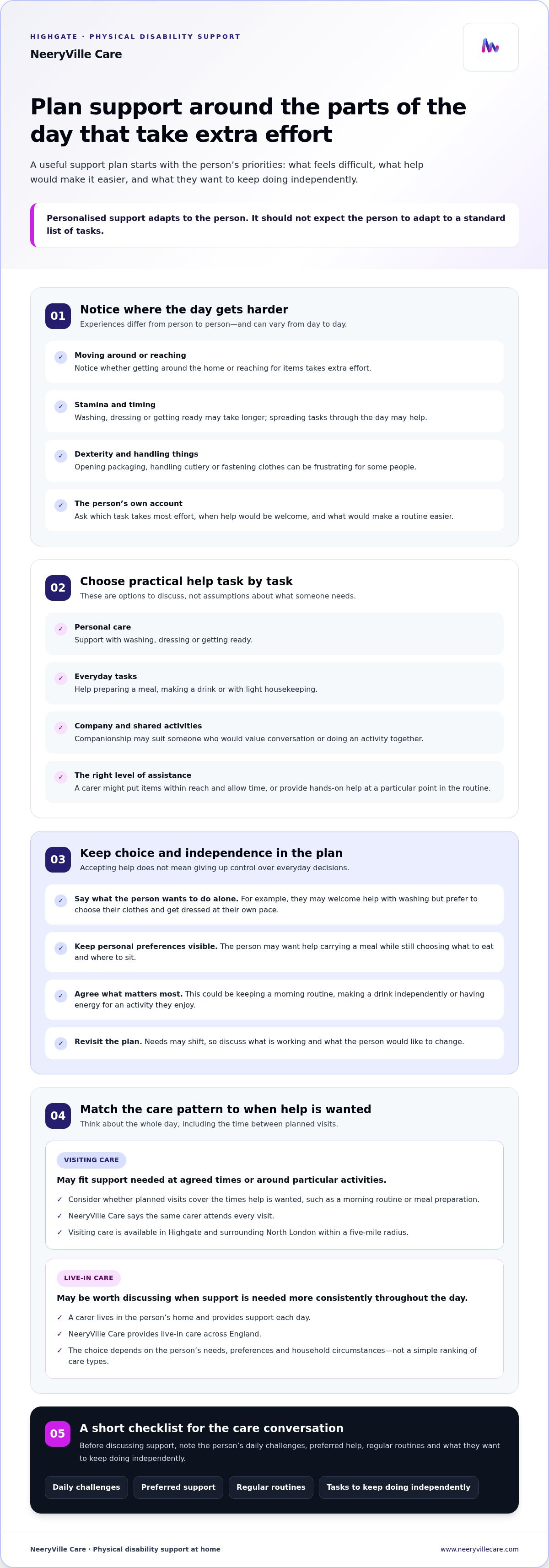
Personalised daily-living support adapts to the person; a one-size-fits-all care plan expects the person to adapt to it. Discuss support task by task, including what feels helpful, what the person prefers to do alone and what may change over time.
How physical disabilities can affect everyday life
Mobility needs may make moving around the home or reaching for an item more difficult. Reduced stamina can mean that washing, dressing and getting ready takes longer, or that a person prefers to spread tasks throughout the day. Changes in dexterity might make opening packaging, handling cutlery or fastening clothes frustrating. These are examples, not a checklist that applies to everyone.
Start with the person’s own account. Which task takes the most effort? Is there a particular time when help would be welcome? Would they like someone to assist directly, or prepare things so they can complete the task themselves? Details such as allowing extra time or keeping a familiar routine can shape useful support. Focus on the person’s experience at home rather than deciding in advance what they must need.
Why independence and personal choice come first
Accepting help doesn’t mean handing over control. A person may welcome assistance with washing but want to choose their clothes and get dressed at their own pace. They might need help carrying a meal but still want to decide what to eat and where to sit. These preferences belong in the support conversation from the start.
Begin with the person’s goals: perhaps keeping a morning routine, making a drink independently or having energy for an activity they enjoy. Then consider whether support could make those priorities easier to maintain. Needs may shift, so revisit what’s working and what the person would like to change. Good support respects the whole person, offers help without taking over and leaves everyday decisions where they belong.
What physical disability support at home can include in Highgate
Useful support is often practical and specific. One person may want help getting washed and dressed before starting the day; another may prefer assistance preparing a meal, managing household tasks or having company during a quieter afternoon. Physical disability support at home Highgate can be arranged around the tasks the person wants help with, rather than treating every household as if it has the same needs.
Matching support to tasks and routines
Start with the shape of an ordinary day. Which tasks take extra effort, and when would help be most useful? Personal care might include support with washing, dressing or getting ready. Help with daily living could involve preparing a meal, making a drink or light housekeeping. Companionship may suit someone who would value conversation or a shared activity. These are options to discuss, not assumptions about what any person needs.
Be clear about how assistance should feel, too. Someone might want a carer to prepare items within reach, then give them time to manage the task themselves. Another person may prefer hands-on help at a particular point in their routine. Visiting or hourly care can be arranged around agreed times and the assistance needed. At NeeryVille Care, the same carer attends every visit, bringing consistency to support. Visiting care is available in Highgate and surrounding North London within a five-mile radius.
Support with the home environment is a separate consideration from care visits. A person may want to explore whether changes to their home could make daily activities easier. GOV.UK explains eligibility and how to apply for Government Grants for Home Adaptations. Adaptations and personal assistance serve different purposes, but both may be relevant to a household’s plans.
Choosing between visiting support and more continuous care
Visiting care takes place at agreed times, so it may suit someone whose main support needs arise around particular activities or points in the day. Consider the gaps between visits as well. If the person manages comfortably for much of the day but would value help with a morning routine or meal preparation, planned visits may fit. If support is needed more consistently throughout the day, live-in care may be worth discussing.
With live-in care, a carer lives in the person’s home and provides support each day. NeeryVille Care provides live-in care across England. The choice depends on the person’s needs, preferences and household circumstances, not a simple ranking of care types. Map when help is wanted, what the person would like to continue doing independently and whether planned visits cover the day as they experience it at home.
If you’re weighing up which pattern of support could fit your household, you can talk through your family’s care needs.
Can physical disability support at home protect safety and independence?
Accepting help doesn’t have to mean giving up control of everyday life. The person can remain involved in decisions about what support looks like, when it’s offered and which tasks they’d rather manage themselves. Families may feel reassured by having practical help in place while also wondering whether it will fit comfortably around the person’s routines. Both concerns deserve space in the conversation.
Home support can provide assistance with agreed tasks, but it can’t remove every risk or guarantee a particular health outcome. The person’s needs, home circumstances and preferences all matter when considering what level of support may suit them.
Keeping the person in control of daily decisions
Ask the person what they’d like help with rather than stepping in automatically. They may welcome assistance with one part of a task but want to complete the rest themselves. Preferences can include how much prompting feels comfortable, what order tasks happen in and when they’d like support to pause. These details make support collaborative and keep personal decisions with the individual.
Person-centred support protects dignity by offering help in a way that respects the person’s choices.
Tasks where the person actively wants assistance.
Activities they prefer to complete independently, even if they take more time.
Situations where they’d value someone nearby without that person taking over.
Needs and preferences can change, so make room for the person to revisit the arrangement. A task that feels manageable one day may be tiring on another. Changes to support don’t have to be treated as a loss of independence.
Considering practical reassurance at home
Talk together about where worries arise during the day. Is there a particular task that feels difficult to manage alone? Would support at an agreed time help the person feel more comfortable? Are there moments when they’d rather have privacy or try independently first? Specific questions help turn general concern into a clearer picture of the assistance wanted.
For families considering physical disability support at home in Highgate, the right arrangement depends on the individual and the support they want. Planned visits may suit needs that arise at particular times; a need for more continuous assistance may lead to a different discussion. The person’s voice should guide that decision, with family observations adding practical details where helpful.
Safety and dignity belong in the same conversation. Discuss boundaries, preferred ways of receiving help and any concerns the person wants addressed. NeeryVille Care provides person-centred home care, with support planned around the person’s needs and preferences.
Preparing for Home Disability Support in Highgate
It can be easier to discuss support by starting with the person’s day rather than a list of services. You don’t need to have every answer ready. Notes about what feels difficult, what matters to the person and when a helping hand would be welcome can make an initial discussion clearer and more useful.
Make a simple picture of the day
For a few days, notice where tasks take extra effort or where help might make a difference. Include what the person wants to keep doing for themselves. Their perspective should lead; family observations can add context, especially if the person would like support expressing their needs.
Note tasks that feel difficult or tiring, and those the person wants to continue managing independently.
Record familiar routines, preferred ways of communicating and times when support may be useful.
Write down what the person would like to achieve, such as having more time or energy for an activity that matters to them.
Keep the notes practical. For example, “help is useful before leaving home” gives a clearer starting point than “needs more support”. Preferences matter too: someone may appreciate a quiet prompt, extra time or help with only one part of a task.
Talk through the support you would like
Use your notes to discuss the person’s priorities and the family’s concerns during the initial assessment. Explain which tasks they’d like help with, what they prefer to do alone and how support could fit around their usual routine. Start with the questions you have today; the conversation can clarify possible next steps.
For physical disability support at home Highgate, NeeryVille Care provides visiting care in Highgate and surrounding North London within a five-mile radius. The same carer attends every visit, helping make support consistent. Following the initial assessment, care can be arranged within 24 to 48 hours. Urgent situations are handled as quickly as possible.
Planning should include the family’s wellbeing as well as the person’s day-to-day needs. If caring responsibilities are becoming difficult to sustain, raise that in the conversation too. Families looking for caregiver burnout support in London can discuss what feels manageable and where additional help may be useful.
You don’t need to make a decision before you feel ready. An initial conversation can help you understand whether visiting care fits the times and tasks where support is wanted and what a next step could look like.
Talk through your care needs with our team
NeeryVille Care’s physical disability support at home in Highgate
Choosing care is a personal decision. Families often want clear information about who will provide support, where visits can take place and what the arrangements involve. NeeryVille Care provides personalised visiting care in Highgate, with practical help planned around the person’s needs and preferences.
NeeryVille Care directly employs its carers and is regulated by the Care Quality Commission (CQC). Its CQC Provider ID is 1-21254500455. The provider is also listed on NHS Find Care. These details give families clear points of reference when learning about its home care.
What families can expect from local visiting care
Visiting care is available in Highgate and surrounding North London within a five-mile radius. The same carer attends every visit, building familiarity with the person’s routines and preferences. Support can be planned around agreed visit times and the help the person wants with daily living.
Following the initial assessment, care can be arranged within 24 to 48 hours. The person and their family can use the assessment to explain what matters most, what assistance would be useful and how they’d like support to fit into the day.
The 14-Day Live Well at Home Guarantee means care can be ended within 14 days with no notice and no fees. Families can decide whether the arrangement feels right without pressure to continue if they decide it isn’t suitable.
Discuss a suitable next step with the care team
Before getting in touch, write down the person’s main priorities, the tasks where they’d welcome assistance and anything they want to keep doing independently. You can also note preferred visit times and questions the family would like to discuss. These details can help make the conversation more useful.
Visiting care costs £28 per hour, fully inclusive, with no hidden fees or travel charges. This gives you a clear basis for understanding the hourly cost as you consider what support may fit your household.
Families can take the next step at a pace that feels comfortable. A conversation with the team can cover local visiting support, the person’s priorities and what an initial assessment involves.
Contact NeeryVille Care to discuss support at home
Take the next step at your own pace
Planning support doesn’t have to mean making every decision at once. A useful next step is to write down what the person would like help with, what they want to keep doing independently and what questions the family would like answered. Those priorities can guide a conversation about whether physical disability support at home Highgate could fit the person’s routines and preferences.
It’s fine if your needs or questions change as you explore the options. The person receiving support should have room to say what feels right, and family members can share their concerns too. A thoughtful conversation can help turn uncertainty into a clearer plan, one step at a time.
Talk to NeeryVille Care about support at home
Start with what matters most to your household. To discuss visiting care in Highgate and surrounding North London, contact NeeryVille Care.
Frequently Asked Questions
Is physical disability support at home suitable for younger adults as well as older people?
Yes. Home-based support isn’t limited to older people. NeeryVille Care supports adults who need assistance at home, including people with mobility difficulties or other conditions. Age alone doesn’t determine what help may be useful. For example, an adult may want practical assistance that fits around work, study or personal activities. The person’s priorities and routines should guide a discussion about support in Highgate.
Can home care support someone living with multiple sclerosis?
Yes. NeeryVille Care supports people who need multiple sclerosis care at home. The conversation can focus on practical daily-living priorities, such as which household tasks the person would like help with and how assistance can fit their preferences. Needs and routines differ from person to person, so support should be discussed individually. This is home-care assistance, not medical advice or a promise of a particular health outcome.
Can physical disability support at home help after a stroke?
Yes. NeeryVille Care offers post-stroke care at home, with practical support focused on needs within the service’s scope. A person may want assistance with everyday activities while continuing to make their own choices about routines and tasks. Home care is distinct from clinical treatment, and no prediction about recovery can be made. The individual’s preferences and the practical help they want are useful starting points for discussion.
What happens if someone’s support needs change after care begins?
If priorities change, the person or family can raise this with the care team and discuss whether the current arrangement still fits. For instance, the person may want help with a different task or prefer a change to how assistance is provided. Open communication helps keep the person’s wishes central as circumstances evolve.
Can a family member be involved in discussing home support?
Yes. A family member may take part in a conversation about support if the person wants them involved. They might help describe routines or share observations while leaving space for the person to express their own preferences. Don’t assume that a relative should speak on someone’s behalf. A respectful discussion listens to the individual first and involves family in the way the person is comfortable with.
Does physical disability support at home include clinical nursing procedures?
No. NeeryVille Care provides home-care support, not clinical nursing procedures. Practical assistance with daily living is different from clinical treatment. The conversation can focus on everyday assistance within home care and the person’s priorities.