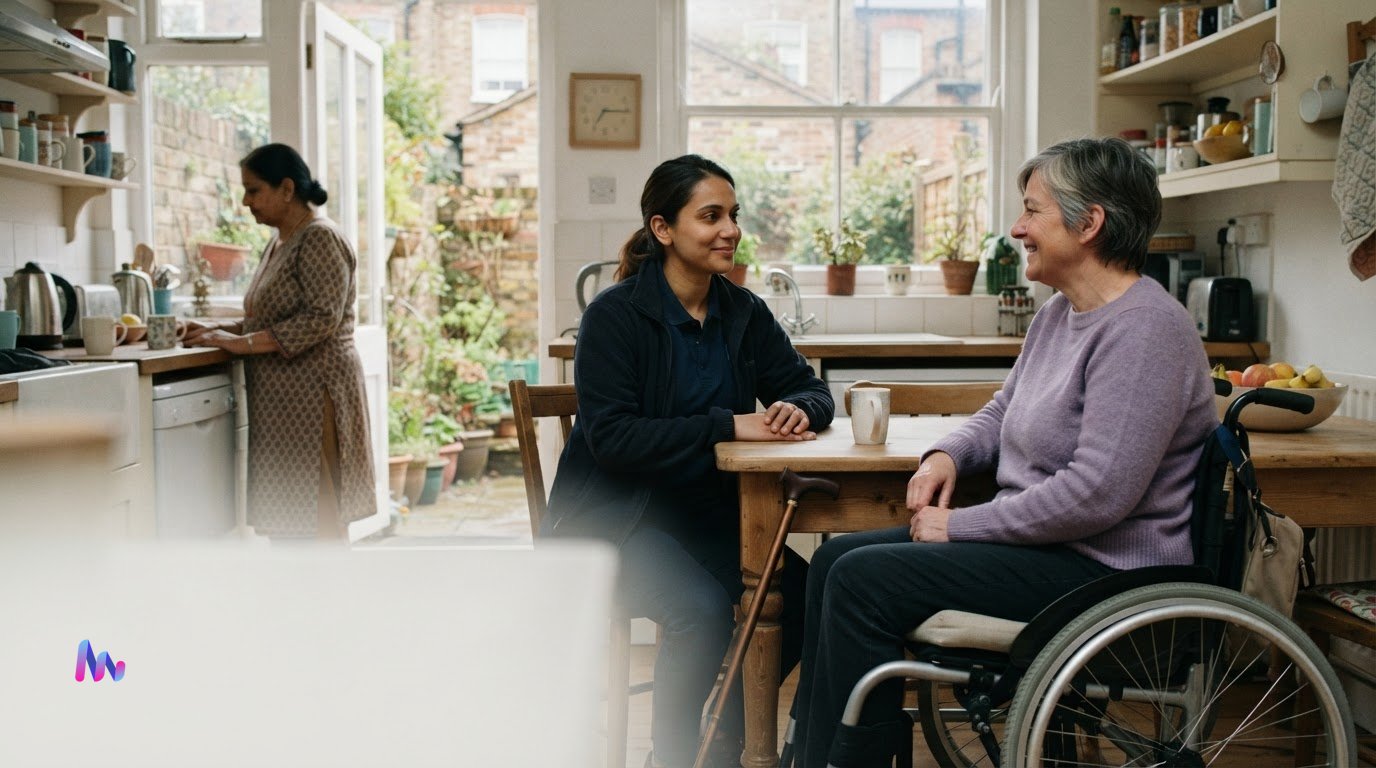
Hoisting and Mobility Support at Home in North London

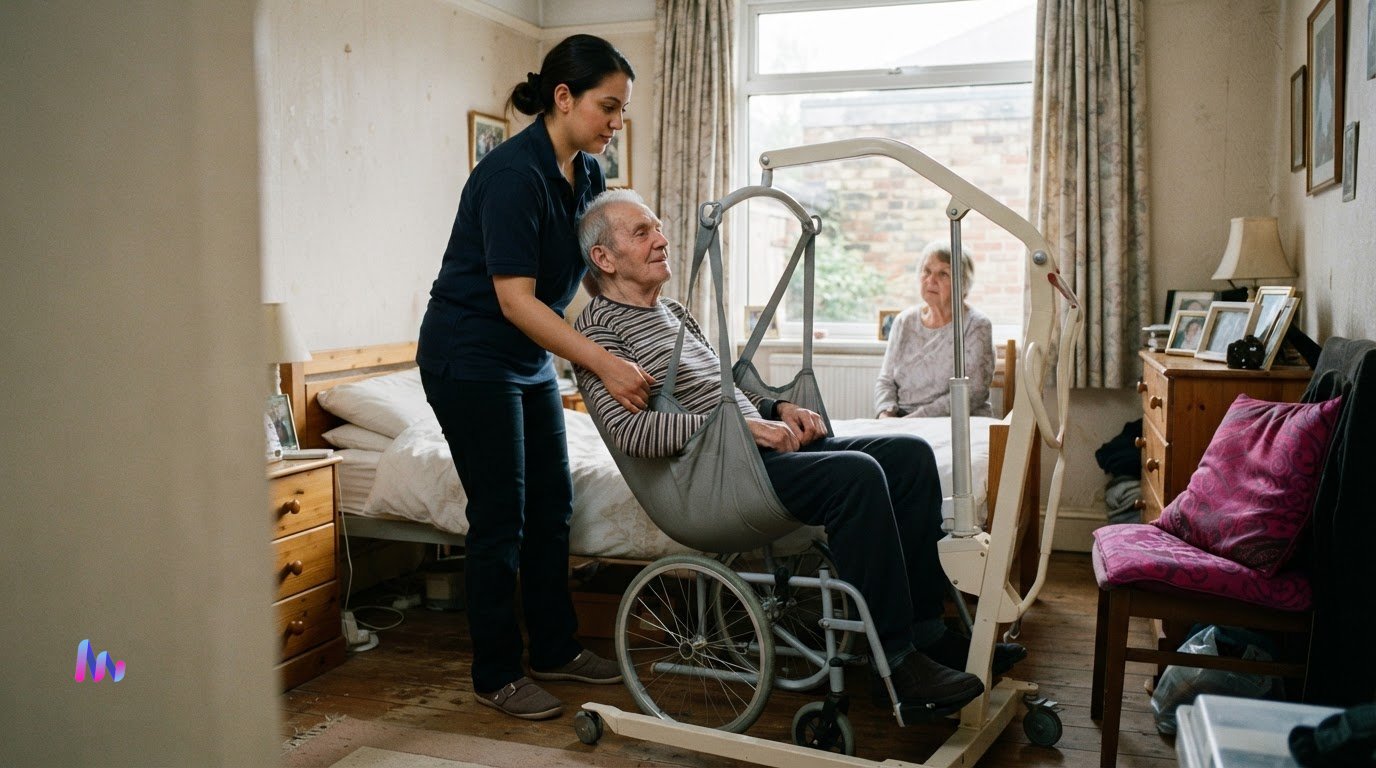
A mobile hoist may be designed for one trained caregiver, but that doesn’t mean every transfer is safe with one person. The number of carers required depends on the hoist’s instructions, the person’s needs and the circumstances of the move. Good hoisting and mobility aid support at home starts with a safe plan tailored to the individual.
It’s understandable to feel unsure when someone you care about needs help moving between a bed, chair or toilet. A hoist uses a sling to support the person during a transfer, and the sling must suit both the person and the task. Planning hoisting and mobility aid support at home also means considering comfort, dignity and the help needed during everyday routines.
This guide explains when one-person use may be appropriate, how hoists and slings work, and what to consider when comparing mobile, ceiling, stationary and bath hoists. You’ll also learn how other mobility aids may suit different abilities, helping you understand the options for hoisting and mobility aid support at home.
Table of Contents
Can a mobile hoist be used by one person?
Some mobile hoists are designed for one trained caregiver, but single-person use isn’t suitable for every transfer. The care plan, equipment instructions, person’s abilities and available space all matter.
A mobile hoist supports someone in a sling suspended from its arm; its wheeled legs allow the caregiver to move the person after lifting. The sling must be positioned and attached correctly before operating the hoist. With some portable hoists, positioning the sling involves gently rolling the person from side to side.
Carer responsibilities during transfers
The carer must follow the person’s care plan and the instructions for the specific hoist. These should identify the sling type and size, any safety devices, and how many carers are needed for the transfer. Before lifting, make sure the equipment suits the person and task, and that there’s enough clear space to use it.
Whether one person can operate a hoist depends on the circumstances, not simply on whether it’s mobile. A risk assessment may show that two carers are needed, and portable equipment may require more space or support. Anyone using a hoist needs training on that equipment. If you’re supporting a family member, don’t attempt a hoist transfer without the appropriate training.
Transfers between beds, chairs and toilets
A mobile hoist may be used to transfer someone between a bed, wheelchair, chair or toilet. The caregiver positions the hoist and sling for the planned move, then uses the equipment to lift and move the person. The route matters: furniture, doorways and space around the bed or toilet can affect whether the hoist can be manoeuvred safely.
Hoists can also help carers avoid manually lifting someone during everyday transfers. In bed, repositioning support may help someone with limited mobility find a more comfortable position. For a toilet transfer, consider the person’s privacy and dignity as well as the equipment’s access and positioning needs.
Don’t use a handling belt to lift someone. It’s intended to assist a person who can support their own weight. If someone has fallen, check for injuries before using equipment or a lifting technique. Seek professional medical help if you’re unsure about their wellbeing.
At home, Personal Care can support daily routines such as washing, whilst post-operative care may help during recovery. These services can complement a transfer plan, but they don’t replace training to operate a particular hoist. Families considering ongoing support can explore live-in care in London when regular help with everyday needs is part of the picture.
What is a Hoist in Home Care?
A hoist is a lifting device chosen to help someone move safely at home. Across England, Scotland, Wales and Northern Ireland, start with a needs assessment through the relevant local authority or social services team. Eligibility depends on assessed needs and local provision. A financial needs assessment usually accompanies a care needs assessment when someone needs help funding home care.
Assessing care and equipment needs
An assessment considers what the person can do independently and where they need help. For example, someone who can sit upright but cannot safely move from a bed to a wheelchair may need different support from someone who can stand briefly. The assessment can identify mobility aids and home-care support suited to daily routines, abilities and surroundings.
Describe the movements that are difficult, such as getting out of bed, moving to a chair or using the toilet. Explain what the person can manage without help and where manual handling feels unsafe. This gives the assessor practical information about the tasks, equipment and support that may help preserve independence.
Choosing equipment and planning care
Hoist selection should take account of the person’s needs, the equipment’s weight capacity and the available space. A risk assessment and care plan should record the hoist, sling type and size, any additional safety devices, and the number of carers needed. These details make the transfer plan specific to the person, rather than relying on a general approach.
Anyone using a home-care hoist needs training on that equipment. Follow the care plan and manufacturer’s instructions, and make sure the person and carer understand the planned steps. A wheelchair transfer, for instance, may need different positioning and room clearance from a transfer between a bed and another seat.
Home hoist and mobility aid costs
There isn’t one price that applies to every home hoist or mobility aid. Costs depend on the equipment selected, the person’s requirements, the home layout and whether structural work is needed. A specialist assessment helps establish which equipment is appropriate before comparing costs.
In the NHS funding scenario described, mobility aids such as hoists are usually loaned free of charge, according to the NHS. Local councils’ social services departments can advise on equipment provision in their area. When someone needs help funding home care, a financial needs assessment usually accompanies the care needs assessment.
Assessing structures for fixed ceiling hoists
A fixed ceiling hoist needs a detailed structural assessment before it’s selected. The ceiling and proposed track route must suit the system and the planned transfers, such as moving between a bed and chair. A structural engineer should advise whether the structure can support the installation.
Installing a ceiling track may require reinforced ceiling joists or changes to door frames. These practical considerations can affect the hoist’s route between locations and the work needed in the home. Include the room layout and intended transfer route in the assessment before choosing a fixed system.
Hoist features including slings and adjustable bases
A hoist’s arm, base and sling work together to support a person during a transfer. The right combination depends on the person’s weight, mobility, comfort and the task, such as moving from a wheelchair to a bed. A feature that helps in one room may be less useful in another, so consider the actual transfer and available space.
A mobile hoist’s adjustable base can help position its legs around furniture or beside a chair. Follow the manufacturer’s instructions when adjusting the base, and consider whether it can approach the bed, wheelchair or other transfer point. The hoist must also have sufficient weight capacity for the person. Specialised bariatric hoists are available for people with larger or heavier bodies.
The sling is central to safe support. Its size and type must suit both the person and the transfer. An unsuitable or incorrectly sized sling can cause discomfort, slipping or inadequate support. The hoist and sling must also be compatible: follow the manufacturer’s advice, as an incompatible combination can make the attachment insecure.
Some hoists support a person with partial mobility to stand and take steps using a harness or sling. Other transfers may require a full-support sling. Someone who can bear some weight might use a different mobility aid, such as a transfer board, depending on their strength and the surfaces involved. The planned device should reflect their abilities, not simply their age.
If someone brings their own sling to hospital, it should only be used with a hoist once compatibility has been established. The care plan should identify the approved hoist and sling combination. The Medicines and Healthcare products Regulatory Agency (MHRA) calls for a documented register of approved combinations in its patient-hoist safety alert. A familiar fit alone doesn’t establish compatibility.
Slings used with lifting equipment need unique identification so users can check their examination status and safety. Avoid sewing identifying labels into sling fabric or attachments, as this can weaken them. Solvents in permanent markers, such as Xylene, can also weaken sling fabric. Preserve identification and inspection details using the method intended for that sling.
For domestic equipment, follow the manufacturer’s servicing schedule and service-life information. For lifting equipment used to lift people at work, the Health and Safety Executive (HSE) describes thorough examination every six months, or examination under a competent person’s examination scheme. Servicing doesn’t replace that statutory examination. A structural engineer should advise whether a wall or floor can support a fixed hoist.
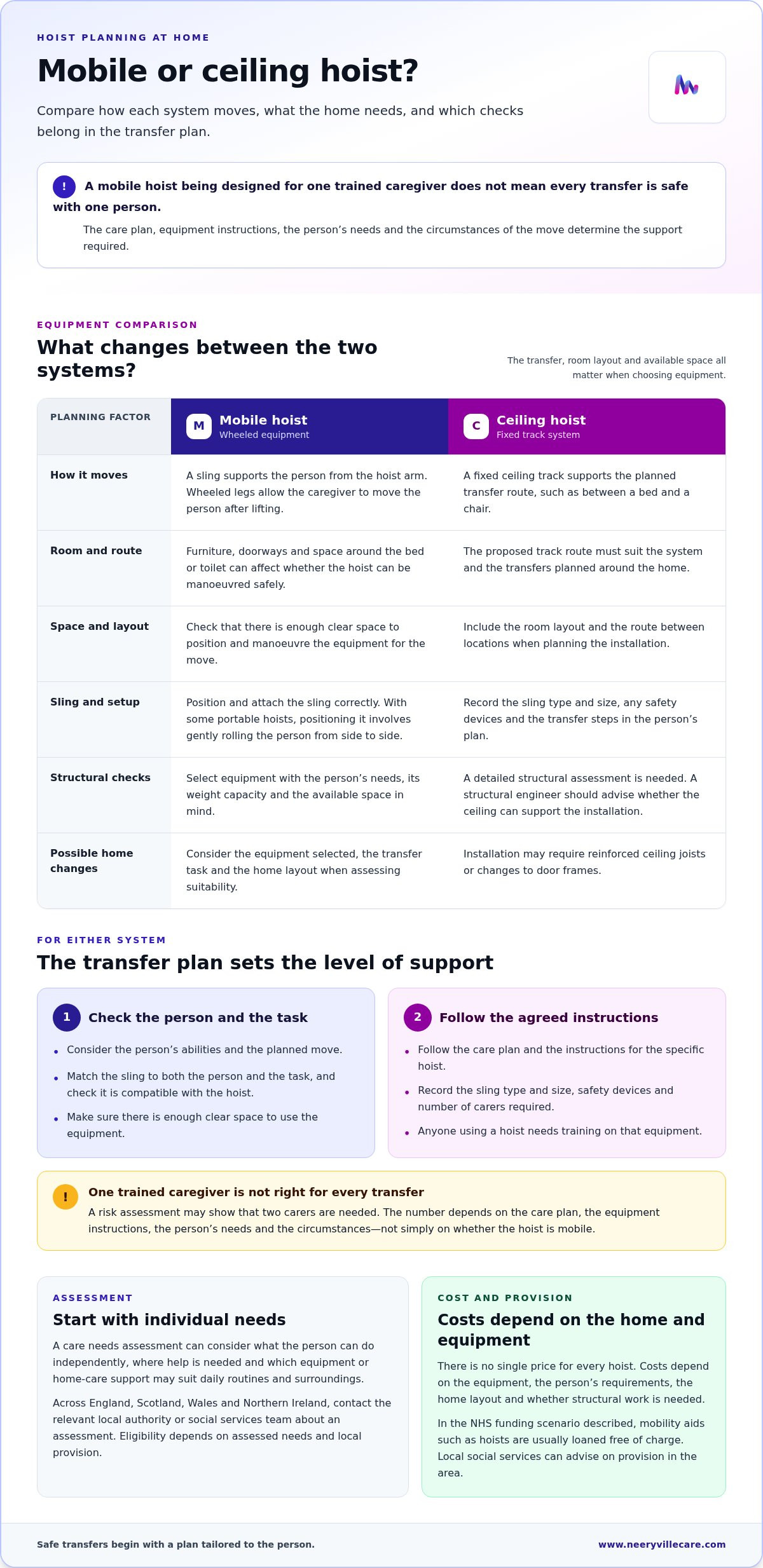
Mobile, ceiling, fixed and bath hoists
Mobile, ceiling, stationary and bath hoists support different transfers, from moving between a bed and chair to bathing. The best fit depends on the person’s abilities, the room and where transfers need to take place.
Mobile and bath hoists
A mobile hoist uses wheels and a sling suspended from an arm, allowing a carer to move someone after lifting. It can support transfers between a bed, chair or toilet, but needs clear floor space for positioning and movement. Consider whether it can approach each transfer point without furniture or narrow access obstructing its base.
A bath hoist is designed for use in the bath environment and to withstand rusting. It can support someone with limited mobility getting into or out of the bath, with caregiver assistance. Consider whether the device suits the person’s transfer needs and the bathroom layout. A bath hoist is for bathing, while a mobile hoist can serve several transfer locations.
Ceiling tracks for beds and sofas
A ceiling hoist runs along a fixed track, moving a person between positions such as a bed and chair. A track planned between a bed and sofa can support transfers without wheeling a mobile frame across the floor. Track placement should reflect the actual route, the person’s transfer needs and the shape of the room.
Some ceiling hoists let a person operate the mechanism once they’re in the sling and attached to the hoist arm. In these circumstances, usually only one caregiver is required. For someone with limited mobility, this can support movement between fixed points while keeping more floor space clear than a mobile hoist.
Portable and fixed ceiling systems
Ceiling hoists are permanent fixtures on overhead tracks, which can be installed to suit a room’s size and shape. This can leave more usable floor space around a bed or chair. A structural assessment is needed before selecting a fixed ceiling system, as the home’s structure and intended track route affect installation.
Portable hoists may be battery-operated, mains-powered or manually operated, depending on individual requirements. A stationary hoist differs from a ceiling track: it’s fixed to a floor or wall and uses a pivoting arm to transfer someone sideways. Consider whether transfers happen at one fixed point or between locations.
Comparing ceiling and mobile hoists
At home, a ceiling track moves a person along its installed route, while a mobile hoist can be wheeled between transfer points. Ceiling systems use overhead space and can leave more floor area available; mobile hoists need room to manoeuvre. A bed-to-chair transfer within one room may suit a track layout, while transfers in several locations may call for different equipment.
The choice also depends on the person’s abilities, the home’s layout and the planned transfers. Compare access around a bed, sofa, toilet or bath, and consider where the hoist must travel. A fixed track needs structural assessment; a mobile frame needs clear routes. These practical differences help identify the system that best supports safe, comfortable movement.
Personalised mobility support at home
The right mobility aid depends on what a person can do during each movement, not simply on their diagnosis. Start by noting whether they can bear weight through their legs, stand briefly, sit steadily or move between chairs. These details help match equipment to daily tasks while supporting comfort, safety and independence.
A stand aid can help someone move from a bed or sofa if they can support their body weight on their legs. It may assist someone who can stand but needs help rising or transferring. If standing isn’t possible, a stand aid isn’t suitable. The key question is what the person can safely manage during the transfer.
For someone moving between two seated surfaces, a transfer board may help when bearing weight through both legs is difficult. The person needs to be positioned so the board bridges the chair and the next surface. A transfer plan should account for their ability to sit and follow instructions, as well as the height and position of both chairs.
A patient turner is designed for transfers between nearby seats, not for moving someone around or between rooms. It may suit a person with some upper-body strength who can stand briefly. Compare its limited purpose with the actual route: moving between nearby chairs differs from transferring across a room.
For someone lying down, glide sheets can assist with repositioning, toileting or washing. They support movement on the bed, rather than lifting someone to a standing position. Be clear about the carer’s task before using them, such as moving the person into a more suitable position for washing.
If someone has fallen, a lifting chair can raise them to a seated position and may be operated by one carer or family member. Some portable lifting cushions can be used without caregiver assistance, supporting independence; another person may be needed with a lifting cushion. Before lifting someone from the floor, check for injuries. If there’s any doubt about their wellbeing, seek professional medical help.
Match each aid to a specific activity: standing from a sofa, moving between chairs, repositioning in bed or recovering from a fall. Then consider whether the person can participate, what assistance they need and where the equipment must fit. This practical approach keeps the person’s preferences central, rather than choosing a device based on one label or assumption.
NeeryVille Care: Live-in Care
NeeryVille Care provides live-in and visiting care for people who need support with daily life at home. If changes in mobility make routines such as washing, dressing or moving around more difficult, care can be tailored to the person’s needs and existing care plan. Hoist selection, installation and equipment operation are separate from these care services.
Live-In Care may suit someone who needs regular support throughout the day, while Visiting Care provides help at agreed times. NeeryVille Care also offers Dementia Care at home and End of Life Care. Families can discuss how care may complement an existing mobility plan and help maintain familiar routines and dignity.
Contact NeeryVille Care to discuss support at home and what care may suit your family’s circumstances.
Plan your next step towards support at home
Choosing equipment is one part of making everyday life at home manageable. The next step is to connect mobility support with the person’s routines, preferences and care needs. This can help families consider how transfers fit alongside washing, dressing and other daily activities, while keeping the person’s comfort and dignity central. Thoughtful hoisting and mobility aid support at home should work around the individual, rather than making every routine feel like a clinical task.
NeeryVille Care offers Domiciliary Care, Live-in Care and Dementia Care for people who need support with daily life at home. This care can complement an existing mobility plan, without replacing equipment assessment or hoist training. Families can explore what kind of help may suit their circumstances and the person’s routines.
Take things one step at a time. A considered plan can make home feel more manageable for everyone.
Frequently Asked Questions
What are the different types of hoist?
Common home hoists include mobile, ceiling, stationary and bath models. A mobile hoist moves on wheels, while a ceiling hoist follows an overhead track. A stationary hoist is fixed to a wall or floor, and a bath hoist is designed for bathing transfers. The useful comparison is where transfers happen: one fixed bedside position differs from moving someone between several rooms.
What is a ceiling hoist?
A ceiling hoist is an electrically powered lift that travels along an overhead track, carrying a person in a sling between planned positions. For example, a track can connect a bed and chair without wheeling a frame across the floor. Tracks can be designed around a room’s size and shape. A person may operate some systems once they’re in the sling and attached.
What is a stationary hoist?
A stationary hoist is fixed to a wall or floor and uses a pivoting support arm to transfer someone sideways. It can suit a transfer between nearby positions, such as a bed and chair, when the person needs lifting support. Unlike a mobile hoist, it doesn’t roll between locations. Consider whether the supporting structure and arm’s reach suit the planned transfer.
What types of hoists and mobility aids can be used at home in the UK?
Home options include mobile, ceiling, stationary and bath hoists, as well as stand aids, transfer boards, patient turners, glide sheets and lifting cushions. Each supports a different movement. A stand aid requires the person to bear weight through their legs; a patient turner is for transfers between nearby seats. Glide sheets assist with repositioning someone lying down. Choose equipment to suit the task and the person’s abilities.
Can you get a hoist or mobility aid funded by the NHS or local council?
In the NHS funding scenario described, mobility aids such as hoists are usually loaned free of charge. Local councils’ social services departments can advise about equipment provision in their area. Start by describing the person’s daily movement needs and requesting a care needs assessment. If help funding home care is needed, a financial needs assessment usually accompanies it. Local arrangements and assessed needs determine the available options.
How do I request a home assessment for hoisting equipment from an occupational therapist?
Contact your local authority’s adult social care team and request a care needs assessment, explaining which movements are difficult at home. Give practical examples, such as transferring from bed to wheelchair or getting to the toilet. Healthcare professionals assess a person’s needs and circumstances before recommending equipment. Include room access and the person’s abilities, so the assessment reflects everyday use as well as the device.
What home alterations and space are needed to install a hoist?
Requirements depend on the hoist and transfer route. A mobile model needs enough clear floor space for positioning and manoeuvring. A ceiling track requires a detailed structural assessment; installation may involve reinforcing ceiling joists or changing door frames. A structural engineer should advise whether a wall or floor can support a stationary hoist. Consider the route from bed to chair, not just the space beneath the lift.
What training do carers need to use a hoist safely at home?
Carers need training to use the specific hoist safely; familiarity with another model isn’t enough. Training should follow the person’s care plan, including the selected sling and transfer steps. The plan records how many carers are needed and any additional safety devices. Before a transfer, carers should follow the equipment instructions and plan, rather than attempting a lift based on experience alone.