How a regulated care agency employs, trains and supervises carers


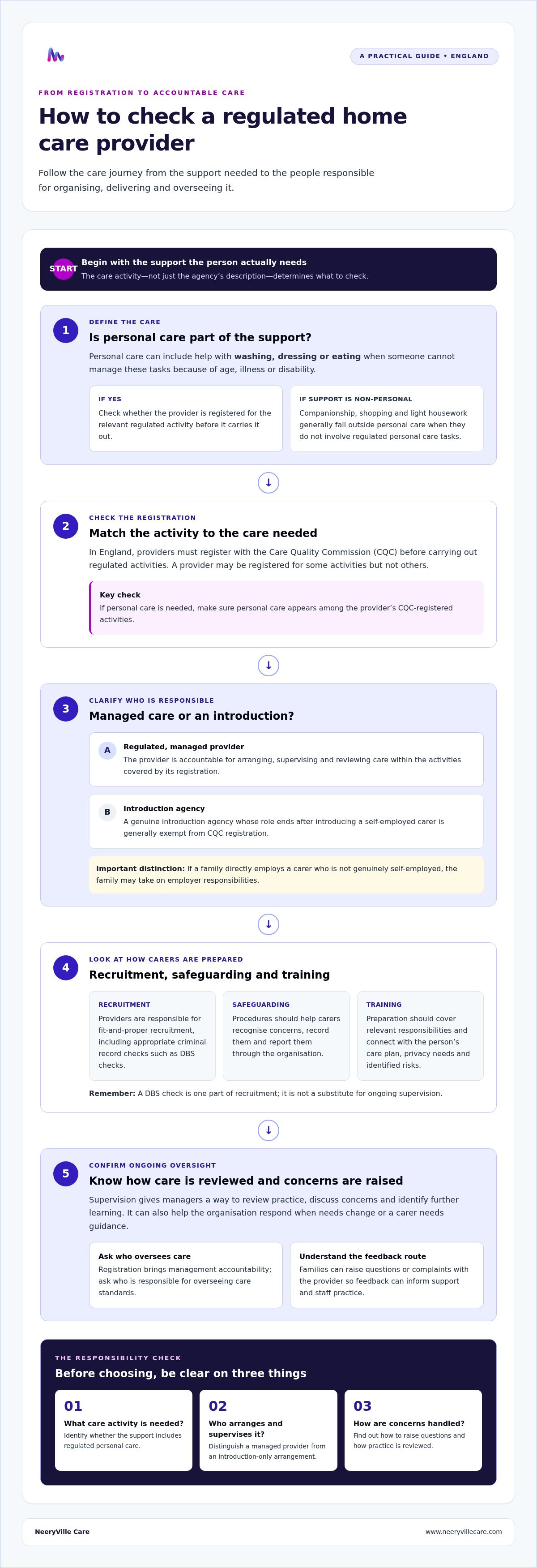
Choosing a regulated care agency means care is organised by a provider accountable to the Care Quality Commission (CQC), not simply arranged through an introduction. In England, providers must register before carrying out regulated activities, including personal care in someone’s home. That’s the practical reason why choosing a regulated care agency can matter: the provider is responsible for arranging, supervising and reviewing care within the activities covered by its registration.
When someone you love needs support at home, reassurance alone is not enough. You need to know who employs and supervises the carer, how the service responds if needs change, and where to raise concerns. CQC regulation provides a framework for those responsibilities, but registration covers specific care activities, so it is important to check what a provider is registered to do.
This article explains what CQC regulation covers and how a directly regulated provider differs from an introductory agency. It also sets out how to use inspection reports and complaints procedures, and what to look for in recruitment, training and supervision. These practical checks can help you decide whether a service fits your family’s needs.
Table of Contents
What is a CQC-regulated care provider?
In England, a home care agency is regulated when it is registered with the Care Quality Commission (CQC) for the regulated activities it provides. Registration means the provider is accountable for meeting requirements around the care it organises and delivers. The Health and Social Care Act 2008 (Regulated Activities) Regulations 2014 are also identified as SI 2014/2936, according to the UK legislation register.
Registration matters when a provider delivers personal care at someone’s home. This can include help with washing, dressing or eating when a person cannot manage these tasks because of age, illness or disability. A provider must register before carrying out a regulated activity. In England, providing one without registration is a criminal offence under the Health and Social Care Act 2008.
A provider may need registration for more than one activity, depending on the care it delivers. The Care Quality Commission (CQC) says a provider may be registered for some regulated activities but not others, so check the specific activities on its registration. If you are arranging personal care, check that this activity appears on the provider’s CQC registration. Companionship, shopping and light housework generally fall outside personal care when they do not involve regulated personal care tasks.
Registration also brings management accountability. Ask the provider who is responsible for overseeing care standards. Registered managers undergo a fit-and-proper-persons assessment before taking sole responsibility for a service. Providers must also carry out fit-and-proper recruitment, including criminal record checks, when employing carers. These responsibilities sit with the provider rather than being left entirely to a family.
An introductory agency has a different role from a managed care provider. A genuine introduction agency whose role ends after introducing a self-employed carer is generally exempt from CQC registration. The distinction is whether the organisation arranges, manages or supervises care, or simply makes an introduction. If a family directly employs a carer who is not genuinely self-employed, the family may take on employer responsibilities.
Regulators differ across the UK: the CQC oversees England, the Care Inspectorate oversees Scotland, Care Inspectorate Wales oversees Wales, and the Regulation and Quality Improvement Authority oversees Northern Ireland. Rules and registration systems vary between these nations, so the relevant regulator depends on where care is delivered.
Regulation does not set one price or establish that a managed provider always costs more than a private carer. Home care costs depend on the type and frequency of support, the care arrangement and location. Ask for a clear quote based on the support required. A local authority can assess a person’s care needs and financial circumstances, then determine whether support or funding is available. CQC regulation does not determine local authority funding decisions.
For families comparing local support, the distinction between regulated care and an introductory arrangement can clarify who is responsible for organising and overseeing care. Information about live-in care in London provides a local point of reference when considering care at home.
Carer employment, training and supervision
In a regulated service, the provider is responsible for its carers. Recruitment, preparation and supervision help connect daily support with each person’s needs.
Carer vetting and safeguarding
Vetting means assessing a carer’s suitability before they support someone, including appropriate criminal record checks. Safeguarding procedures help staff identify and report possible abuse or neglect. These measures matter because a carer may enter someone’s home and help with private, everyday tasks.
Regulated providers are responsible for fit-and-proper recruitment, including Disclosure and Barring Service (DBS) checks. A DBS check is one part of recruitment, not a substitute for ongoing supervision. The provider also needs safeguarding procedures explaining how carers recognise concerns, record them and report them through the organisation.
For families, this structure provides a route for raising concerns beyond the individual carer. A clear process helps staff respond when someone’s behaviour, wellbeing or circumstances raise a safeguarding concern.
Staff training and best practice
Training prepares carers to provide support safely, respectfully and consistently. Regulated providers must meet standards covering staff training, qualifications, safeguarding, health and safety, and quality of care. Training in safeguarding and medication management helps carers understand important responsibilities during everyday visits.
Good preparation should connect directly with the person’s care plan. For example, a carer helping someone wash should understand the agreed approach, the person’s privacy needs and any identified risks. This turns written instructions into considerate support instead of relying on assumptions or inconsistent habits.
Supervision gives the organisation a way to review practice, discuss concerns and identify further learning. It also helps managers respond when a person’s needs change or a carer needs guidance. Families can raise questions or complaints with the provider, so feedback can inform decisions about support and staff practice.
Employment arrangements matter, too. An employer of a carer may have duties involving contracts and payslips, National Living Wage, payroll and tax, paid holiday, statutory sick pay, workplace pensions and employer’s liability insurance. With a regulated provider, the organisation manages its carers and the service. A family that directly employs a carer may take on employment responsibilities themselves. That distinction can make a practical difference when arranging dependable support at home.
Differences between regulated providers and introductory agencies
The key difference is who organises and remains responsible for care. A regulated provider manages the service, while an introductory agency may simply introduce a self-employed carer.
Choosing a regulated provider gives families a clear route for care planning, supervision and complaints. This can be particularly helpful when needs may change or family members cannot manage the arrangements themselves.
Provider compliance and CQC enforcement
Provider compliance means meeting the requirements attached to registration and the care activities delivered. The Care Quality Commission (CQC) assesses services against five questions: are they safe, effective, caring, responsive and well-led?
The CQC can inspect a service, impose registration conditions, suspend or cancel registration, and prosecute providers for serious breaches. These powers mean a provider’s obligations are subject to independent oversight, not just its own policies. A rating offers a useful snapshot, but read the inspection findings to understand the reasons behind it.
Services from regulated providers
Regulated providers organise care activities covered by their CQC registration. In home care, this may include personal care, such as help with washing or dressing, delivered through domiciliary or live-in care. The specific activities covered depend on the provider’s registration.
The distinction matters when someone needs different kinds of help. Companionship and shopping support generally fall outside regulated personal care, while hands-on help with daily living may require registration. A provider can be registered for some activities but not others, so check that its registration matches the care being arranged.
By contrast, an introductory agency may stop its role after introducing a self-employed carer. The family may then need to manage the arrangement, including finding replacement cover if the carer is unwell or leaves. CQC-regulated providers maintain a personalised care plan and review it as the person’s needs change.
Choosing a provider
Questions about responsibility help families understand what a service actually provides. Ask who employs the carer, who reviews the care plan, and who arranges cover if the usual carer cannot attend. The answers show whether an organisation manages care or only makes an introduction.
Also ask which regulated activities the provider’s registration covers, how to raise a complaint, and how changes in care needs are reviewed. These questions help you compare the provider’s responsibilities with the support your relative needs.
Check that the CQC registration covers the care activities required.
Ask who oversees carers and reviews the care plan.
Find out how replacement cover and complaints are handled.
A regulated provider offers a defined structure of accountability. An introductory arrangement may suit families confident managing care themselves, while provider oversight can be particularly valuable when needs are complex or changing.
CQC inspections and assessment of care services
The Care Quality Commission (CQC) assesses registered services against fundamental standards. Its findings can show how a provider manages safety, care quality and ongoing improvement.
A rating is useful evidence, but it cannot tell you everything about the care one person will receive. Read the findings alongside the service’s current approach and your relative’s needs.
Regulated activities and care services
Regulated activities are specific health and social care services that providers must register to deliver in England. The CQC assesses the activities within a service’s registration, not every kind of help a person might receive.
Domiciliary and home care services may include personal care in someone’s home. Companionship, shopping assistance and light housework generally fall outside personal care when they do not involve defined personal care tasks. The task itself, not simply the label “homecare”, determines whether it falls within regulated care.
Diagnostic and screening services are clinical service areas, distinct from everyday home care such as help with washing or dressing. Understand a provider’s registration in relation to the care it actually delivers. This helps families avoid assuming that one registration covers every health or social care activity.
Limits of regulator ratings
A CQC rating assesses a service; it does not guarantee how every visit will feel for an individual. Ratings range from Outstanding to Inadequate, and inspection findings explain the evidence behind the judgement.
Inspectors consider whether care is safe, effective, caring, responsive and well-led. They also assess person-centred support, risk management, staffing and governance. A rating can highlight strengths or concerns, but read the report to understand the specific findings and context.
Care needs can change after an inspection, so an older report may not reflect every current detail. A rating cannot replace conversations about an individual care plan, preferences or changing routines. Use it as one source of evidence, then consider whether the provider’s current arrangements address those needs.
The CQC does not assess local authorities as commissioners or decide their funding and procurement decisions. A provider’s rating therefore does not tell you whether a council will fund care. Service assessments and funding decisions are separate, each with its own purpose.
For a balanced picture, note the report’s findings on safety, dignity and leadership, then consider how they relate to the support required. A strong rating may be reassuring, but the detail matters: check which service was assessed, what inspectors found, and whether the report covers the care activities relevant to your family.
Public inspection reports, notifications and complaints
Use the Care Quality Commission (CQC) register to check a provider’s registration, regulated activities, rating and latest inspection report. Regulation also requires providers to maintain complaints and safeguarding procedures, report specified serious events and remain accountable for care quality.
Inspection reports and notifications
A CQC inspection report records inspectors’ findings and the service’s rating, helping families understand what was assessed. Search the CQC register for the provider, then compare its registered activities with the personal care or other support you are arranging.
Read the latest report’s findings as well as its rating. The detail can show where inspectors identified strengths or concerns, including safety, dignity and how care is organised. A provider’s registration and report relate to its service, so check that you are viewing the right organisation and care activity.
Providers must submit CQC notifications for specified events, including deaths, safeguarding concerns and serious injuries. These notifications support regulatory oversight; they do not replace raising a concern directly with the provider about an individual care arrangement.
Complaints procedures and escalation
A formal complaints procedure sets out how a provider receives, investigates and responds to concerns. It should give families a clear route for escalation if the initial response does not resolve the issue.
Describe the concern with relevant details, such as the visit, care task or communication involved, and raise it through the provider’s complaints process. Keep a record of the response and any agreed action. If the concern remains serious or unresolved, families can raise concerns about regulated care with the regulatory body.
For example, raise a concern about missed personal care with the provider first, so it can address the arrangement and review what happened. A safeguarding concern involving possible abuse or neglect should follow the provider’s safeguarding procedures and reporting route.
Regulatory oversight and accountability
Regulatory oversight means the CQC can assess a provider’s service and take action when standards or registration requirements are not met. This matters because complaints and serious incidents can reveal issues that need attention beyond a single care visit.
Registered providers must notify the CQC about specified events, while inspection reports make findings available for families to consider. The provider remains responsible for the care it delivers and its complaints procedure. The CQC provides regulatory oversight, rather than managing each family’s care arrangement.
Consider the report, registration details and complaints route together. A report may describe service-wide findings, while a family’s complaint concerns a particular experience. These sources serve different purposes, but together they help clarify who is responsible and how concerns can be escalated.
NeeryVille Care: Live-in Care
NeeryVille Care provides CQC-regulated live-in care for people who need ongoing support at home, helping them keep familiar surroundings and daily routines. Its home care services also include domiciliary care, dementia care and end of life care.
Live-in care can suit someone who needs ongoing support and wants to remain at home. Domiciliary care can work well for people who need visits for particular daily tasks, while dementia care is shaped around the person’s needs and routines. The right arrangement depends on the support required and how it fits into family life.
Choosing care is a personal decision, and it is reasonable to take time to understand the options. Contact NeeryVille Care to discuss care at home and arrange a free care assessment.
Take the next step towards care at home
Arranging support for someone close to you can bring practical questions and difficult emotions at once. You do not need to settle every detail immediately. Start by considering what would help daily life feel safer and more manageable, while respecting your relative’s wishes and routines.
When asking, “Why choose a regulated care agency?”, focus on what matters to your family: clear responsibility, support at home and care shaped around the person. You might also ask, “Why choose a regulated care agency for this situation?” The answer depends on the support your loved one needs and the kind of partnership that feels right.
A thoughtful first conversation can make the next step clearer. Take it one step at a time, keeping your loved one’s comfort at the centre.
Frequently Asked Questions
What are the risks of unregulated care?
Care without a regulated provider can leave families with less independent oversight and more responsibility for managing arrangements. For example, an introductory service may only introduce a self-employed carer, leaving the family to arrange cover if that person is ill or leaves. This is not automatically unsuitable; it may work for families able to manage care directly. The key is to understand who is responsible for supervision, continuity, employment arrangements and responding to concerns.
What does CQC regulation mean in practice?
In practice, a regulated provider is registered with the Care Quality Commission for the activities it carries out in England. The provider is responsible for organising and overseeing care within that registration. For families, this means there is a defined organisation to approach about the service, its care arrangements and any concerns. It does not mean every kind of help, such as companionship or shopping, is itself a regulated activity.
What if a provider is not on the register?
First, consider what the provider actually does. A genuine introductory agency whose role ends after introducing a self-employed carer is generally exempt from CQC registration. However, a provider that organises, manages or supervises regulated care must register for the relevant activity. In England, carrying on a regulated activity without registration is a criminal offence under the Health and Social Care Act 2008. The distinction depends on the service’s role and tasks.
Why does this distinction matter for setting expectations?
This clarifies who takes responsibility after care begins. If an organisation manages the service, it oversees care within its registered activities. If an introductory agency only makes an introduction, the family may need to manage the carer and arrange replacement cover. For example, if a carer becomes unwell, knowing who arranges the next visit helps families plan and avoid assuming an introductory service provides managed cover.
Why does choosing the right regulated activities matter?
Registration covers particular activities, not every service described as care. If you are arranging hands-on help with washing, look for registration covering personal care rather than relying on a general provider name. Companionship or shopping assistance generally falls outside personal care when no defined personal care tasks are involved. Matching registration to the support needed clarifies which organisation is accountable.
Why does regulation matter when something goes wrong?
Regulation gives families a route to raise concerns with the provider and, where appropriate, the Care Quality Commission. Raise a complaint about a missed visit with the provider, while a concern involving possible abuse or neglect should follow safeguarding procedures. Registered providers also notify the CQC about specified serious events. This distinguishes an individual service complaint from information that may require regulatory attention.
What checks and standards does the Care Quality Commission (CQC) use to assess home care agencies?
The CQC assesses whether a service is safe, effective, caring, responsive and well-led. Inspectors consider how it manages risk, staffing, governance and person-centred support. A family in Highgate, Crouch End or Hampstead can use the public inspection report to see what inspectors found about the assessed service. Read the findings, not only the rating, and make sure the report relates to the care activity being considered.
What safeguarding, staff training and background checks must regulated care agencies provide?
Regulated providers are responsible for fit-and-proper recruitment, including criminal record checks, and for ensuring carers are suitably vetted, trained and supervised. Training includes safeguarding and medication management, while safeguarding procedures help staff identify and report suspected abuse or neglect. Ask how a concern is recorded and passed to the appropriate manager. These practical details show how an organisation turns formal responsibilities into safer day-to-day care.