CQC inspection reports for Highgate care agencies

Updated: 3 days ago
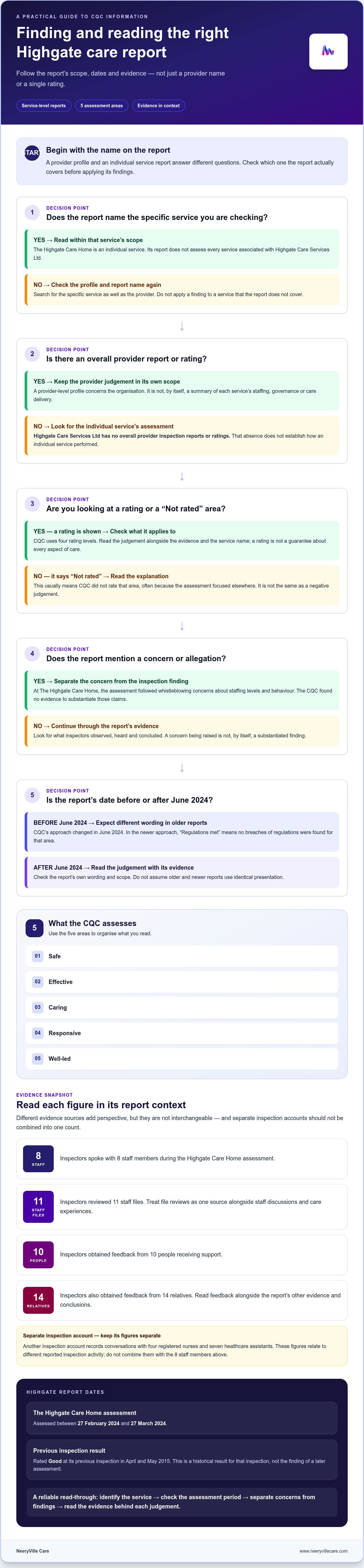
The key detail is that CQC inspection reports for Highgate care agencies are published against individual services, and a provider-level rating may not appear. Highgate Care Services Ltd has no inspection reports or ratings for the provider overall. The Highgate Care Home in London was assessed between 27 February 2024 and 27 March 2024.
It’s understandable to look for a clear rating when weighing up care for someone close to you. The CQC uses four rating levels for most services and assesses them across five areas: safe, effective, caring, responsive and well-led. A report can therefore tell you much more than a single overall judgement.
This guide explains where to find the relevant service report, how to read its rating and findings, and why provider-level and service-level information can differ. It also looks at what the Highgate assessment says, so you can approach the information calmly and focus on what matters to your family.
Table of Contents
Care quality and staff relationships
A CQC report offers more than a judgement: it records what inspectors observed and heard. At The Highgate Care Home, the assessment followed whistleblowing concerns about staffing levels and behaviour. The CQC found no evidence to substantiate those claims. A concern may prompt scrutiny, but the report sets out what inspectors could establish during their assessment.
Staff conversations give families one view of how care is organised and experienced. During the assessment, inspectors spoke with 8 staff members. In a separate inspection account, the team spoke with four registered nurses and seven healthcare assistants. These figures relate to different reported inspection activity, so read each in the context of its report rather than combining them as one interview count.
Records and staff accounts can help explain how everyday care is delivered. At The Highgate Care Home, inspectors reviewed 11 staff files during the inspection. A file review is one source of evidence; the report’s findings should be read alongside its account of staff discussions and care experiences. Look for the specific evidence behind each judgement, including whether the report describes a concern, an action taken, or a finding inspectors could substantiate.
Use this simple sequence to make sense of the findings:
Identify the service and inspection period named in the report.
Separate reported concerns from inspectors’ evidence and conclusions.
Read comments about staffing alongside the report’s account of staff relationships and care quality.
Notice whether the report describes a required improvement or says the service met expectations.
CQC describes a Good service as performing well and meeting its expectations. That rating does not remove the value of reading the supporting detail. The report may explain what inspectors considered in relation to care and staff interactions. In reports using CQC’s newer approach, “Regulations met” means no breaches of regulations were found for that area. CQC’s approach changed in June 2024, so older reports may use different wording.
Families can also read findings about safeguarding with care: a concern being raised is not the same as a substantiated finding. The report’s wording helps show what inspectors concluded. For context on safeguarding in care, consider how concerns are described and addressed, rather than relying on a headline alone.
Inspectors obtained feedback from ten people and 14 relatives during the Highgate Care Home inspection. Their feedback offers perspectives from people receiving support and those close to them, but it should be read alongside the inspection’s other evidence. Consider what the report says about the experiences described, and whether inspectors connect those accounts to their findings. A positive or critical comment is useful context, not by itself a complete account of care quality.
It can help to distinguish between what people said, what inspectors observed and what the report concluded. These kinds of evidence can complement one another, but they are not interchangeable. Feedback may describe an individual experience, while the assessment explains how evidence informed the inspectors’ judgement. Read comments in context, including any discussion of staff relationships, communication or responses to concerns. This keeps your attention on the substance of the report rather than treating a single account or rating as a substitute for its detailed findings.
Provider-level inspection reports and ratings
A provider profile and a service report answer different questions. Read each within its own scope, rather than treating one judgement as a summary of every service.
Provider inspection reports
A provider profile concerns the organisation responsible for services; an inspection report records an assessment of a particular service. Highgate Care Services Ltd has no overall provider inspection reports or ratings. That absence does not establish how an individual service performed. Look instead at the assessment linked to that service, including its inspection period and findings.
Keep provider and service names separate when noting findings. The Highgate Care Home, for example, is an individual service; its report does not assess every service associated with Highgate Care Services Ltd. When comparing records, note the name on each profile and the specific service covered by each report.
This distinction matters when a provider runs different kinds of care. A judgement for one service cannot, by itself, describe another service’s staffing, governance or care delivery. Check the report’s scope before applying its findings to the support your relative is considering.
Provider ratings
Read a rating as a judgement about the service and assessment it applies to, not as a guarantee about every aspect of care. The evidence in the report gives that rating context. Before using it to inform a family decision, note the service name, assessment date and findings attached to the judgement.
The Highgate Care Home was rated Good at its previous inspection in April and May 2015. That historical result belongs to that inspection. It does not establish the findings of a later assessment, so compare the report dates before drawing conclusions about changes over time.
Reports may also include judgements for specific areas, some marked “Not rated”. This means the CQC did not rate that area, usually because the assessment focused elsewhere. It is not the same as a negative judgement. Read the accompanying evidence to see what inspectors did and did not assess.
Older reports may show a red cross where enforcement action followed regulatory breaches. In the newer approach, enforcement appears separately from the assessment judgement. This change in presentation can affect how a report looks at first glance, so check its format and wording before comparing it with another assessment.
For a useful comparison, record the service, assessment period, judgement and any enforcement information separately. This keeps historical ratings in context and helps prevent a judgement about one service being mistaken for an organisation-wide result.
Governance and documentation
Governance findings are easier to understand when linked to specific records, decisions and dates. Highgate reports refer to documents such as care files, risk assessments, staff files and safeguarding notification records. Each gives inspectors a different view of how a service was run and concerns were handled.
The Highgate Care Home inspection on 31 May and 1 June 2017 reviewed eight people’s care files and risk assessments. These records help show how individual needs and identified risks were documented. Read the report’s examples carefully: they explain what inspectors examined, rather than offering a general description of every person’s care.
The 2017 inspection was conducted under Section 60 of the Health and Social Care Act 2008. The assessment examined whether the provider met requirements associated with the Health and Social Care Act 2008 and aimed to rate the service under the Care Act 2014. Those named legal frameworks identify the context of that inspection; the report’s findings explain how the service performed against the requirements assessed.
Notification records matter, too. At the time of inspection, one safeguarding concern at Highgate Home Care had not been notified to the Care Quality Commission. Separate the concern itself from the reporting issue: the report identifies the concern and records that it had not been notified by the time of inspection. This wording helps families understand precisely what was documented.
When reviewing governance findings, note these details from the report:
Record type: identify whether inspectors reviewed care files, risk assessments or notification records.
Finding: distinguish the evidence described from inspectors’ judgement about it.
Timing: note the inspection date and whether the report describes a concern at that time.
Response: look for any action or improvement stated in the report itself.
These steps keep a finding in context. For example, a missing notification is a specific documentation concern; it should not be treated as proof of unrelated failures. Likewise, a review of eight care files in 2017 shows what inspectors examined during that inspection, not every record held by the service.
Medication records are another important example of documentation connected to care delivery. The Highgate Care Home report identified a breach of Regulation 12 of the Health and Social Care Act 2008 (Regulated Activities) Regulations 2014 because medicines were not managed safely. Read the stated evidence alongside the regulation and the report’s assessment, rather than relying on a brief rating or headline alone.
Governance findings can relate to both systems and individual records. Connect the named document, inspection period and conclusion to understand what the report says without extending its findings beyond the evidence.
Inspection information for individual services
The 2024 assessment of The Highgate Care Home ran from 27 February 2024 to 27 March 2024. The onsite inspection took place on 27 February 2024, and CQC also used remote methods. Keep the assessment period separate from the onsite date: they describe the wider assessment window and the day inspectors visited.
At the time of the 2024 assessment, 48 residents were living at The Highgate Care Home, which provided accommodation for 52 people requiring nursing and personal care. These figures describe different things. One is the number of residents present during the assessment; the other is the home’s stated accommodation capacity at the time of inspection.
The same report records 84 members of permanent staff at the time of assessment. Treat that figure as a snapshot connected to the assessment, not as a description of staffing on every day in the period. If you’re reviewing the report with relatives, note the date and wording beside each figure so the detail remains tied to its original context.
Follow a clear sequence to keep dates and figures straight:
Write down the service name, The Highgate Care Home, before noting any findings.
Record the full assessment period separately from the onsite inspection date.
Keep the resident count, accommodation capacity and permanent staff figure in distinct notes.
Use the report’s own wording to identify when each figure applied.
This approach is useful when a report gives several time references close together. For example, 27 February 2024 is the onsite date, while 27 February to 27 March 2024 is the assessment period. Neither should be substituted for the other when describing the assessment.
Remote assessment methods also form part of the 2024 account. Read these alongside the onsite date, rather than assuming every part of the assessment happened during the visit. The distinction helps explain how the assessment was conducted without overstating what inspectors observed in person.
When discussing the report, use precise wording such as “48 residents at the time of the 2024 assessment” or “84 permanent staff at the time of assessment”. This keeps each detail anchored to The Highgate Care Home and the relevant period. It also makes comparisons with another report more careful, since figures from different dates may describe different circumstances.
For providers other than NHS trusts, CQC publishes assessments on the profile pages of the individual services they run. This makes the service profile page a place to consult for its assessment, while the report details should still be read with their stated context. The Highgate Care Home had 49 people using the service on the day of the inspection. That count refers specifically to the inspection day, so it should not be substituted for the number recorded as living there at the time of the wider 2024 assessment. The CQC carried out the assessment using onsite and remote methods. The inspection was conducted by two inspectors, an assistant inspector and an expert by experience. Those roles describe who took part in the inspection; they do not change the distinction between the inspection-day count and the separate assessment-period figure.
What did recent CQC reports say about care quality and safety in Highgate agencies?
The Highgate Care Home report includes feedback from ten people and 14 relatives. These accounts add personal perspectives to the inspection record. Read them as evidence reported during that assessment, not as a statement that every resident or relative shared the same experience.
Start by identifying who gave each view. The report distinguishes feedback from people using the service from feedback given by relatives. This matters when considering daily care: a relative’s account may describe family observations, while a person’s account reflects their own experience. Keep each perspective linked to its stated source.
Next, consider how the report presents those accounts. Note whether feedback relates to a particular aspect of care, a specific interaction or a broader experience. The number of contributors provides context, but does not explain every individual account. The report’s wording and supporting evidence offer more detail.
The report also references the Mental Capacity Act 2005 as the legal framework for decisions on behalf of people who may lack capacity. This reference identifies the framework relevant to the report’s discussion. Read the surrounding passage to understand which decision-making issue inspectors considered, rather than treating the reference alone as a finding of non-compliance.
Use these steps when reviewing this part of the Highgate Care Home report:
Separate comments from the ten people from comments by 14 relatives.
Note the care experience or decision-making issue each comment relates to.
Read the report’s explanation around each account before drawing conclusions.
Keep the Mental Capacity Act 2005 reference connected to its specific report context.
This approach helps families take personal feedback seriously without treating a limited number of accounts as a complete picture. If a relative describes a concern, for example, note how the report describes it and what related evidence it gives. Then distinguish that account from the inspectors’ conclusions about the service.
The Mental Capacity Act 2005 reference deserves the same careful reading. The report identifies it as the framework for decisions made on behalf of people who may lack capacity. The surrounding details show how that subject arose in the assessment. Avoid inferring a particular outcome unless the report explicitly records it.
By keeping voices, subjects and conclusions distinct, families can interpret the Highgate Care Home findings with care. The ten people and 14 relatives provide important perspectives, while the report’s explanation supplies the context needed to understand them.
NeeryVille Care: Live-in Care
NeeryVille Care provides live-in care for people who need ongoing support while remaining at home. A CQC report helps you understand an inspected service; the next decision is what support fits your family’s daily life. Live-in care provides one-to-one support from a carer who lives in the home, rather than care limited to scheduled visits. For someone living with dementia, familiar surroundings and personalised support may be important considerations.
Consider the practical needs behind the decision: the help required each day, the person’s routines and preferences, and the reassurance relatives need. These details can guide a conversation about whether live-in care is suitable. Contact NeeryVille Care to discuss your family’s needs and arrange a free care assessment.
Choose the next step that feels right
Use CQC inspection reports for Highgate care agencies as one part of your decision, then consider what would help your relative feel supported day to day. A suitable arrangement should respect their routines, preferences and need for familiarity, alongside the practical help your family is seeking. NeeryVille Care provides live-in care, dementia care and domiciliary care, giving families different options for support at home. A conversation about your relative’s needs can help you explore which type of care fits your situation.
You don’t have to settle every detail at once. Take the next step at a manageable pace, keeping your loved one’s comfort and dignity at the centre.
Frequently Asked Questions
Where can I find CQC inspection reports for care agencies serving Highgate?
Find CQC inspection reports for Highgate care agencies through the Care Quality Commission’s service profiles. Search by provider or service name, then compare the location and type of service before opening a report. For example, a report for The Highgate Care Home relates to that individual service, not automatically to every care service run by the same provider. Match the profile details to the care service you’re considering.
How does the CQC rate care agencies, and what do the rating categories mean?
The CQC uses four categories for most rated services: Outstanding, Good, Requires improvement and Inadequate. They range from exceptionally strong performance to serious concerns that may require enforcement action. Ratings apply to assessed services, not necessarily every service run by the same provider. Check the individual judgements in the report, too. An area marked “Not rated” was not rated in that assessment, so it does not mean the same as a poor rating.