Resolving Issues with a Home Carer: A Calm, Practical Guide


You notice a change after a visit: your mum seems unsettled, a task has been missed, or the carer’s approach doesn’t feel quite right. You want to speak up, but you’re worried about upsetting a relationship that matters. Resolving issues with a home carer can feel delicate, especially when you’re unsure whether the concern is serious enough to raise or who should hear about it. If you’re looking for support with home care, clear communication can help keep your loved one’s needs in focus.
It’s reasonable to want compassionate care and an honest conversation. Raising a concern doesn’t have to mean making an accusation or ending a valued arrangement. A calm, specific discussion can help everyone understand what happened and agree a practical change, while keeping your loved one’s comfort and dignity at the centre.
This guide explains how to describe an issue clearly, choose who to contact and share useful details. You’ll learn how to agree next steps and review whether they’re working, as well as recognise when a concern may need a formal complaint or urgent safeguarding action. If someone may be in immediate danger, prioritise their safety and seek urgent help.
Table of Contents
When should you raise an issue with a home carer?
Speaking up can feel difficult when someone you love depends on regular support. You may worry that a small concern will damage a valued relationship, or wonder whether you’re making too much of a one-off problem. You don’t need to wait until an issue becomes serious to ask for a calm conversation. Changes in routines, communication or personal preferences are worth discussing when they affect your loved one’s comfort, dignity or confidence.
A single misunderstanding may be resolved with a quick clarification. A recurring pattern needs closer attention. One late arrival may have an understandable explanation, but repeated delays that leave someone waiting for help deserve discussion. The same applies if agreed tasks are regularly missed, visits change without clear communication, or your relative feels dismissed when expressing a preference.
Recognising a routine concern or a recurring pattern
Describe what you’ve noticed rather than guessing why it happened. Note the date, the task or arrangement involved, and what changed. “The shopping wasn’t put away on Tuesday” is more useful than “The carer doesn’t care”. A pattern may reflect unclear instructions, changed needs or different expectations, as well as a service problem. Home care can involve practical and personal support, so identify which part of the arrangement is causing difficulty. For background, see Understanding Home Care Services.
Ask whether the care plan or agreed routine still reflects what the person needs. Perhaps help with dressing now takes longer, or a preferred visit time no longer suits. A respectful conversation can clarify the expectation and identify a practical adjustment before frustration builds.
Keeping the person receiving care at the centre
Where possible, ask your loved one what feels comfortable and how they’d like the concern handled. They may want to explain it themselves, have you support the conversation, or prefer that you raise it on their behalf. Respect their privacy and involve them in decisions to the extent they’re able and wish to take part. If they can describe their experience, make space for their words rather than speaking over them.
Be alert to the difference between a concern that can be reviewed routinely and one that cannot wait. If someone is in immediate danger, or you suspect abuse, neglect or another serious risk to their safety, take prompt action and seek urgent help through the appropriate emergency or safeguarding channel. Don’t postpone this until a scheduled review or routine discussion. Resolving issues with a home carer starts with a proportionate response: a calm conversation for a manageable concern, and prompt escalation when safety may be at risk.
If the difficulty is about companionship or the way social support is provided, a different arrangement may help. Explore what companionship care at home can involve, while keeping your loved one’s preferences at the heart of any decision.
How to talk to a home carer about a problem constructively
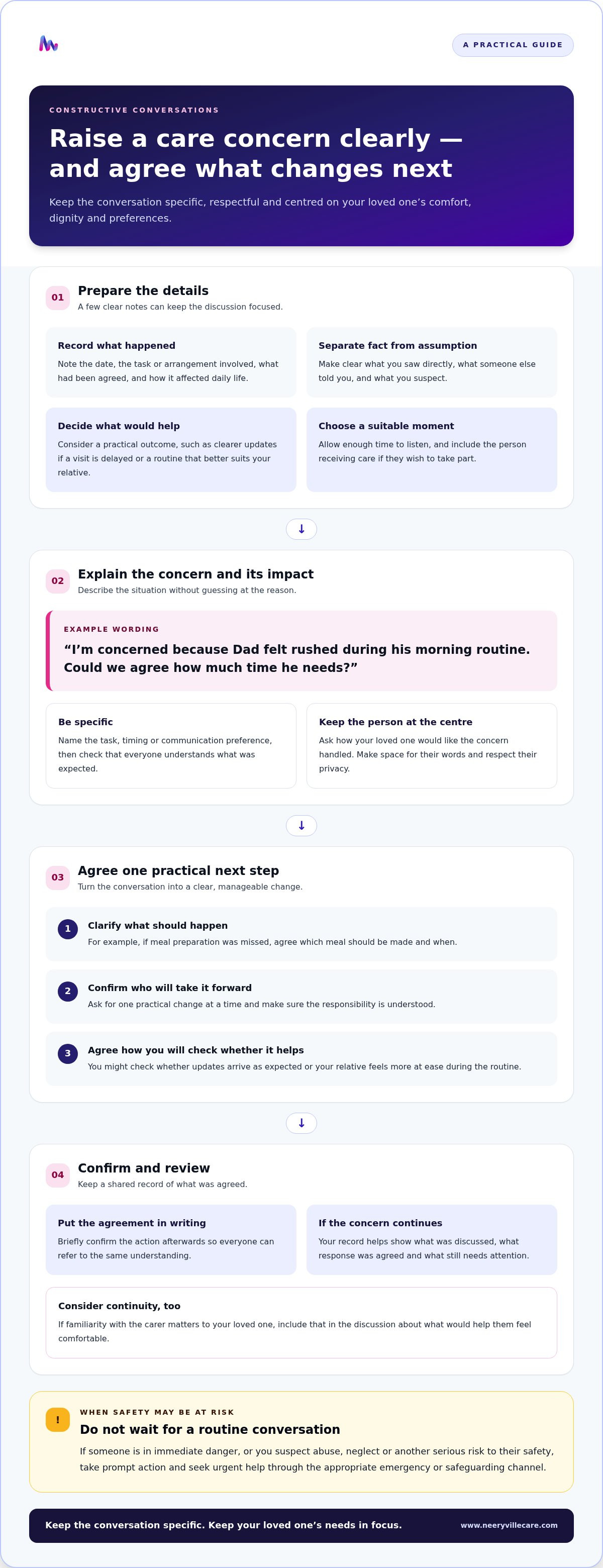
A clear, respectful conversation can protect both the quality of care and the relationships around it. Before you speak, decide what needs to change. Describe the concern calmly, explain its effect on your loved one and agree one practical next step. This keeps the discussion focused on improving support rather than assigning blame.
Prepare what you want to say
Make a few notes beforehand so worry or frustration doesn’t obscure the details. Record dates, what happened, what had been agreed and how it affected daily life. Separate what you directly saw from what someone else told you or what you suspect. For example, “The visit was scheduled for the morning, but Mum was still waiting for help at lunchtime” is clearer than “Nobody turns up on time”.
Think about the outcome you’re hoping for. It might be a clearer update if a visit is delayed, more explanation before a task is changed, or a routine that better suits your relative. Choose an appropriate moment to talk, when there’s enough time to listen and the person receiving care can take part if they wish.
Explain the impact and agree a clear next step
First-person wording can help keep the conversation open: “I’m concerned because Dad felt rushed during his morning routine. Could we agree how much time he needs?” Be specific about the task, timing or communication preference. Then check that you share the same understanding of what was expected. A missed meal-preparation task, for instance, may need a clearer agreement about which meal should be made and when.
Ask for one practical change at a time, and confirm who will take it forward. Agree how you’ll tell whether it has helped, such as whether updates arrive as expected or your relative feels more at ease during the routine. If continuity matters to the person, discuss whether familiarity with the carer could support their comfort.
Afterwards, briefly confirm the agreed action in writing so everyone can refer back to the same understanding. If the change doesn’t resolve the concern, you’ll have a clear record of what was discussed and what still needs attention. This steady, specific approach can make resolving issues with a home carer more manageable, without losing sight of the person’s dignity and preferences.
If you’re considering a different or more personalised home-care arrangement, information about NeeryVille Care’s support is available through the contact page.
What to do if the concern is not resolved
If a concern continues after you’ve raised it, the next step depends on its nature and urgency. A useful record can help you explain what happened and show what has already been tried. Note the date, the concern, who you spoke to, the response and any agreed actions. Keep copies of relevant messages or care notes, and record whether the change made a difference.
When to make a formal complaint
If conversations haven’t resolved a repeated concern, put it in writing to the provider’s appropriate care-management contact, following its complaints procedure. Keep the account factual and include dates, examples, the impact on your relative, the outcome you want and copies of earlier messages. Registered care providers in England must have a complaints system. The provider should acknowledge a complaint within three working days and agree a reasonable timescale for a full response. Don’t assume a particular resolution date.
If you remain dissatisfied after the provider has considered the complaint, the Local Government and Social Care Ombudsman can consider complaints about adult social care. For council-arranged care, raise the complaint with the local authority first. The Care Quality Commission (CQC) does not resolve individual complaints, but information shared with it can inform its regulatory work. Its role is different from the Ombudsman’s.
When a concern may involve safeguarding
Suspected abuse, neglect, coercion or immediate danger is not simply a service issue. Contact the adult safeguarding team at the relevant local authority in England and share what you know, including any immediate risks. If someone is in immediate danger, seek urgent help rather than waiting for the provider’s complaints process. You can read about NeeryVille Care’s safeguarding approach for information about how serious concerns are treated.
Clear records can make resolving issues with a home carer more manageable, but safety comes first. Choose the route that matches the concern, and keep the person’s wishes, privacy and wellbeing at the centre of each next step.
How to review the outcome and protect continuity of care
A concern isn’t fully resolved just because a conversation has taken place. The change needs to work in your loved one’s day-to-day life. Agree in writing what will happen, who is responsible and when you’ll review it. A short message can help everyone share the same understanding and give you a clear point of reference if the problem returns.
Check whether the change has made a difference
Compare what happens during subsequent visits with the action you agreed. If the plan was to give your relative more time to get ready, notice whether the routine feels less rushed. Ask them privately, where appropriate, how they feel about the change and whether they feel listened to. Record specific examples of what has improved and what remains difficult, without turning the review into a judgement about someone’s character.
Care needs and communication preferences can change. A routine that once worked may no longer be comfortable or practical. If the agreed change hasn’t helped, explain what is still happening and return to the provider’s appropriate care-management or formal complaints route. Keep your notes and earlier correspondence together so the history doesn’t get lost or have to be reconstructed from memory.
Keep support steady while concerns are addressed
Throughout the review, keep your relative’s immediate wellbeing and essential daily support in view. Involve a family member or advocate if the person wants help communicating or keeping track of next steps. If family caring responsibilities are also becoming difficult, acknowledge that strain and seek suitable support for yourself too. You don’t have to carry every part alone.
Continuity can matter as much as the practical tasks themselves. Familiar routines and communication can help a person feel more at ease, particularly if changes are unsettling. If consistency between visits is a concern, explore whether continuity with the same carer could better reflect the person’s preferences. The right arrangement should support both the tasks that need doing and the individual’s comfort and dignity.
Resolving issues with a home carer takes follow-through: confirm the action, review its effect and raise the concern again through the appropriate route if it persists. If needs or preferences have changed, it may be time to consider a more personalised home-care arrangement. NeeryVille Care’s contact page has details for discussing support.
Finding a better-fitting home-care arrangement in North London
Not every concern means care must end. Sometimes a clearer update, a small adjustment to the routine or a shared understanding of preferences is enough. If the difficulty continues, or the person’s needs have changed, it may help to consider whether a different support arrangement would feel more comfortable and practical.
The right fit should reflect the person’s choices, daily rhythm and the assistance they need, as well as the tasks involved. Visiting care can provide practical help at agreed points in the day alongside companionship and conversation. NeeryVille Care’s local focus includes Highgate N6, Crouch End N8, Hornsey, Camden, Hampstead, Finsbury Park, Kentish Town, Tufnell Park, Haringey, North London, Hungerford, Chelsea, Kensington, Hillingdon, Enfield, Hackney, London and Angel. Families in Highgate and Hampstead may be looking for support that fits around familiar routines at home. Find out more about care in London.
Match the support to the person’s changing needs
Consider what is working well and what feels difficult. Does your relative want more time for personal care, help with meals, support to keep to a familiar routine, or regular companionship? Their answers can help shape a more useful conversation about care. Needs and preferences may change, so it’s sensible to revisit the arrangement when daily life changes, rather than assuming the original plan will always suit.
Think, too, about how support is delivered. A person may feel more settled when communication is clear and their choices are respected. Families can share helpful context while keeping the person involved in decisions as much as they wish and are able. A personalised arrangement should consider emotional comfort alongside practical daily-living assistance.
Take a calm next step with NeeryVille Care
NeeryVille Care is a CQC-regulated provider offering personalised home-care support. A conversation can help you explain what matters to your family, including the routines your loved one values, the difficulties you’ve noticed and the kind of assistance that may help. There’s no need to have every answer prepared. Start with what you know and what you’d like to feel different.
Resolving issues with a home carer can sometimes lead to a better understanding and a workable adjustment. At other times, it can make clear that a different arrangement may better suit the person. Either way, keeping their dignity, preferences and comfort at the centre can help you choose a thoughtful next step.
For information about discussing a personalised arrangement, visit NeeryVille Care’s contact page.
Take the next step towards care that feels right
Raising a concern can feel daunting, but a calm, specific conversation can help clarify what needs to change. Keep the person receiving care involved, agree practical next steps and review whether daily support has improved. If the issue persists, use the appropriate formal route; if someone may be unsafe, act promptly.
Resolving issues with a home carer can also help you recognise when the current arrangement no longer fits. NeeryVille Care is a CQC-regulated home-care provider offering personalised visiting care in North London and live-in care across England. Support should respect the person’s routines, preferences and dignity, as well as their practical needs.
You don’t have to work through every decision at once. A thoughtful conversation can be a steady first step towards support that feels more comfortable for your loved one and your family.
Frequently Asked Questions
How do I raise a concern with a home carer?
Raise it calmly and describe what happened, when it happened and how it affected the person receiving care. For example, explain that a visit started later than agreed and your relative was left waiting for help. Say what change you’re hoping for, such as clearer updates or a different routine. Resolving issues with a home carer is easier when the concern is specific and the person’s preferences remain central.
What should I do if a home carer repeatedly misses agreed tasks?
Keep a factual record of missed tasks, including dates, what had been agreed and any effect on your loved one. Check whether the instructions or care plan may need clarification, then raise the pattern with the carer or the provider’s care-management contact. Explain which tasks are being missed and ask what practical change will address this. If the problem continues, use the provider’s formal complaints process.
Can I ask for a different home carer?
Yes, you can explain to the care provider why a different arrangement may better suit the person receiving support. Describe the issue respectfully, such as discomfort with a particular routine or a preference for greater continuity. Ask how the provider can take the person’s wishes into account. In North London, including Highgate N6 and Hampstead, a conversation can help clarify what support arrangement may fit their needs and preferences.
What happens if a home-care concern is not resolved?
If the provider’s response doesn’t resolve the concern, follow its formal complaints procedure and include your records, earlier communications and the outcome you’re seeking. In England, the Local Government and Social Care Ombudsman may consider complaints about adult social care after the provider has had the opportunity to respond. For council-arranged care, raise the complaint with the local authority first. The CQC uses information to inform its regulatory work, but doesn’t resolve individual complaints.
When should I report a concern about a home carer as a safeguarding issue?
Report a concern promptly if you suspect abuse, neglect or coercion, or believe someone may be unsafe. Contact the adult safeguarding team at the relevant local authority in England and share the facts you know. If there’s immediate danger, seek urgent help rather than waiting for a routine care review or complaints response. You don’t need to establish exactly what has happened before raising a genuine concern about someone’s safety.
Should I speak to the home carer or the care provider first?
For a routine misunderstanding, you may be able to speak directly with the carer at an appropriate moment and agree a clear change. Contact the provider’s care-management team if the issue is recurring, involves care arrangements or feels difficult to raise directly. If you suspect abuse or there’s an immediate safety risk, don’t wait for a conversation with the carer; report it through the appropriate safeguarding or urgent route.
How can I support a loved one while a concern is being resolved?
Keep your loved one involved, listen to what they say and ask how they’d like you to help. Where appropriate, check privately whether they feel comfortable and whether daily support is meeting their needs. Keep essential routines steady where possible, note any changes and share relevant information with the care contact. Involve a trusted family member or advocate if your loved one wants support communicating or following up.