Remote Care for a Parent in the UK: A Practical Guide


What if the first step in caring for a parent from afar isn’t finding a care service, but getting a clear picture of what they need? If you’re searching for “arranging care for a parent from a distance UK”, you may be worried because you can’t check in every day, aren’t sure who should coordinate support, or find that conversations with family and professionals are scattered. You don’t have to solve everything at once. Start by listening to your parent and agreeing one practical next step.
A shared plan can help you understand your parent’s day-to-day needs, discuss their wishes and agree who will keep everyone informed. This guide covers practical first steps, from noting changes to comparing local support and choosing a reliable way to communicate with care professionals. You’ll also find questions to ask when considering visiting, overnight or live-in care, including when your parent lives in a different part of the UK. The aim is support that offers reassurance while respecting your parent’s dignity, preferences and independence.
Table of Contents: arranging care for a parent from a distance UK
Organising Remote Care for a Parent: First Steps
Worry can feel sharper when you’re too far away to see how your parent is managing. Decisions about support may seem to fall to you, even when you don’t have the full picture. Start with a conversation, not a solution. Ask what has changed, what help your parent would welcome and what they want to continue doing independently. Then agree one next step and when you’ll speak again.
Separate concerns that may need urgent attention from support that can be planned. If you believe your parent is in immediate danger, contact the emergency services. Other concerns, such as finding meals difficult, struggling with household routines or feeling isolated, may call for a considered conversation about suitable support. The right approach depends on your parent’s circumstances and wishes.
Care and support arrangements differ across England, Scotland, Wales and Northern Ireland. The overview of social care in the United Kingdom explains this devolved structure, which is useful context when your parent lives somewhere different from you. Check the relevant local guidance for the place where your parent lives rather than assuming the arrangements are the same across the UK.
How to understand what support your parent may need
Ask about specific everyday tasks rather than using broad questions. “Is it harder to get washed in the morning?” may be easier to answer than “Are you coping?” With your parent’s agreement, note changes in mobility, meals, medication routines, household tasks and social contact. Record when a difficulty occurs and what help your parent says would make a difference. Ask what matters most to them, including the routines they want to keep, so the discussion focuses on their preferences as well as your concerns.
Who to speak to when you cannot visit regularly
Ask your parent whether they’d like a trusted local person involved, and agree what that person may help with. They might notice changes during a visit or help pass on a question, but don’t assume they can take on ongoing responsibility. Your parent may also want you to speak with their GP or another relevant health professional. Check what information your parent is comfortable sharing and how best to involve them.
Keep concerns, contact details and agreed follow-up actions in one secure place that the people involved can access appropriately. Write down who will do what and when you’ll check back. If safety is a concern, use the appropriate local route for advice; NeeryVille Care also provides information about its safeguarding approach. These first steps can help you move from uncertainty towards arranging care for a parent from a distance UK while keeping your parent’s choices and communication at the centre.
How to coordinate a parent’s care from another town or country
Once you have a clearer sense of your parent’s needs, agree how updates will happen. Choose one main contact method that works for them, whether that’s a phone call, video call or another familiar option. Set a predictable check-in routine around their preferences and, if you live abroad, the time difference. A regular conversation can help you stay connected without making your parent feel monitored.
Keep practical information in one secure record, with access limited to people who need it and whom your parent is comfortable involving. Include their preferences and routines, important contact details, agreed tasks, questions for professionals and outstanding follow-up. Ask before sharing sensitive updates, and agree what can be shared, with whom and by which method. This helps everyone work from the same information without circulating personal details more widely than necessary.
How to create a useful family care plan
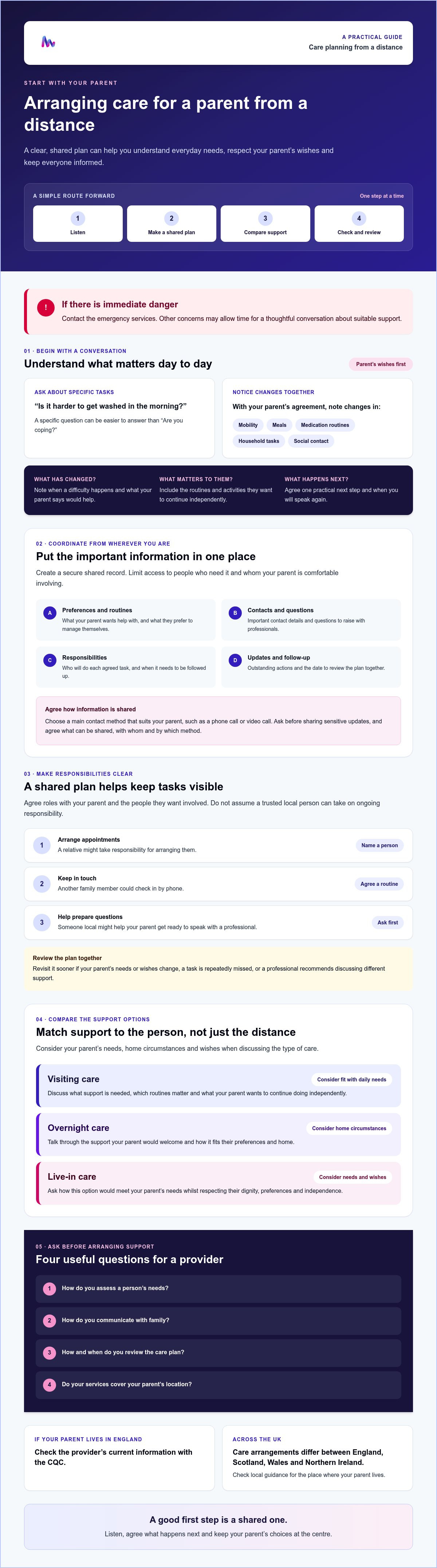
Make responsibilities visible so important tasks don’t quietly fall to one person. For example, one relative might arrange appointments, another could check in by phone, and someone local might help your parent prepare questions. Write down the person responsible for each task and when it should be followed up. Age UK’s guide to arranging social care can also help families understand practical care-planning considerations.
Record the support your parent has agreed to receive alongside what they prefer to manage independently. Set a date to review the plan together. Revisit it sooner if your parent’s needs or wishes change, a task is repeatedly missed, or a professional recommends discussing different support.
How to stay involved while respecting your parent’s independence
Ask how involved your parent wants you to be and what updates they’d find reassuring. Some may welcome a brief message after a professional visit; others may prefer to handle appointments themselves and share only key information. Offer choices and practical help rather than making decisions on their behalf. Wherever possible, let your parent guide how the arrangement works.
Coordinating from afar can be emotionally demanding, especially when family members have different views or responsibilities feel uneven. If the strain is building, make space to discuss what support you need, too. NeeryVille Care’s care team can be a starting point for a conversation about home care options and how communication with family may be discussed. Clear roles, agreed updates and a plan that can adapt make arranging care for a parent from a distance UK feel less like managing everything alone.
Which care options can help when you live far away?
There isn’t one arrangement that suits every parent. Start with the help they want, the tasks that have become difficult and what can work safely and comfortably in their home. With your parent’s involvement, discuss their needs with an appropriate professional or care provider. Then compare the level and timing of support available, including whether the service covers their area.
Home care can help with practical daily living, companionship, personal care or medication support, depending on the service agreed. It isn’t the same as clinical nursing procedures, and it doesn’t arrange a place in a residential care home. If your parent may need clinical treatment or a different living arrangement, ask the relevant health or social care professional what options to explore. The NHS social care and support guide offers a useful starting point for understanding care and support in the UK.
When visiting care or overnight support may be worth exploring
Scheduled visiting or domiciliary care may suit someone who wants to remain at home and needs help at particular points in the day, such as getting washed, preparing a meal or keeping up with household routines. Ask whether the proposed visits cover the tasks your parent wants help with and fit their preferred routine. Families in the area can read about visiting care in Highgate.
If concerns mainly arise at night, discuss overnight support as a separate possibility. Describe what is happening, such as your parent needing help to settle or feeling unsafe when getting up. Ask the provider what type of overnight support is available and whether it fits the needs identified. Don’t assume that overnight care or planned visits will address every concern.
When families may consider live-in care at home
Live-in care may be worth discussing when ongoing support and companionship are important, and your parent would prefer to stay in familiar surroundings. It’s one option, not a default choice. Suitability depends on your parent’s wishes, assessed needs, home circumstances and the support a provider can offer. NeeryVille Care provides live-in care across England; explore its live-in care service details as one point of reference.
Before deciding, ask how a provider would understand your parent’s routines, what support could be included and how the plan could be reviewed. If you’re arranging care for a parent from a distance UK, involve your parent in comparing options wherever possible. Their preferences matter as much as the practical level of help, and a thoughtful discussion can clarify which questions to take forward.
How to check providers and arrange care safely from a distance
Choosing support remotely can feel daunting. Make the decision more manageable by asking each provider the same questions and noting the answers. Involve your parent wherever possible, and check that the proposed support reflects their wishes as well as the needs you’ve identified.
Use this checklist when speaking with a provider:
How will you learn about my parent’s needs, preferences and daily routines?
What assessment takes place before support is agreed, and how will my parent be involved?
Who will be our agreed contact, and how will updates be shared with my parent’s consent?
How can we raise a concern, and how will you review whether the support remains suitable?
What is included in the proposed care, and what falls outside the service?
Ask for clear explanations rather than relying on assumptions. If medication support is discussed, clarify what help is included and how it would fit your parent’s routine. Agree how family members can pass on observations and receive relevant updates, while respecting your parent’s privacy.
Questions to ask a home care provider before agreeing support
A useful conversation should leave you understanding how the provider will build a personalised plan, not just what tasks might be carried out. Ask how your parent’s feedback will be heard, how concerns are handled and who to contact if circumstances change. Confirm that any information shared with relatives is agreed with your parent wherever possible.
If care is being arranged in England, check the provider’s current registration and published information through the Care Quality Commission (CQC), the independent regulator of health and adult social care in England. A provider’s CQC information is one part of your checks; it doesn’t replace asking direct questions about the support proposed. Care pathways and public support arrangements vary across the UK, so confirm local guidance with the relevant official bodies where your parent lives.
How to plan a calm start and review the arrangement
Agree with your parent what the first period of support should focus on, such as help with a particular daily routine or companionship. Ask how they feel about the arrangement, then set a suitable time to review it with them and the provider. Discuss what is working, what feels uncomfortable and whether any needs or preferences have changed.
As part of your checks, read the provider’s information about raising concerns and safeguarding. NeeryVille Care explains its safeguarding approach, which families can review alongside the questions above. A clear assessment, agreed communication and a planned review can bring structure to arranging care for a parent from a distance UK.
Remote Care for a Parent with NeeryVille Care
After considering different types of support and questions to ask a provider, you may want to explore whether professional home care could help your family. NeeryVille Care is a CQC-regulated home care provider. It offers live-in care across England and domiciliary care in North London. Its listed local areas include Highgate N6, Crouch End N8, Hornsey, Camden, Hampstead, Finsbury Park, Kentish Town, Tufnell Park, Haringey, Hungerford, Chelsea, Kensington, Hillingdon, Enfield, Hackney, London and Angel. Confirm whether the relevant service is available where your parent lives.
As you continue arranging care for a parent from a distance UK, treat an initial discussion as a chance to understand possibilities, not a commitment. Your parent’s wishes, assessed needs and home circumstances all matter. Be open about what you’re unsure of, and ask what would need further assessment or discussion before any support is agreed.
What to discuss when exploring care with NeeryVille Care
Describe a typical day, including the routines your parent wants to keep, what has become difficult and what help they would welcome. Depending on your parent’s circumstances, you could raise companionship, dementia care, medication support or assistance with daily living. Ask how these needs and preferences would be considered when discussing a personalised care plan, and what communication with family might look like with your parent’s agreement.
Service suitability is individual. A useful conversation should clarify what support may be appropriate, whether the service covers your parent’s location and what questions remain. If live-in care is of interest, you can review live-in care across England, then discuss how this option might relate to your parent’s needs and home.
How to take the next step as a family
Where possible, involve your parent in the first conversation and ask how they’d like to take part. Beforehand, make a short list of questions about routines, preferences, the support being considered and how updates could be shared. Agree who will join the discussion and who will note any follow-up points. A clear list can help everyone feel heard, even when family members can’t be there in person.
There’s no need to have every answer ready. Start with what you know, explain what worries you and ask what the next step could be. NeeryVille Care may be one provider to speak with if its location and services appear relevant. A calm conversation can help you explore the options while keeping your parent’s dignity, choices and independence at the centre.
Take the next step at a pace that feels right
Care from a distance can feel like a great deal to manage. Begin with what your parent says matters most, keep communication clear and share responsibilities so everyone knows what they’ve agreed to do. Then explore support that fits your parent’s needs, preferences and home circumstances. A thoughtful plan can help you stay involved without taking away their independence.
If you’re arranging care for a parent from a distance UK, NeeryVille Care may be one provider to discuss with. It’s a CQC-regulated home care provider, offering live-in care across England and domiciliary care in North London, including Highgate and Hampstead. Availability and suitability depend on your parent’s location and circumstances, so use an initial conversation to ask questions and understand possible options.
You don’t need to have every answer before you begin. One calm conversation can help you see the next step more clearly, with your parent’s wishes at the heart of the plan.
Frequently Asked Questions
How do I arrange care for my elderly parent if I live far away?
Start by talking with your parent about what has become difficult and what help they’d welcome. Note specific concerns, such as preparing meals, managing daily routines or feeling isolated, then agree who will gather information and follow up. With your parent’s consent, you could speak with a trusted local contact or relevant professional. Compare support options against their needs and preferences, and keep a shared record of decisions and next steps.
Can I arrange home care for a parent without living nearby?
Yes, you can explore home care and help coordinate it from another town or country. Involve your parent in discussions wherever possible, and ask the provider how they’ll understand their needs, agree the support and communicate with family. Before choosing a service, confirm that it covers your parent’s area and ask how updates will be shared with your parent’s agreement. A regular check-in routine can help you stay involved without taking over.
What should I do if my parent refuses care?
Try to understand what’s behind the refusal before pressing for a decision. Your parent may be worried about losing independence, having a stranger at home or accepting help with personal tasks. Listen without judgement and ask whether they’d consider a smaller change, such as help with one agreed routine or companionship. If you’re concerned about their wellbeing, discuss your observations with an appropriate health or social care professional and ask what support or advice is available.
How can I check whether a UK home care provider is trustworthy?
Ask how the provider assesses needs, personalises support, shares updates and responds to concerns. Request clear information about who to contact and how the plan will be reviewed. In England, check the provider’s current registration and information with the Care Quality Commission (CQC), the regulator for health and adult social care. Care regulation and public support arrangements differ across the UK, so check the relevant official regulator where your parent lives.
Is live-in care suitable for a parent who lives alone?
It may be an option if your parent wants ongoing support at home, but living alone doesn’t automatically mean live-in care is needed or suitable. Consider your parent’s wishes, assessed needs, home circumstances and the kind of support they’d welcome. Discuss these with a provider and ask what the proposed care would include. Visiting or overnight support may also be worth exploring if help is needed at particular times rather than throughout the day.
How do I keep track of my parent’s care from another country?
Agree a check-in routine and contact method that suit your parent, taking time differences into account. Keep a secure shared record of key contacts, preferences, agreed tasks and questions for professionals. Make responsibilities clear, so each family member knows what they’ve agreed to do. Ask your parent what updates they want and who may receive them. This can help you stay informed while respecting their privacy and independence.
Can NeeryVille Care arrange support for a parent anywhere in the UK?
No. NeeryVille Care provides live-in care across England, not throughout the whole UK. Its domiciliary care is focused on North London, including Highgate and Hampstead. If your parent lives elsewhere, ask whether the relevant service covers their location before discussing arrangements. NeeryVille Care is a CQC-regulated home care provider, and its support can include companionship, dementia care, medication support and help with daily living, subject to individual circumstances.