How Much is 24/7 Care at Home in London? A 2026 Price and Funding Guide

Updated: Jul 24

Many families believe that moving a loved one into a residential facility is the only affordable way to ensure their safety, yet the reality of staying at home is often far more accessible than you might think. You want your parent or partner to remain in the familiar surroundings of their own house, surrounded by memories, but the worry of hidden agency fees or the fear of losing the family home to pay for support can be paralysing. It's a deeply personal and emotional journey, and you deserve a guide that offers both professional clarity and genuine empathy.
You're likely asking exactly how much is 24/7 care at home in London as you plan for 2026, especially when balancing a budget against the need for high-quality, CQC-regulated assistance. We understand these pressures. This guide provides a transparent look at live-in care rates, explains how to access state benefits like NHS Continuing Healthcare, and demonstrates why home-based support is a viable, dignified alternative to a care home. We'll walk through the funding options together, giving you the peace of mind that comes with knowing your family is in safe, expert hands.
Table of Contents
What is 24/7 Care at Home and How Does it Work in London?
Choosing to keep a loved one at home when they require round-the-clock support is a decision rooted in love and a desire for continuity. In London, where the pace of life is fast but the value of a familiar neighborhood like Highgate is immeasurable, 24/7 care provides a safety net that allows seniors to age with dignity in their own surroundings. This level of support isn't a one-size-fits-all solution; it's a bespoke arrangement where a professional carer lives within the home or a team of carers works in shifts to ensure constant supervision. Families often begin their journey by asking how much is 24/7 care at home in London, but the answer starts with understanding which model of support best suits their domestic rhythm.
A live-in carer does more than just monitor safety. They become a steady companion, managing medication, preparing nutritious meals, and handling light housekeeping whilst providing the emotional stability that a busy hospital or residential ward often lacks. This personalised approach is why many London families are moving away from residential placements. They want the one-to-one attention that ensures a parent isn't just another room number, but a person whose individual preferences and history are respected every single day.
This commitment to person-centred care is shared by high-quality providers globally; for example, you can learn more about 24/7 Care Services to see how comprehensive disability support is structured in other regions.
Live-in Care vs 24-Hour Hourly Care
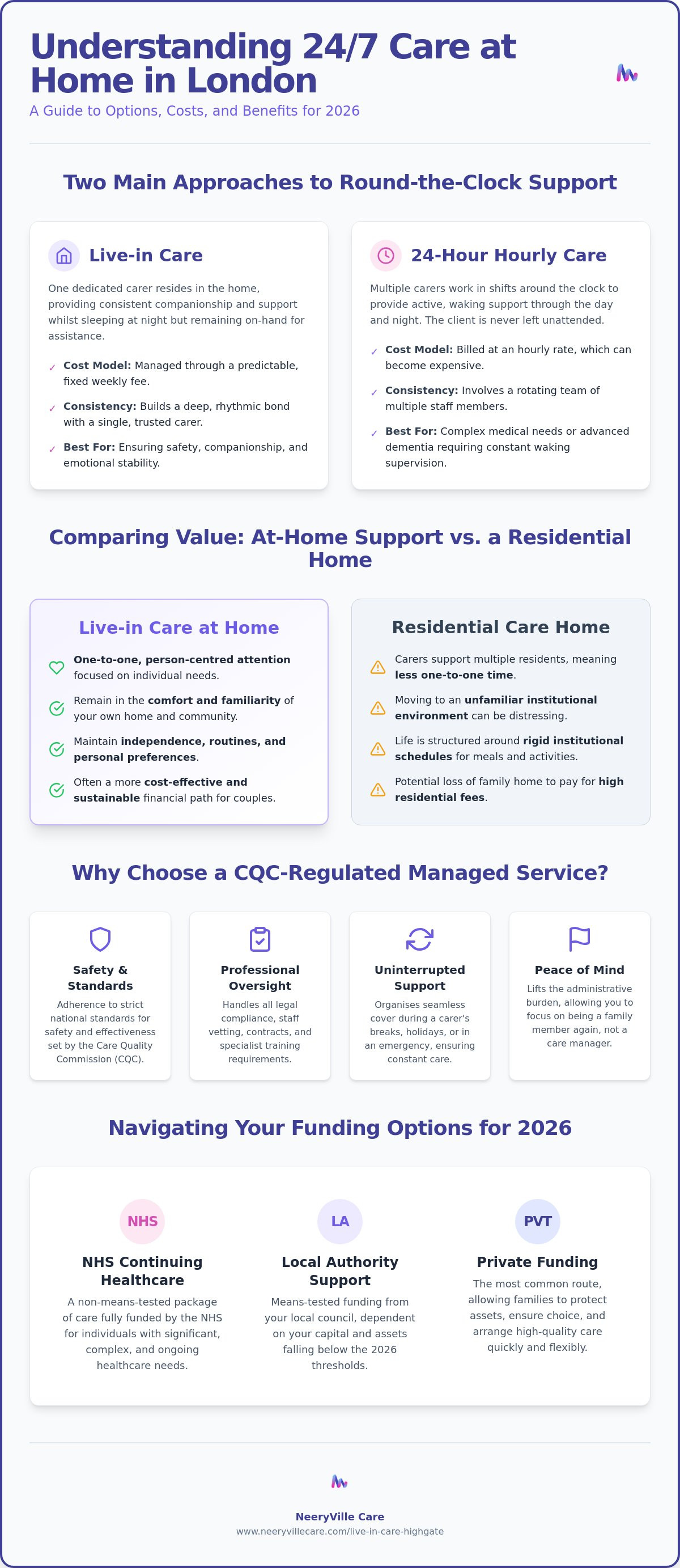
The distinction between these two models is often a source of confusion. Live-in care typically involves one dedicated carer who resides in the home, sleeping at night but remaining on-hand for occasional assistance. It's often managed through a fixed weekly fee, providing financial predictability. In contrast, 24-hour hourly care involves multiple staff working on a shift rotation to provide active, waking support through the night. This is often necessary for those with complex medical needs or advanced dementia who cannot be left alone even whilst they sleep. When considering how much is 24/7 care at home in London, the choice between a single live-in presence and a rotating team will be the primary driver of your final quote. Consistency matters. A single carer builds a deep, rhythmic bond that multiple visiting staff simply cannot replicate.
The Legal and Safety Framework in 2026
Safety is the cornerstone of any care arrangement. The structure of Home care in the United Kingdom ensures that regulated providers meet strict national standards for safety and effectiveness. For families in North London, choosing a CQC-regulated agency is non-negotiable. It provides a clinical authority that self-employed carers cannot offer. A managed service handles the complexities of legal compliance, staff training, and the logistical challenge of organising cover during a carer's breaks or holidays. This professional oversight, often supported by out-of-hours management specialists like Contesto, ensures that the quality of support remains unwavering, even during a crisis. It's about creating a partnership where the agency lifts the administrative burden, leaving you free to focus on being a daughter, son, or spouse again.
For those living in N6 and surrounding areas, our live-in care in Highgate offers a local, regulated solution that prioritises both safety and the comfort of remaining in a cherished home.
Calculating the Cost: Live-in Care vs Hourly Care in 2026
Determining how much is 24/7 care at home in London requires a careful look at your family's specific daily needs. London's unique economic landscape, particularly in areas like Highgate, means that standard national averages rarely apply. Whilst hourly domiciliary visits are effective for specific tasks, they can quickly become prohibitively expensive if you require a constant presence. For families needing support throughout the day and night, a weekly live-in fee often offers a more sustainable and predictable financial path. This model provides a fixed structure, allowing you to plan your household budget without the worry of fluctuating hourly invoices or unexpected surcharges for travel time.
The "London Premium" reflects the higher operational costs of the capital. In Highgate N6, carers often face higher living and travel expenses, which must be reflected in their compensation to ensure we attract and retain the very best talent. We believe that professional carers deserve a fair wage that acknowledges their immense responsibility. By choosing a local specialist, you ensure that your carer is supported by a team that understands the specific logistics of North London, from local pharmacy connections to the nuances of Haringey and Barnet health services. Just as you might check out Instant Recovery for reliable vehicle assistance across the capital, this local expertise ensures a smoother, more responsive experience for your loved one.
Factors Affecting Your Care Quote
Complexity is a primary driver of any care quote. Support for those living with advanced dementia or Parkinson’s requires a higher level of specialist expertise and medication management. Similarly, if your loved one requires frequent assistance during the night, the arrangement may transition from a standard live-in model to a waking-night service. However, for many, the most significant value is found when caring for couples. Since a live-in carer supports the entire household, the cost for two people is often only marginally higher than for one. This makes it a much more economical choice than paying for two separate beds in a residential home, allowing couples to stay together in their cherished environment.
Managed Service vs Introductory Agencies
You may encounter introductory agencies that appear cheaper on the surface. These agencies simply match you with a self-employed carer, leaving you with the legal responsibilities of an employer. This includes managing payroll, tax, and finding emergency cover if the carer falls ill. A managed service, like NeeryVille Care, removes these risks. We handle the rigorous recruitment, specialist training, and CQC compliance, ensuring you have a professional safety net 24/7. This managed approach provides a level of security that introductory models cannot match. For those navigating these decisions, reviewing the NHS guidance on self-funding care can help clarify your responsibilities as a self-funder.
If you're feeling overwhelmed by the options, we're here to help you request a personalised cost breakdown tailored to your family's specific needs in North London.
Comparing Value: Live-in Care vs Residential Care Homes in London
Families often assume that a residential care home is the most cost-effective solution for round-the-clock safety. However, when you look closely at how much is 24/7 care at home in London, the value of staying put becomes clear. In 2026, premium nursing home fees in North London and Highgate often exceed the cost of professional home support. Research shows that self-funded nursing care in the capital now averages approximately £1,759 per week. Despite these high costs, residential facilities typically operate on a one-to-many staffing ratio. This means your loved one's needs are balanced against those of several other residents. With live-in care, the attention is strictly one-to-one. Every interaction is dedicated solely to your family member's comfort and routine.
For couples, the financial comparison is even more compelling. Most care homes charge per person, which effectively doubles the weekly cost if both partners need support. A live-in carer provides assistance to both individuals within their shared home for a single weekly fee plus a modest surcharge. It's a practical way to keep a marriage intact and avoid the heartbreak of separation during the later stages of life. Beyond the immediate invoice, there are often hidden costs in residential settings, such as top-up fees for specific rooms or services, which can lead to unexpected financial strain.
The Emotional and Practical ROI
Staying in a familiar environment offers a clinical advantage that a new facility cannot replicate. For those living with dementia, the layout of a lifelong home provides vital cognitive anchors that help maintain independence. Staying in Highgate N6 allows your loved one to keep their social health intact by remaining close to the neighbours and local shops they've known for decades. Home care offers a level of flexibility that a care home cannot match; you can adjust the level of support as needs change without the trauma of another move. It's about preserving a sense of self whilst ensuring every medical and personal need is met with professional precision.
Asset Protection and the Family Home
The fear of losing the family home to pay for care is a significant source of anxiety for many Londoners. One of the most important benefits of home-based support is the way it interacts with the 2026 financial assessment rules. When you receive care in your own house, the value of your property is generally excluded from the local authority means test. This allows families to protect their most significant asset whilst still accessing support. To understand how these rules apply to your specific situation, it's helpful to review the current guidance on local council funding for homecare. By choosing Live-in Care Highgate, you're not just buying a service; you're securing a future where your loved one remains in the heart of their community, safe and supported in the home they love.
Funding Options: Navigating Local Authority Support and Private Fees
Finding out how much is 24/7 care at home in London is often the first step in a larger journey toward securing your loved one's future. Once you understand the rates, the focus naturally shifts to the various funding streams available to bridge the gap between need and affordability. In 2026, the financial landscape for social care in England is still defined by specific capital thresholds. If your family member has savings or assets above £23,250, they'll generally be expected to self-fund their support. For those with assets between £14,250 and £23,250, the local authority may provide partial funding, whilst individuals with less than £14,250 typically have their care costs fully met, though they may still contribute from their income.
The most comprehensive form of support is NHS Continuing Healthcare (CHC). This is a package of care fully funded by the NHS for adults with a primary health need, often arising from complex or unpredictable conditions like advanced dementia or stroke recovery. Unlike social care funding, CHC isn't means-tested; it's based entirely on the intensity and nature of the care required. Securing this can be a life-changing result for families, as it covers the entire cost of 24/7 support at home. If your loved one doesn't qualify for CHC but still requires nursing input, they might be eligible for NHS Funded Nursing Care (FNC), which in 2026 provides a flat-rate contribution of £219.71 per week directly to the provider.
State Benefits You Can Claim Today
Regardless of your financial status, you should explore non-means-tested benefits. Attendance Allowance is available to those over state pension age who need help with personal care due to illness or disability. The 2026 rates offer a vital weekly contribution that can be put toward private live-in care fees. Similarly, Personal Independence Payment (PIP) may be available for those under pension age. We always recommend starting with a Care Needs Assessment from your local London council. This assessment is free and serves as the gateway to Direct Payments, a system that puts the care budget directly into your hands, allowing you to choose a managed service that matches your family's values.
Third-Party Funding and Equity Release
For many Londoners, the value tied up in their home is their greatest asset. Equity release has become a common way to fund how much is 24/7 care at home in London without the need to sell the property or move into residential care. By unlocking a portion of the home's value, families can secure a high-quality live-in carer whilst maintaining the comfort of their familiar surroundings. You might also consider an Immediate Needs Annuity, which provides a guaranteed income for care in exchange for a one-off lump sum. To ensure these decisions are made with legal clarity, it's essential to have a Lasting Power of Attorney (LPA) in place. This allows you to manage your loved one's affairs with confidence and safety during difficult times.
Navigating these funding routes can feel overwhelming, but you don't have to do it alone. We're here to help you book a free funding consultation to explore the options available for your family in North London.
Choosing NeeryVille Care: Bespoke 24/7 Support in Highgate
Selecting a care provider is an act of profound trust. It is the moment you step back from being a primary caregiver and return to being a daughter, a son, or a spouse. At NeeryVille Care, we understand that whilst you are rightly concerned with how much is 24/7 care at home in London, your ultimate priority is the emotional well-being and safety of your loved one. Our approach is deeply person-centred. We don't just match carers to clinical needs; we match them to personalities. We believe that a shared interest in gardening, a similar sense of humour, or a mutual love for local Highgate history can be just as vital for health as medication management.
Our expertise extends to the most complex requirements. We provide specialised support for those living with dementia, Parkinson's, and stroke recovery. These conditions require more than just a presence; they require a deep understanding of changing behaviours and physical needs. Our Highgate-based team is rooted in the North London community. We know the local pharmacies, the GP surgeries, and the quietest paths in Waterlow Park. This local presence allows us to be responsive and present in a way that national agencies simply cannot replicate. We offer transparent pricing structures that eliminate the anxiety of hidden fees, ensuring you have a clear financial roadmap from the very start.
A Managed Service You Can Trust
The distinction between a managed service and an introductory agency is fundamental to your peace of mind. As a CQC-regulated provider, NeeryVille Care takes full responsibility for the legal and administrative burden of employment. We handle the rigorous selection process, the background checks, and the ongoing professional training of every carer. This means you never have to worry about payroll, tax, or finding emergency cover if a carer is unwell. Our team provides 24/7 backup, ensuring that your loved one is never without support. For families who may only need occasional assistance, we also offer Visiting Care Highgate to help bridge the gap before full-time support is required.
Getting Started with Your Care Journey
Beginning your care journey should feel like a relief, not a chore. We start with a comprehensive initial assessment in your home, where we listen to your concerns and learn about your loved one’s daily rhythm. This allows us to build a bespoke care plan that respects their dignity and independence. We are committed to a responsive service; in many cases, we can implement support within a matter of days, providing immediate stability during a crisis. Our goal is to lift the weight from your shoulders, providing a steady guide through the complexities of 2026 care funding and implementation. When you are ready to take the next step, you can speak to our compassionate team about home care costs and discover how we can support your family.
Securing Your Loved One's Future at Home
Navigating the financial and emotional landscape of elderly support is a significant journey. You now have a clearer understanding of how much is 24/7 care at home in London and the various funding streams that can make this dignified choice a reality. By choosing a managed service, you protect your family from the legal risks of direct employment whilst ensuring a level of safety that only a CQC-regulated provider can offer. Whether you're exploring NHS Continuing Healthcare or considering the value of staying in your cherished Highgate home, remember that you don't have to make these decisions in isolation.
Our team brings specialist dementia expertise and deep local knowledge of the N6 area to every care plan we create. We're here to act as your steady guide, lifting the administrative burden so you can focus on quality time with your loved one. Every family's situation is unique, and we're ready to help you find the most sustainable path forward.
Request a Personalised Care Cost Assessment
You've taken the first brave step by seeking information. We're here to help you take the next one with confidence and safety.
Frequently Asked Questions
Is 24/7 live-in care cheaper than a care home in London?
Live-in care often represents better value than a residential placement, particularly for couples. Premium nursing homes in North London can cost upwards of £1,759 per week per person. In contrast, a live-in carer can support a couple in their own home for a single weekly fee plus a modest surcharge, making it a significantly more economical choice that keeps partners together.
Will the local council pay for my 24/7 care at home?
Local authority funding depends on a financial means test. In 2026, if your savings and assets are below £23,250, you may be eligible for partial support; if they are below £14,250, the council may meet the full cost of your care. A major advantage of home care is that the value of your property is usually excluded from this assessment, helping you protect the family home.
What is the average weekly cost of a live-in carer in London in 2026?
Market rates for a managed live-in service typically range from £1,200 to £1,800 per week for standard support. If your loved one requires specialist dementia care or a carer who remains awake throughout the night, fees can rise to £2,500 or more. When families ask how much is 24/7 care at home in London, they should remember these figures include the security of a fully managed, CQC-regulated service.
Does Attendance Allowance cover the full cost of 24/7 care?
Attendance Allowance is a non-means-tested contribution toward care costs, but it will not cover the full weekly fee of a 24/7 carer. It's designed to help with the extra costs of being disabled or ill. Whilst it provides a helpful weekly boost to your budget, it should be viewed as one part of a wider funding plan that might include private savings or other state benefits.
Can I get 24/7 care at home if I have dementia?
Yes, specialist dementia care at home is one of the most effective ways to manage the condition. Staying in a familiar environment with a consistent routine helps reduce the confusion and anxiety often triggered by a move to a care home. Managed providers match carers with specific dementia training to ensure safety, medication support, and emotional well-being are maintained around the clock.
What happens if our regular live-in carer needs a break or falls ill?
A managed service ensures that your loved one is never left without support. We take full responsibility for organising a trained replacement carer to cover breaks, holidays, or unexpected illness. This seamless transition is a primary benefit of using a CQC-regulated agency over a self-employed carer, as it removes the stress of emergency recruitment from the family.
Are there extra costs for care during bank holidays or weekends?
Weekly live-in rates generally include standard weekends, but bank holidays typically incur an additional charge. Most agencies, including those in Highgate and North London, charge a higher daily rate for days such as Christmas, New Year, and Easter. We provide a clear, transparent breakdown of these occasional surcharges during your initial assessment so there are never any hidden surprises.
How do I know if I am eligible for NHS Continuing Healthcare (CHC)?
Eligibility for CHC is determined by a "primary health need" rather than a specific diagnosis. A multidisciplinary team will assess whether your care needs are complex, intense, or unpredictable. If your needs are primarily health-related rather than social, the NHS may pay 100% of the cost of your 24/7 support at home. This assessment is separate from the local council's means test.