Elderly Support Services in Highgate: A Guide for Families

What if the right support isn’t about doing more, but about making everyday routines feel safer and easier? If you’re wondering whether occasional visits will be enough, or worrying about loneliness, personal care or meals, you’re not alone. Finding elderly support services Highgate families can consider starts with understanding what matters to your loved one and where they’d welcome help.
The choice can feel unclear. Visiting care may suit someone who needs help at particular times, whilst overnight or live-in care offers a different level of presence. The best fit depends on the person’s preferences, daily routines and when support is wanted, not simply on choosing the most intensive option.
This guide explains home-care options, how to think through the level of support that may be right, and what to ask a provider before making arrangements. NeeryVille Care is a CQC-regulated home-care provider offering flexible hourly visits in Highgate and Hampstead, alongside live-in care nationwide. We’ll help you approach the next steps calmly, with your loved one’s comfort and dignity at the centre.
Table of Contents
Elderly support services in Highgate: recognising when extra help may be useful
Noticing a change in someone you love can feel worrying. It doesn’t automatically mean they need care or that their independence has to change. It may be a reason to pause, listen and ask whether some everyday tasks have become harder than they used to be.
What changes might prompt a conversation about support?
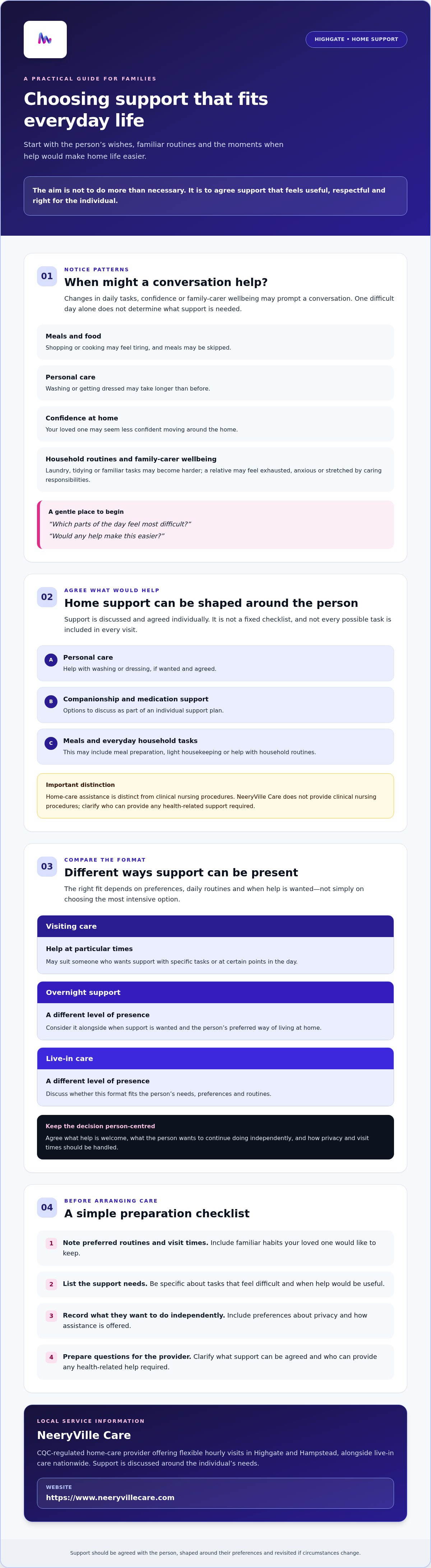
Look for patterns rather than treating one difficult day as proof that help is needed. Perhaps meals are being skipped because shopping or cooking feels tiring. Washing or getting dressed may take longer, or your loved one might seem less confident moving around the home. They may also be finding it harder to keep up with laundry, tidying or other familiar routines.
Start gently: “Which parts of the day feel most difficult?” or “Would any help make this easier?” Ask what support would feel acceptable, too. A person may welcome help with meal preparation but prefer to manage washing privately. An overview of assistance with daily activities can offer general background, but the right arrangements depend on the individual.
Consider family-carer strain alongside the older person’s needs. If a relative is regularly exhausted, anxious or struggling to balance caring with other responsibilities, it may be time to talk about sharing some tasks. A conversation about caregiver burnout support can help families recognise that their wellbeing matters, too. Asking for help is not a failure; it can make support more sustainable for everyone.
How can support protect choice and familiar routines?
Good support should fit around a person’s life, rather than take over unnecessarily. If your loved one usually prepares breakfast at a certain time, for example, assistance might focus on the parts they find difficult while leaving the rest of the routine in their hands. Agreeing what help is wanted, and what they’d rather do themselves, keeps the conversation practical and respectful.
Person-centred support means agreeing help around the person’s preferences, routines and priorities.
Include your loved one in decisions about visit times, privacy and how assistance is offered. They may prefer time to get to know a carer, or want family involved in planning. Keep checking that the arrangement still feels right as circumstances change. For families exploring visiting care in Highgate, writing down the tasks that feel difficult and those they want to keep doing independently can help make an initial discussion clearer.
What elderly home support in Highgate can include
Elderly home support is practical assistance arranged around a person’s needs and the routines they want to keep in their own home. The type and amount of help should be discussed and agreed individually. Someone who manages most daily activities may only want help with a particular task, whilst another person may benefit from a different arrangement as their needs change.
That flexibility matters. “Home care” doesn’t mean every possible task is included in every visit. Talk through what would help, when it’s needed and what your loved one prefers to continue doing independently. The NHS Social care and support guide explains more about the kinds of social care available and how to explore support.
Which everyday tasks might a home-care visit support?
Depending on the agreed plan, support may include personal care such as help with washing or dressing, companionship, medication support or meal preparation. Practical home help may include light housekeeping and help with everyday household tasks. These are options to discuss, not a standard checklist that applies to everyone. Families can explore home help in Highgate if household routines are becoming difficult to manage.
Be specific about what the person wants help with. For example, they might appreciate assistance preparing lunch but prefer to choose and serve their own breakfast. A clear conversation about preferences, privacy and priorities helps shape support around the individual, rather than asking them to fit around a fixed routine.
Home-care assistance is distinct from clinical nursing procedures. NeeryVille Care does not provide clinical nursing procedures, so families should clarify the nature of any health-related support required and who is able to provide it.
When might overnight or live-in support be considered?
If reassurance or assistance may be needed during the night, families can ask about overnight support, including waking-night or sleeping-night care. The right arrangement depends on the person’s circumstances and what support is agreed. It shouldn’t be assumed necessary simply because nights feel worrying.
Live-in care is a separate option: a caregiver lives in the client’s home to provide ongoing support there. It may be worth discussing if needs extend beyond particular visits or overnight hours, while considering the older person’s wishes and home-life preferences. Neither arrangement is automatically the right choice. Talk through what happens during the day and night, what help is wanted and what the provider can agree to deliver.
If you’re weighing up which tasks or level of support could suit your family, you can discuss your care needs with NeeryVille Care as a practical next step.
Choosing between visiting, overnight and live-in care in Highgate
These arrangements differ mainly in when support is available and how it fits around life at home. There’s no fixed checklist, diagnosis or single sign that determines the right choice. Start with the times help is wanted, the tasks to agree and the older person’s preferences about sharing their home and daily routine.
When might flexible visiting care suit an older person?
Scheduled visits may be a good starting point if help is wanted at particular times, such as getting ready, preparing a meal or keeping up with a daily routine. Agreed tasks can focus on those needs, while the person continues to manage other parts of the day in their own way. NeeryVille Care offers flexible hourly home visits in Highgate and Hampstead. Find out more about visiting care in Highgate.
If the need is specifically at night, ask how the proposed overnight care in Highgate arrangement works, including what support is agreed and whether it matches the person’s preferences.
What questions help families compare levels of support?
Before choosing, consider: At what times is help needed? Which tasks matter most to the older person? Is night-time assistance a concern? How would a caregiver’s presence affect household routines, privacy or other people at home? Might needs change, and how could the plan be reviewed?
Visits provide support at agreed times; live-in care means a caregiver lives in the person’s home. The distinction can help narrow down options, but a thoughtful discussion should also cover the individual’s wishes and the tasks a provider can agree to deliver. The Care Act 2014 statutory guidance sets out principles for care and support in England, including wellbeing. Exploring elderly support services Highgate families can consider is a conversation, not a decision that has to be made from a checklist.
How to prepare for arranging elderly support services in Highgate
It can help to gather your thoughts before speaking with a provider. You don’t need to have every answer or make decisions straight away. A few clear notes can make the conversation calmer and keep your loved one’s wishes at the centre.
What should families discuss before requesting support?
Begin with the older person’s priorities and ask what they’d welcome help with. With their permission, note the usual daily routine, preferred times for visits, tasks they want to keep doing themselves and any preferences about privacy or how support is offered. Ask who they’d like involved in conversations. Share only information relevant to planning support, and check before passing on personal details.
What should you ask a home-care provider?
Ask how the provider discusses needs and agrees the support plan, how it’s reviewed, and how changes in circumstances can be raised. Find out how they communicate with the older person and, if agreed, their family. You might also ask how they approach continuity of care and what happens if a regular carer can’t attend. Clear answers should help you understand the arrangement without pressuring you to decide.
It may be useful to prepare a short list of questions, such as:
Which tasks can be included, and how are they agreed?
Can preferred routines and visit times be discussed?
How can the older person or family share feedback or raise a concern?
How will everyone talk about support if needs or preferences change?
Be open about practical details that could help a provider understand the routine, such as when assistance would be most useful or who the person wants contacted. Avoid sharing sensitive information that isn’t needed for the discussion. If the older person finds it difficult to explain their preferences, give them time and ask how they’d like family to support the conversation.
NeeryVille Care provides flexible hourly home visits in Highgate and Hampstead. Families can discuss what help may fit their circumstances and explore elderly care at home without assuming one plan suits everyone. NeeryVille Care’s listed local areas include Highgate N6, Crouch End N8, Hornsey, Camden, Hampstead, Finsbury Park, Kentish Town, Tufnell Park, Haringey, North London, Hungerford, Chelsea, Kensington, Hillingdon, Enfield, Hackney, London and Angel.
Explore personalised elderly support services with NeeryVille Care in Highgate
Choosing support can feel like a significant step. It can also begin with a straightforward conversation about what would make daily life easier, and what your loved one wants to keep doing independently. NeeryVille Care offers flexible hourly home visits in Highgate and Hampstead, with support discussed around each person’s needs and preferences.
How can local support fit an individual’s needs?
Start with the routine: when would help be welcome, and what matters most to the older person? Depending on their circumstances and what’s agreed, support may include companionship, personal care, medication support, meal preparation or help with daily living. Not every task will suit every person, and the plan should reflect the individual rather than assume a standard package.
NeeryVille Care is a CQC-regulated home-care provider. Families can ask how support is planned and what tasks can be agreed, then consider whether hourly visits fit the person’s daily life. For more information about local visiting care in Highgate, explore the service details as part of your decision.
Family carers matter, too. If caring responsibilities are affecting your own wellbeing, seeking caregiver burnout support in London may help you think through what guidance or additional support could be useful. You don’t have to wait until you feel overwhelmed to ask questions or talk about sharing care responsibilities.
What is a simple next step for Highgate families?
You can begin by sharing a few details: the routines your loved one values, where they’d welcome assistance, and any questions or concerns the family has. It’s fine to be unsure about the right level of care. A conversation can help clarify which needs to discuss and what options may be worth exploring, without committing to an arrangement before you’re ready.
Ask what you need to understand how support could work, including how preferences are considered and how changing needs can be discussed. The aim is to explore a suitable next step at a pace that feels comfortable for your family.
Contact NeeryVille Care to discuss elderly support services Highgate families may be considering and share what matters to your loved one.
Take the next step at a pace that feels right
Choosing elderly support services Highgate families can feel confident about starts with the older person’s perspective: what they’d welcome help with, which routines matter and how much support feels comfortable. Scheduled visits, overnight care and live-in care offer different arrangements, so the right fit depends on individual needs and preferences.
NeeryVille Care is a CQC-regulated home-care provider offering flexible hourly visits in Highgate and Hampstead. Depending on what’s agreed, support may include companionship, personal care or medication support. You can discuss the practical details and ask questions without needing to have every decision settled first.
A thoughtful conversation can be a manageable first step towards support that respects your loved one’s choices and helps them feel at home. Take it one question at a time.
Frequently Asked Questions
What elderly support services are available in Highgate?
Local elderly support services Highgate families explore may include scheduled home visits and agreed help with daily living, personal care, companionship, medication support or meals. The exact tasks depend on the person’s needs, the plan agreed and the provider’s services. NeeryVille Care offers flexible hourly domiciliary visits in Highgate. Before choosing support, discuss what your loved one would welcome and which routines they’d like to maintain.
How do I know whether my elderly parent needs support at home?
There’s no single sign that determines whether your parent needs care. Notice whether difficulties with daily tasks, confidence, familiar routines or social contact are recurring, then ask what they’ve found difficult and what help they’d welcome. Keep the conversation respectful and centred on their wishes. If you’re concerned about their health or wellbeing, seek appropriate professional advice. Support can be explored gradually, according to their circumstances and preferences.
Can an older person receive care at home in Highgate?
Yes, home-care support can be arranged in Highgate, depending on the person’s needs and the provider’s service arrangements. Scheduled visits may include agreed assistance such as personal care, companionship or meal preparation. NeeryVille Care offers flexible hourly domiciliary visits in Highgate and Hampstead. Contact providers directly to check local availability, discuss whether the support is suitable, and clarify which tasks and visit arrangements can be agreed.
What is the difference between visiting care and live-in care?
Visiting care involves a caregiver attending at agreed times to provide planned support. Live-in care involves a caregiver residing in the person’s home to provide ongoing support, as arranged. Neither option is automatically better. Consider when help is needed, the tasks involved, household arrangements and how your loved one feels about having a caregiver at home. These details can help you compare options without relying on a fixed checklist.
Can home-care visits include help with medication and meals?
They may, if medication support or meal preparation is available from the provider and agreed as part of the person’s support plan. NeeryVille Care lists both among its offerings. Ask how assistance is planned and what the caregiver can do. Don’t assume a home-care visit includes clinical nursing procedures or tasks outside the agreed service. Clarifying this beforehand helps everyone understand the arrangement and its boundaries.
How should I choose an elderly care provider in Highgate?
Ask how the provider learns about the older person’s needs, agrees tasks and communicates with the person and family. Discuss visit arrangements, continuity of care and how changes in circumstances can be reviewed. Check relevant regulatory information directly through the Care Quality Commission (CQC). Choose a provider whose explanations are clear and whose proposed support respects the individual’s preferences, rather than relying on a generic checklist alone.
Is overnight care available for older people in Highgate?
Overnight support is an option families can ask about if assistance may be needed at night. What’s suitable depends on the person’s circumstances and the type of help required, so ask what the arrangement would include and whether it fits their preferences. NeeryVille Care provides information about overnight care in Highgate. Discuss the details directly with the provider before deciding.