Co-ordinating with GPs and District Nurses in Highgate

A change in someone’s health can leave families wondering who to tell and whether the right support will follow. For families coordinating with GPs and district nurses Highgate, local NHS arrangements can add another layer of uncertainty, especially when clinical care and help with everyday routines overlap.
It’s understandable to worry that an instruction or change might not reach everyone involved. The roles are different: GPs provide primary medical care, district nurses deliver nursing care at home, and home-care workers support daily living, such as personal care and medication support. Home care can complement NHS services, but it doesn’t replace clinical care.
This guide explains how to share clear, useful information, keep everyday support in step with the person’s preferences and understand why NHS arrangements can vary across Highgate, which spans Camden and Haringey. Knowing who to contact and having a personalised care plan can make it easier to take the next step towards support at home.
Table of Contents
Why coordinating home care with GPs and district nurses matters in Highgate
When a loved one is supported at home by family, a GP, perhaps a district nurse and a home-care worker, it can feel as though you’re responsible for keeping everyone connected. One person may know about a health concern, while someone else sees how the person is managing day to day. If updates are unclear, families may be left wondering who to tell and what happens next.
Coordination doesn’t mean every professional does every task, or that information automatically moves between services. It means understanding each person’s role, agreeing which updates matter and keeping support centred on the individual’s needs and wishes. Clear arrangements can reduce avoidable confusion and help families explain concerns consistently, even when different professionals are involved at different times.
Coordinated home support means the right people understand their responsibilities, share relevant updates appropriately and keep the person’s priorities at the centre. For families coordinating with GPs and district nurses Highgate, this provides a practical starting point when several people are involved in someone’s care.
What coordinated support at home means for a Highgate family
Imagine someone has begun waking later and no longer wants breakfast at the usual time. A home-care worker might notice the change during visits, while a family member knows it is unusual. With the person’s agreement, recording what has changed and sharing a relevant concern with the appropriate professional can help avoid assumptions. Everyday support should still respect the person’s preferences, rather than treating a familiar routine as fixed.
If there’s a new clinical concern, the family can seek advice from the appropriate NHS professional. A home-care worker can provide daily-living support and pass on relevant observations through agreed arrangements, but doesn’t diagnose the cause or take on nursing procedures. The district nurse role centres on nursing care in the community, rather than practical assistance with everyday routines.
When several professionals are involved
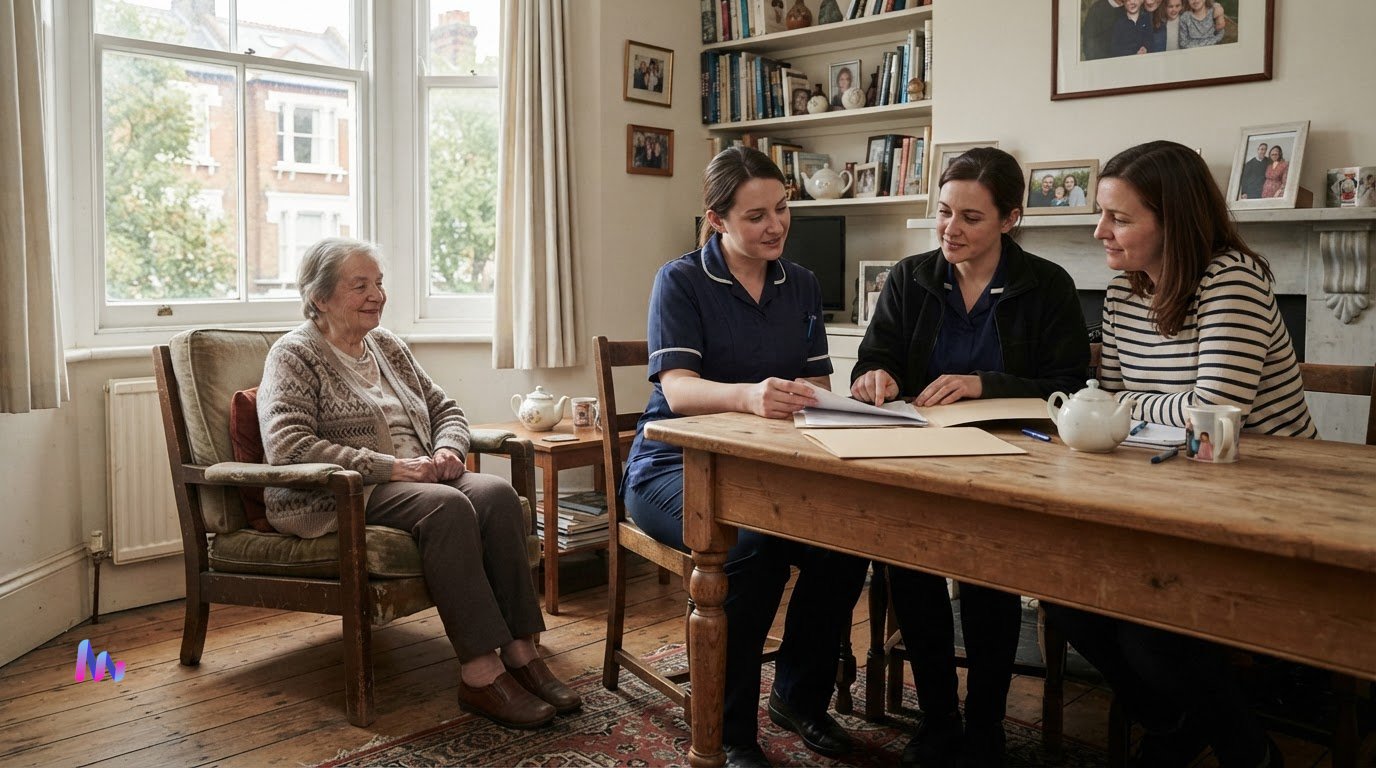
A GP may provide primary medical care, such as assessing a health concern or reviewing treatment. A district nurse may provide nursing care at home. A home-care worker may support personal care, meals, companionship or medication support in line with the person’s care plan. These services can all be part of someone’s life without having the same responsibilities.
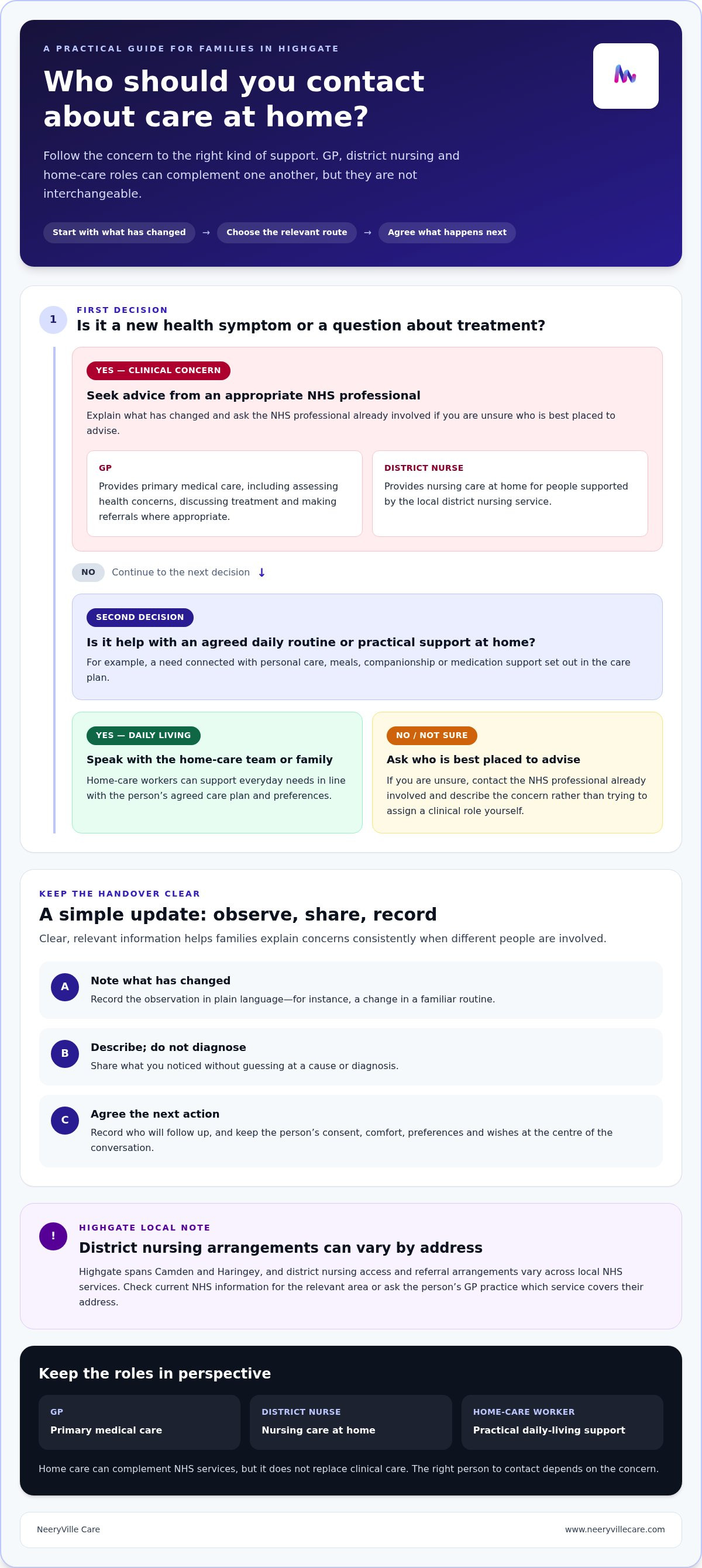
Not everyone receiving home care needs district nursing. When several professionals are involved, it helps to know whom to approach for each kind of concern. A new health symptom or a question about treatment belongs with an appropriate NHS clinician. A difficulty with an agreed daily routine is usually a matter for the home-care team or family. If you’re unsure, ask the NHS professional already involved who is best placed to advise. Clear boundaries help families share concerns without expecting one person to manage everything.
Coordination can begin with a few steady habits: note what has changed, describe what you observed rather than guessing at a cause, and record who will follow up. Let the person’s consent, comfort and preferred way of living guide those conversations. Support is more useful when it fits the individual, rather than simply following a timetable.
GPs, district nurses and home-care workers: who does what?
Knowing who is responsible for each part of someone’s support can make family conversations clearer. These roles can complement one another, but they aren’t interchangeable. The comparison below is a general guide. Individual arrangements depend on the person’s needs and the services involved.
This isn’t a ranking of importance. Each role has a different purpose, and the right person to contact depends on the concern. A new health symptom is a matter for an NHS clinician. Help with a daily routine is generally part of home-care support or a family discussion.
The GP and district nurse: clinical care and local NHS arrangements
A GP provides primary medical care and can assess concerns, review health needs and refer to other services. A district nurse provides nursing care through their service. District nursing access and referral arrangements vary across local NHS services, so the route may differ between Highgate addresses. Check current NHS information for the relevant area or ask the person’s GP practice which service covers their address.
Families don’t need to work out clinical responsibilities alone. If you’re unsure whether a concern belongs with the GP or district nursing team, explain what has changed and ask the NHS professional already involved for guidance. Home-care support works alongside clinical care, not in place of it.
The home-care worker: practical, person-centred help
A home-care worker can support everyday life in line with the person’s needs and agreed care plan. This may include personal care, help with meals, companionship or medication support. The plan can reflect preferences, such as how someone likes to start the day, and make clear what assistance has been agreed.
Home-care workers don’t diagnose health conditions or carry out clinical nursing procedures. NeeryVille Care provides domiciliary and live-in care, which supports daily living alongside NHS clinical care. If someone needs regular visits at home, visiting care in Highgate can provide practical support shaped around their daily needs.
Keeping responsibilities clear helps everyone understand where to direct questions and what information may be useful to share. If you’re considering practical support at home, you can talk with NeeryVille Care about home-care needs.
What information helps GPs, district nurses and home-care teams stay aligned?
It can be hard to remember every detail during a call or appointment, especially when you’re worried. A brief, factual update helps explain what has changed and what you’re asking about, without trying to interpret the cause. The person’s views matter too. Involve them in decisions about their information and seek their agreement before sharing personal details where appropriate.
Useful care updates are factual, relevant, timely and shared appropriately. For families coordinating with GPs and district nurses Highgate, this approach can make conversations clearer without assuming that every service shares information automatically.
A short update can cover:
Current concern: What prompted you to get in touch?
Relevant change: What have you noticed, and when did it begin?
Agreed actions: What has already been discussed, and what follow-up was agreed?
Useful contact details: Who is the agreed family contact, and how can they be reached?
Build a simple shared record for everyday updates
Keep dates, observations and agreed next steps together in a notebook or another secure record that suits the people involved. Use plain language. “Seemed more tired after lunch on Tuesday” describes an observation; “the medication is making them tired” assumes a cause. Note who you spoke to and any follow-up they agreed, so the family can refer back to the details rather than rely on memory.
Keep sensitive details private and share only relevant information with appropriate people, taking the person’s preferences and agreement into account. A record is a memory aid, not a shared clinical file. Don’t assume every professional can access it or accepts updates in the same format.
Agree who communicates and how
Where the person agrees, it may help to name a main family contact for routine updates, while keeping the person involved as much as they wish. Decide how that contact will pass on relevant information, and establish the preferred method with each service instead of assuming one route works for everyone. Keep messages brief and focused on what the recipient needs to know.
Routine observations can be recorded and raised through the relevant agreed channel. If a concern needs prompt clinical advice, contact an appropriate NHS professional rather than waiting for the next routine update. Explain what you observed, when it happened and whether anything has changed since. You don’t need to diagnose the problem. A straightforward account gives the clinician useful context.
These habits can reduce repeated explanations and help families keep track of next steps. They also leave room for the person’s priorities, comfort and privacy to guide what is shared.
How Highgate families can prepare for a joined-up care conversation
A conversation about support can feel daunting when you’re trying to explain changes, remember earlier advice and speak for someone you care about. A little preparation can make it calmer and more focused. Start with the person’s priorities, bring a few clear notes, then finish by agreeing who will do what next.
Prepare the person’s priorities and questions
Begin by asking the person receiving care what matters most to them. It might be managing a morning routine independently, feeling less rushed at mealtimes or knowing what support is available if they feel unwell. Their preferences help keep the discussion centred on daily life, rather than just a list of tasks.
Before speaking with a professional, jot down the main concern and practical details that may help explain it. Note when a change began, how often it happens and whether it affects an existing routine. Include what support is already in place and what has changed. Describe what you’ve noticed rather than suggesting a diagnosis.
Check the right local route
Highgate’s NHS arrangements can vary by address, so don’t assume that information for another neighbourhood or borough applies. District nursing eligibility, referral routes and service contacts depend on local NHS arrangements. Check current information from the relevant NHS service or ask the person’s GP practice which service to approach for that address.
Verifying the address matters because district nursing access and referral arrangements can differ across local NHS services. If you’re unsure which team covers the person’s home, make that one of your first questions. This keeps the conversation grounded in the current local route, rather than relying on an old contact detail or someone else’s experience.
Close the conversation with clear next steps
To keep the discussion manageable, work through a short sequence:
Agree priorities: Ask the person what they most want help with or want to preserve in daily life.
Note concerns: Write down observed changes and questions in plain language.
Identify the right professional: Contact the relevant NHS service or GP practice for clinical or referral questions, and the home-care team for agreed daily-living support.
Record next actions: Note who will act, the expected timing discussed and when the plan should be reviewed.
Before ending a call or meeting, briefly repeat the agreed actions and confirm the appropriate contact route for any follow-up. Keep the details with your notes, and revisit them if circumstances change. If you’re carrying a lot of responsibility yourself, recognising that strain matters too; families may also find caregiver burnout support in London useful to explore.
How NeeryVille Care can fit into home support in Highgate
Once the roles of NHS professionals and home-care workers are clear, families can consider what practical support would make day-to-day life easier. NeeryVille Care provides domiciliary care focused on Highgate and North London, as well as live-in care. For families coordinating with GPs and district nurses Highgate, the distinction matters: home care supports everyday living, while NHS clinicians provide medical and clinical nursing care.
Support may include personal care and help with daily routines, companionship and agreed medication support. A care plan can set out how assistance fits the person’s preferences, routines and needs. This is practical support at home, not a substitute for clinical assessment, treatment or nursing procedures.
Choose support around the person’s day-to-day needs
The right pattern of care depends on the individual. Visiting support may suit someone who wants help at particular points in the day, such as getting ready, preparing a meal or keeping up a familiar routine. Live-in care may suit someone who wants more continuous support at home. Neither option is automatically right for everyone. The person’s wishes, daily needs and home life should guide the discussion.
A personalised approach can help keep support familiar and respectful. For example, a plan might record how someone prefers to approach their morning, what they enjoy doing independently and where they welcome assistance. This helps make care part of home life, rather than a routine imposed from outside. Families exploring a more continuous arrangement can read about live-in care in Highgate.
Take a calm next step with the family
Before discussing support, gather a simple picture of the person’s priorities, current arrangements and the parts of the day that feel most difficult. Include the person receiving care in the conversation as much as they wish. Note what already works well, so any new support can build on familiar routines instead of changing them unnecessarily.
A conversation with NeeryVille Care can explore practical home-care support in light of those needs and preferences. It can help families consider what everyday assistance may suit the person, while clinical questions remain with the appropriate NHS professionals. You don’t need every detail settled before starting. Begin with what matters most at home, then talk through the support that may fit.
Share your family’s priorities with NeeryVille Care and discuss a calm, practical next step for support at home.
Take the next step at a pace that feels right
Support at home can change as a person’s needs and wishes evolve. Keep their priorities at the centre of future conversations and revisit arrangements when something changes. Coordinating with GPs and district nurses Highgate isn’t about managing every detail perfectly. It’s about helping the person feel heard and making everyday support fit their life.
NeeryVille Care is a CQC-regulated provider offering personalised domiciliary care focused on Highgate and North London, alongside live-in care. Its North London focus includes Highgate N6, Crouch End N8, Hornsey, Camden, Hampstead, Finsbury Park, Kentish Town, Tufnell Park, Haringey, Hackney, Angel and London. NeeryVille Care also serves Hungerford, Chelsea, Kensington, Hillingdon and Enfield. A conversation can help your family consider practical support that fits the person’s routines, while NHS clinicians continue to provide medical and clinical nursing care.
You don’t need to have every answer before you begin. Talk with NeeryVille Care about support at home in Highgate and discuss a practical next step for your family.
Frequently Asked Questions
Can a home-care worker contact a GP on someone’s behalf?
A home-care worker may be able to pass on an observation, but shouldn’t be assumed to contact the GP or speak for the person automatically. Agree with the person who will make routine calls and follow the GP practice’s stated process. For example, a worker might report that lunch has repeatedly been left untouched; deciding whether this signals a health problem is for a clinician. Respect the person’s wishes and agreed information-sharing arrangements.
Do district nurses visit every day?
There isn’t one daily visiting schedule for everyone. How often a district nurse visits depends on the person’s assessed nursing needs and the arrangements of the local NHS service. Ask the team responsible for their care what the current plan is and how to raise a change in need. A home-care visit is separate support with daily living and doesn’t replace a district nurse’s clinical role.
What should a family do if someone’s health changes between district nurse visits?
Write down what has changed and contact the person’s GP or appropriate NHS service for clinical guidance. Don’t wait for the next planned visit if you’re concerned. For urgent help, follow the NHS guidance on urgent and emergency care; call 999 for an emergency. A home-care worker can share an observation, but can’t replace clinical assessment or advise on treatment.
Can district nurses change someone’s medication?
Medication decisions should be handled by an appropriately authorised healthcare professional and follow the person’s clinical plan. Don’t change a dose or stop a medicine based on a guess or an informal conversation. If you’re worried about a medicine, contact the clinician responsible for the person’s care or speak to a pharmacist. They can advise based on the individual’s circumstances and current medication information.
Does someone have to be housebound to receive district nursing in Highgate?
Eligibility depends on clinical need and the access criteria of the local NHS service, so don’t assume one rule applies across Highgate. Families coordinating with GPs and district nurses Highgate should confirm which service covers the person’s address and what criteria it uses. Check current local NHS information or ask the GP practice. This helps establish the right route, but doesn’t guarantee eligibility.
Can a family member request a district nurse visit directly?
Families can ask for information, but the route for requesting district nursing varies between local services. Contact the person’s GP practice or the relevant NHS service for current instructions, and explain the nursing concern and the person’s address. Asking how to access the service is different from qualifying for a visit: the NHS team will consider its criteria and the person’s needs, so a request doesn’t guarantee a referral or visit.