Care options when you can't cope: a guide for families


What if getting help didn’t mean giving up the routines and comforts that matter to your loved one? If you’re looking into care options when you can't cope anymore, it may be because you’re worried about their safety, stretched thin or unsure how long you can keep managing alone. That’s a difficult place to be. Needing support isn’t a failure, and it doesn’t mean you have to make a major decision all at once.
The right support often starts with the gaps that are hardest to manage. Scheduled visits may help with daily tasks, whilst overnight care, respite or live-in care may suit different needs. It’s understandable to feel uncertain about welcoming someone into the home or changing a familiar routine. Personalised support can be shaped around the person’s preferences, dignity and independence.
This guide explains how the main home care options differ, what to consider when choosing the level of support, and what financial help may be available in England. You’ll also find practical steps to help your family feel less overwhelmed, without pressure to decide everything today.
Table of Contents
When caring feels impossible: recognise what is becoming too much
There may be days when you’re exhausted before the day has properly begun. You might worry about leaving your relative alone, feel guilty for becoming impatient, or wonder how long you can keep doing everything yourself. These feelings don’t mean you’ve failed. They can be a signal that the support around you and your loved one needs to change.
Caregiver strain is the emotional and physical pressure that can build when caring demands exceed the support available. The related idea of caregiver burden describes the demands and effects of caring on a family member. Recognising strain early can help you look at practical support before exhaustion becomes harder to manage.
What can feeling unable to cope look like?
There isn’t one pattern. You might feel persistently tired, worried, irritable or unable to concentrate. Perhaps you’re constantly on alert in case your loved one needs help, even when you’re trying to rest. Some carers find themselves withdrawing from friends or putting their own everyday needs aside.
It can also show up in practical details: meals are missed, household tasks pile up, appointments are difficult to coordinate, or medication support and personal care take more time than the family can reliably provide. One difficult day doesn’t define the situation, and these signs don’t diagnose a health condition. But if they keep happening, they’re useful clues that the current arrangement may be stretched.
When does the situation need urgent attention?
Care planning and emergencies need different responses. If someone is in immediate danger, seriously unwell or at risk of harming themselves or another person, call 999 or go to A&E. Home-care arrangements aren’t a substitute for emergency or clinical support.
If you or someone close to you needs urgent mental-health help but isn’t in immediate danger, use the NHS guidance on getting urgent mental-health help. In England, you can call NHS 111 and select the mental-health option. If the concern isn’t an immediate crisis, a GP can help you consider appropriate support.
Once urgent risks have been addressed, consider what would make ordinary days safer and more manageable. Write down the moments that cause the most worry, such as being alone for long periods or struggling with evening routines. This can help your family describe what’s becoming difficult and explore care options when you can't cope anymore without feeling pushed into one big decision.
Support can help both the person receiving care and the family member providing it. Families in the capital considering longer-term help at home can explore live-in care in London as one option.
Care options when you can’t cope anymore: what support can look like
Home care means practical support in the person’s own surroundings, shaped around their needs, preferences and usual routines. It can help with daily tasks, personal care, meals, companionship or medication support, depending on the care plan. The aim is to make everyday life more manageable whilst helping the person retain as much independence as possible.
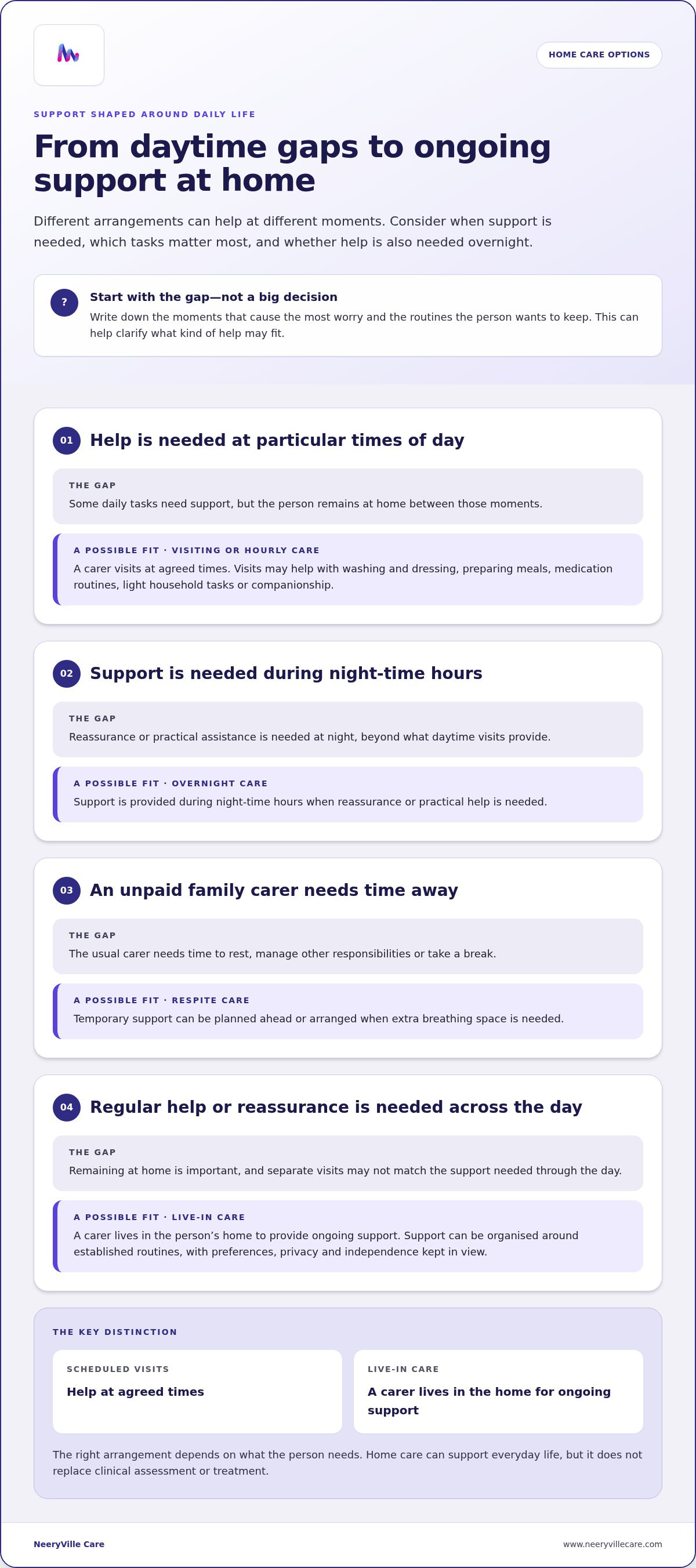
There isn’t one arrangement that suits every family. Care options when you can't cope anymore range from planned help at particular points in the day to more continuous support at home. Start by considering when help is needed, what tasks would make the biggest difference, and whether support is also needed overnight.
What can visiting, overnight and respite care provide?
Visiting or hourly care involves a carer coming at agreed times. Visits may support a person with washing and dressing, preparing meals, medication routines, light household tasks or companionship. This can suit needs that arise at particular times of day, while the person remains at home between visits.
Overnight care provides support during night-time hours when reassurance or practical assistance is needed beyond daytime visits. Respite care is temporary support that gives an unpaid family carer time away to rest, attend to other responsibilities or take a break. It can be planned ahead or arranged when the usual carer needs extra breathing space. These arrangements may complement help from relatives, a GP, community health professionals or local authority adult social care, depending on the person’s circumstances.
A scheduled visit brings help at agreed times; live-in care means a carer lives in the person’s home to provide ongoing support. This distinction can help families decide whether needs are occasional and predictable or arise regularly throughout the day and night.
When might live-in care be worth considering?
Live-in care may be worth exploring when a person needs regular assistance, companionship or reassurance across the day, and remaining at home is important to them. A carer living in the home can provide a more sustained presence than separate visits, with support organised around established routines. The person’s preferences, privacy and independence remain important parts of planning the arrangement.
Care at home can sit alongside family involvement and appropriate health or social care input. It doesn’t replace clinical assessment or treatment, and the right support depends on what the person needs. NeeryVille Care provides live-in care across England for people who need regular support at home.
You don’t need to decide on a long-term arrangement before talking through what is difficult. A calm conversation about the pressure points, daily routines and the person’s wishes can help clarify whether a visit, overnight support, respite or live-in care feels like a sensible next step. You can talk with NeeryVille Care to discuss home support without treating the conversation as a commitment.
How to compare care options without losing sight of what matters
Comparing care is less about finding one option that is “best” and more about matching support to the person’s daily pattern. Consider when help is needed, which tasks are difficult, how long they spend alone and whether they need reassurance at night. Mobility and familiar routines can also affect what feels comfortable at home.
This comparison can help you think through care options when you can't cope anymore. It’s a starting point, not a fixed decision. Needs and preferences can change, so an arrangement that works now may need adjusting later.
Which level of care fits the pattern of support needed?
If someone mainly needs help at agreed times, such as preparing for the day or settling in the evening, visiting care may be a practical fit. If they need reassurance during the night, overnight support may be more relevant. Where assistance is needed regularly through the day, live-in care may be worth considering. NeeryVille Care provides Visiting Care in Highgate and surrounding North London within a five-mile radius.
Care intensity should follow the person’s assessed needs and preferences, not a one-size-fits-all idea of what a family ought to choose. The level of support can be reviewed as circumstances change, rather than treated as an irreversible decision.
What helps care feel personal and reassuring?
Bringing someone into the home can raise understandable questions about privacy, dignity and disruption. Talk about the person’s routines and wishes: how they like to start the morning, what support they welcome, and which tasks they prefer to do themselves. Small details can help care fit around the person, rather than make their day feel organised around care.
NeeryVille Care provides the same carer for every visit or every day, supporting familiarity and continuity. Clear communication about preferences and boundaries helps everyone understand what support should look like. Trust matters too; safeguarding and care standards are part of considering how a person’s wellbeing and dignity are supported at home.
What to do next when you need more support at home
You don’t have to map out every future need before asking for help. A useful first step is to make the day-to-day pressures easier to describe. Family observations can help shape an initial assessment, but they don’t predetermine what support will be right. Involve the person receiving care wherever possible, respecting their choices and privacy throughout.
How can you prepare for a care conversation?
A few notes can make a difficult conversation clearer. Focus on what happens in an ordinary week, rather than trying to create a perfect care plan. Include what is working well, too. This gives everyone a balanced picture of the person’s needs and the routines you want to preserve.
List tasks that feel difficult to manage, such as preparing meals, getting dressed or keeping track of daily routines.
Note the times when help matters most, including mornings, evenings or overnight.
Write down familiar routines, preferences, communication needs and any worries about accepting support.
With the person’s agreement, invite a trusted relative to share observations or help make notes.
Try to distinguish what you’ve directly noticed from what you’re concerned might happen. For example, “Mum needed help preparing lunch on several days this week” is more useful than a general feeling that everything is becoming unsafe. Specific examples help clarify where assistance may be useful without labelling or blaming anyone.
How can you make a first step feel manageable?
Choose one immediate pressure point to discuss first. Perhaps it’s the morning routine, a period when the person is alone, or the strain of providing support every evening. You can then explore whether a scheduled visit, overnight help, respite or more continuous support might address that need. Starting with one part of the day doesn’t mean ignoring other concerns; it makes the conversation easier to begin.
An initial assessment helps build a clearer picture of the person’s needs, preferences and household routines, so support can be considered in context. Share relevant observations, and make space for the person to explain what they would welcome or find uncomfortable. Their wishes may differ from a family member’s expectations, so listen carefully and discuss any concerns without rushing towards a decision.
NeeryVille Care can arrange care within 24 to 48 hours of the initial assessment anywhere in England. This gives families a practical route to explore support while keeping the conversation focused on what would help at home. If you’re also feeling depleted, your own wellbeing deserves attention; asking another trusted person to share the load can be a helpful first move.
You can take the next step at a pace that feels manageable, with no need to resolve every question at once.
How NeeryVille Care can help your family feel supported at home
Choosing support is personal. Your loved one may want to stay in familiar surroundings, keep their usual routines and have a say in how help is provided. NeeryVille Care is a directly employed, CQC-regulated care provider offering personalised home-based support. Families can talk through what feels difficult and what matters most, then explore an approach that respects the person’s dignity and choices.
What can families expect from NeeryVille Care?
Support is considered in the context of the person’s daily life. That might mean discussing which tasks they want help with, what they prefer to manage themselves and how support can fit around household routines. A conversation can also clarify what the family hopes will feel different, helping everyone focus on practical needs rather than making assumptions.
It’s natural to have questions about welcoming care into the home. Include the person receiving support in those discussions wherever possible, and let their preferences guide decisions about how help is provided. Families can share observations too, bringing together the different perspectives needed to consider a thoughtful plan.
How can you explore support without pressure?
A friendly conversation or care assessment gives you space to explain what is happening at home and discuss possible support. You can begin with one concern rather than trying to plan for every future need. Families in Highgate N6, Crouch End N8, Hornsey, Camden, Hampstead, Finsbury Park, Kentish Town, Tufnell Park, Haringey, North London, Hungerford, Chelsea, Kensington, Hillingdon, Enfield, Hackney, London and Angel can explore Live-In Care across England. Visiting Care is provided in Highgate and surrounding North London within a five-mile radius. You can also explore Live-In Care in London.
NeeryVille Care’s 14-Day Live Well at Home Guarantee means you can end care within 14 days with no notice and no fees if it isn’t right for you. This gives families a clear option if the arrangement doesn’t feel right, without requiring them to treat the first conversation as a permanent commitment.
Taking time to talk through what matters can make the next decision feel less daunting. Support should work for the person receiving care and the family around them.
Take the next step at a pace that feels right
Asking for help doesn’t mean you have to hand over every part of caring or decide your family’s future today. It can begin with one honest conversation about what feels hardest, what your loved one wants, and what would make home life more manageable. From there, you can consider care options when you can't cope anymore with greater clarity and without losing sight of the person behind the practical needs.
It’s also all right if your first step is simply gathering information or involving someone you trust. A thoughtful plan can take shape gradually, with your loved one’s dignity and choices kept at its heart. You don’t have to carry every concern alone.
Support can start with a conversation, not a commitment. Take things one step at a time, and remember that seeking help is a caring choice for your loved one and for you.
Frequently Asked Questions
What should I do first if I can’t cope with caring for a loved one?
Start by choosing one difficult moment to describe, such as meals being missed or evenings feeling unmanageable. Talk with your loved one and someone you trust, and note what would make that moment easier. If there’s immediate danger or a mental-health crisis, contact emergency services or use NHS urgent mental-health support. For ongoing practical concerns, consider what help could fit around the person’s wishes.
Can someone receive care at home instead of moving into a care home?
Home-based support may be suitable if the person’s needs and circumstances can be supported safely at home and this is what they prefer. Before deciding, consider how they manage daily tasks, what help they welcome and whether the home environment works for their needs. An assessment can help explore this. Home care is not a replacement for emergency services or clinical treatment when those are required.
What is the difference between visiting care and live-in care?
Visiting care centres on planned support during visits, while live-in care involves a carer living in the home. For instance, help with a particular morning task may call for a different pattern from support that is needed regularly throughout the day. NeeryVille Care’s Visiting Care is £28 per hour, fully inclusive. Live-In Care is £190 per day, fully inclusive. Consider the person’s routine, how often help is needed and how they feel about having support at home when weighing up the options.
How quickly can NeeryVille Care arrange support?
NeeryVille Care can arrange care within 24 to 48 hours of the initial assessment anywhere in England. The assessment helps the team understand the situation and consider the support needed. For urgent situations, the team responds as quickly as possible. Immediate danger or a clinical emergency requires emergency services, not a home-care arrangement.
Will the same carer visit every time?
Yes. NeeryVille Care provides the same carer for every visit or every day, helping your loved one build familiarity and continuity. Share what helps them feel at ease, how they prefer to communicate and any concerns about welcoming support at home so care can reflect their preferences.
Is it selfish to ask for respite care when I’m struggling?
No. Taking a break doesn’t mean you care any less or have failed your loved one. Respite can give you time to rest, manage other responsibilities or spend time with family and friends. To help the break feel reassuring, share useful information with the person supporting your loved one, such as preferred routines, ways to communicate and what helps them feel settled.
Does NeeryVille Care provide Visiting Care throughout England?
NeeryVille Care provides Visiting Care in Highgate and surrounding North London within a five-mile radius. Live-In Care is available across England. Families in areas such as Highgate, Camden or Hampstead can discuss their day-to-day needs and location together in an initial conversation.
What happens if live-in care does not feel right within the first two weeks?
NeeryVille Care’s 14-Day Live Well at Home Guarantee means you can end care within 14 days with no notice and no fees if it isn’t right for you. If something is concerning you, share specific examples with the care team so the issue is clear and the family can decide what feels appropriate.