24/7 On-Call Support from a Care Agency: What Should Families Expect?


What does “24/7 support” mean in practice: can you contact someone for guidance, or is a carer also present in the home? When care needs change after hours, knowing the difference helps families plan. People looking for 24/7 on-call support from care agency teams need clear details about who they can contact, what help is available and whether a carer lives in the home.
It’s understandable to want reassurance that your loved one has support when routines change, and to value seeing a familiar face. An on-call contact and a carer living in the home are different arrangements. The right option depends on the person’s needs and the kind of support your family is looking for.
This article explains what round-the-clock on-call support can mean, what to clarify when comparing care arrangements, and how continuity can make support feel more familiar. At NeeryVille Care, live-in care means a carer resides in the home, with 24/7 availability included. The same carer is provided every day, helping build familiarity and a steady relationship. NeeryVille Care is a CQC-regulated home care provider, offering families a clear starting point for understanding support at home.
Table of Contents
Why 24/7 on-call support from a care agency matters to families
Not knowing whom to contact when a loved one needs help can leave families feeling unsettled, especially if they live some distance away. A change in someone’s usual routine, a new difficulty getting ready for bed or a question about medication support can raise concerns outside ordinary office hours. These situations don’t always mean there’s an emergency. But understanding the care arrangement and how to reach the right person can make planning feel clearer.
The phrase 24/7 on-call support from care agency can describe different arrangements. Generally, it means a contact is available outside usual hours for care-related queries or concerns, within an agreed scope. The phrase alone doesn’t explain whether a carer lives in the home, what support is available or how a concern will be handled. Those details matter when you’re comparing care options.
When families start looking for round-the-clock support
Support needs may shift gradually. Someone who usually manages their evening routine might begin needing help with personal care or settling comfortably for the night. A relative living elsewhere may wonder how to respond if plans change, or whether they can reach someone familiar with the care arrangement. Clear information gives families a practical point of reference while keeping the person’s preferences, privacy and independence at the centre.
What reassurance should mean in a care arrangement
Reassurance comes from knowing who takes a call, what support they can provide and what happens next. Availability and in-person care are different parts of an arrangement, so check what each means in practice. An on-call contact is not an emergency medical service. If someone is in immediate danger or needs urgent medical attention, call 999.
In plain English, on-call support means having an agreed way to contact a care provider outside usual hours, with clear information about the help available. Before relying on an arrangement, understand the contact details, operating hours, concerns covered and whether the response involves guidance, coordination or a visit. Specific expectations help everyone know what to do.
Home care can involve different forms of practical and personal support, as outlined in this general overview of home care services. The arrangement that suits someone depends on their circumstances and the support they need at home. For families in the capital exploring care with a carer living in the home, NeeryVille Care offers live-in care in London. Understanding what the arrangement includes is a useful first step towards making a decision that respects the person’s dignity and familiar routines.
What 24/7 on-call support means alongside live-in care
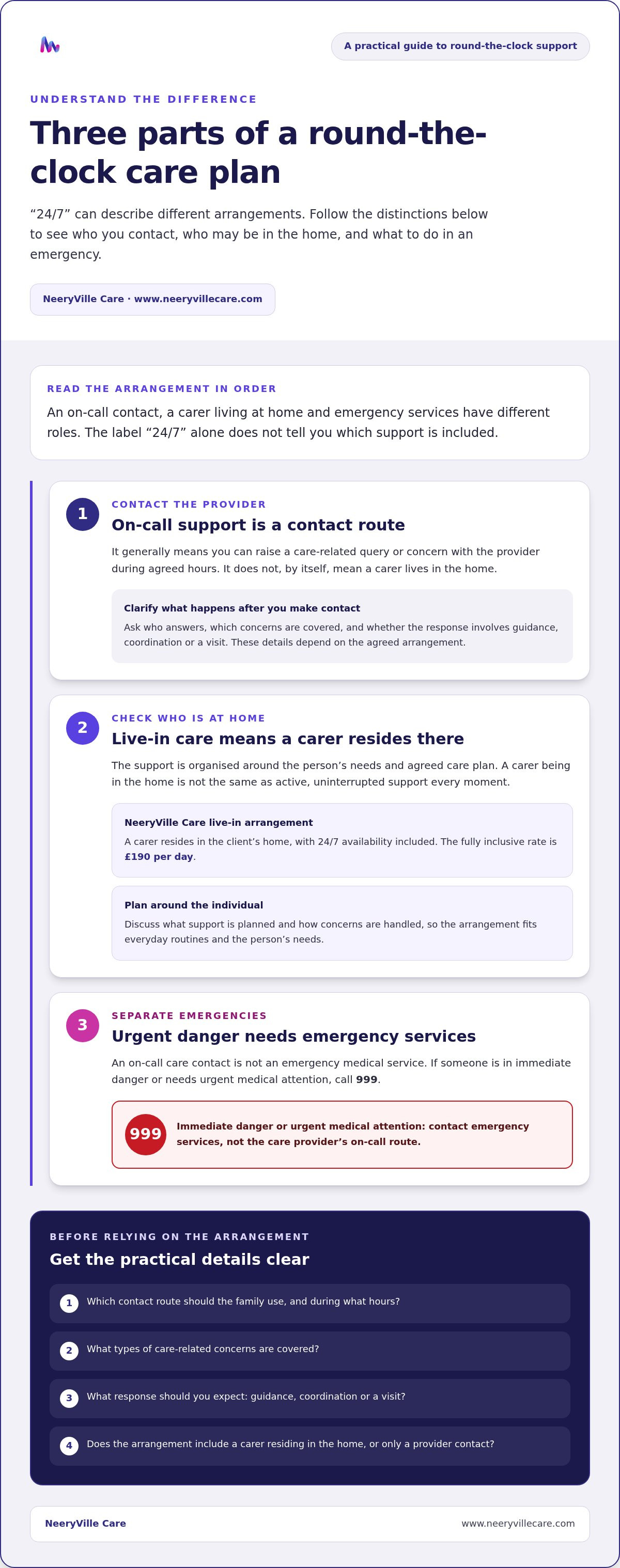
“Round-the-clock care” can refer to different kinds of support. Phone-based on-call support provides a way to contact a care provider during specified hours. Live-in care means a carer resides in the person’s home, with the support organised around the individual’s needs and care plan. Knowing which arrangement is being discussed helps families understand what to expect day to day.
That distinction matters because families need to know what support looks like in practice, not just how it is labelled. The phrase 24/7 on-call support from care agency doesn’t explain who answers, what help is available or whether the arrangement includes a carer in the home. Ask for clear details about contact routes, the support provided and how care is planned, rather than relying on the words “24/7” alone.
On-call contact, live-in care and emergency attendance
Think of these as distinct parts of a care plan. An on-call contact gives families a route to raise a care-related concern. A live-in carer resides in the home as part of the agreed arrangement. Emergency services respond to immediate danger or medical emergencies. If someone is in immediate danger or needs urgent emergency help, call 999 rather than relying on a care contact.
It’s also helpful to understand that a carer being in the home is not the same as active, uninterrupted support every moment. Live-in care is organised around the person’s needs and agreed care plan. Discuss what support is planned and how concerns are handled, so the person and their family know how the arrangement fits everyday life.
What NeeryVille Care means by live-in support
With NeeryVille Care’s live-in care, a carer resides in the client’s home. The service includes 24/7 availability, and the fully inclusive rate is £190 per day. This is a live-in arrangement, with care shaped around the person’s needs and agreed plan.
Live-in care is available across England. For families in London, live-in care in London can support someone to remain in familiar surroundings, with their routines and personal preferences part of everyday life. The key practical difference is that a carer lives in the home, rather than support being limited to contact with a provider by phone.
Before settling on an arrangement, write down the situations that cause the most uncertainty, such as changes to an evening routine or a need for more help at home. This gives the care discussion a useful starting point. Families considering how live-in care could fit their circumstances can talk with NeeryVille Care about their needs and the next steps.
How to compare 24/7 care agency support with confidence
A useful comparison focuses on what the arrangement provides, not just the phrase “24/7”. Write down the contact route, the hours covered, the type of support offered and what happens when someone gets in touch. Check whether in-person care is part of the plan, and how it is organised.
Use these points to make the differences easier to see:
Live-in care means a carer resides in the home; out-of-hours contact means there is an agreed route to reach the care provider. They have different roles, so look at how each fits the person’s needs and the wider care plan. The phrase 24/7 on-call support from care agency is useful only when families understand the practical details behind it.
Questions that clarify the scope of availability
As you compare arrangements, establish when support is available, how contact is made and what happens after a concern is raised. Does the arrangement include guidance, planned care at home or attendance? These distinctions help you understand what support can offer when a routine changes, rather than treating “24/7” as a complete description of the service.
Continuity, oversight and trust
Continuity matters in small, everyday ways. A carer who understands someone’s preferences, usual routine and how they like support offered can help care feel more familiar and respectful. NeeryVille Care directly employs its carers and provides the same carer every day for live-in care, supporting a consistent relationship at home.
Regulation is another useful part of the picture. NeeryVille Care is regulated by the Care Quality Commission (CQC), the independent regulator of health and social care in England. CQC regulation is relevant when considering provider oversight, alongside the details of the individual’s care plan. Look for clear, person-centred arrangements: who provides support, how it fits the person’s needs and what the family can expect.
A practical checklist for arranging round-the-clock home care
Taking the next steps can feel more manageable when you break them into a few clear stages. You don’t need to have every detail worked out before beginning. Start with what would help your loved one feel comfortable and supported at home, then use the assessment to shape a suitable arrangement.
Describe what daily life looks like. Note routines, support needs and the times of day that are most difficult. Include personal preferences, such as how your loved one likes help with personal care, meals or getting ready for bed.
Arrange an initial assessment. Discuss the person’s needs, home environment and priorities. This helps shape a personalised care arrangement around the individual, rather than relying on a generic schedule.
Review the care details and quote. NeeryVille Care provides care details and a personalised quote before an agreement, so you can understand the proposed support and its cost.
Agree the plan and timing. Once the details are understood and agreed, the next steps can be organised. Care is generally arranged within 24 to 48 hours of the initial assessment anywhere in England. Urgent situations are handled as quickly as possible.
Prepare for the initial care assessment
A few notes can help you explain the situation clearly, especially if several family members are involved. Describe what the person manages independently, where they need assistance and what helps them feel at ease. Mention changes in routine or support needs, too. These details help build a person-centred plan that respects the individual’s dignity, familiar habits and choices.
Check location, timing and the care guarantee
NeeryVille Care provides live-in care across England. Visiting care is available in Highgate and surrounding North London within a five-mile radius. The company’s local relevance includes Highgate N6, Crouch End N8, Hornsey, Camden, Hampstead, Finsbury Park, Kentish Town, Tufnell Park, Haringey, North London, Hungerford, Chelsea, Kensington, Hillingdon, Enfield, Hackney, London and Angel. Visiting care coverage is specific to Highgate and surrounding North London, while live-in care is available across England. The fully inclusive rates are £190 per day for live-in care and £28 per hour for visiting or hourly care. Consider which pattern of support best fits the person’s day-to-day needs and home life.
The 14-Day Live Well at Home Guarantee means care may be ended within 14 days with no notice and no fees. This gives families a defined period to consider how the arrangement fits the person’s routines and preferences.
As you plan, keep a short list of questions about the care plan, timing and the difference between availability and attendance. Clear expectations help families understand the arrangement and the support it provides.
How NeeryVille Care provides clear, consistent support at home
Families need more than reassuring language. They need to understand who will provide care, how the arrangement is organised and what it means day to day. NeeryVille Care is a CQC-regulated home care provider with directly employed carers. For families considering 24/7 on-call support from care agency arrangements, it helps to understand how on-call contact differs from live-in care, where a carer resides in the home and 24/7 availability is included.
NeeryVille Care is listed on NHS Find Care. Its Care Quality Commission (CQC) Provider ID is 1-21254500455. CQC regulation is relevant to understanding provider oversight in England, alongside the practical details of an individual’s care plan. Clear planning, safeguarding and consistent relationships all matter when support takes place in someone’s own home.
A consistent, regulated approach to care
For live-in care, the same carer is provided every day; for visiting care, the same carer is provided every visit. Familiarity can help a person feel more at ease with everyday support, from maintaining routines to sharing personal preferences. It also gives the carer a chance to learn what matters to the individual, helping keep care centred on their needs and dignity.
Safeguarding is an important consideration in any home care arrangement. NeeryVille Care’s guidance on safeguarding at home explains its approach to protecting people receiving care. Families can consider this alongside the proposed care plan to understand how support is intended to respect the person’s wellbeing and choices.
NeeryVille Care’s live-in care includes 24/7 availability in the fully inclusive daily rate. The care plan explains how support is organised around the person’s needs, daily routines and preferences. Families can discuss those practical details as part of arranging care.
Take the next step at your own pace
You can begin by describing the support your loved one needs and the routines they value. An assessment helps shape a personalised care arrangement, and care details and a personalised quote are provided before an agreement. A conversation can help clarify the options and give your family a clearer sense of what support at home could involve.
Make your next care decision with confidence
Choosing support for someone you love doesn’t mean you have to resolve every uncertainty at once. A useful next step is to focus on what would help them feel comfortable at home, what matters most to their daily routine and what your family needs to understand before deciding.
Clear expectations around 24/7 on-call support from care agency arrangements can help you talk through those priorities calmly. Raise the questions that matter most, consider how different support could fit your loved one’s life and take time to decide what feels right. The conversation can start with your family’s circumstances and the person’s preferences.
There’s no need to have all the answers before reaching out. A conversation with NeeryVille Care can help make the next step clearer and keep your loved one’s wishes at the heart of the decisions ahead.
Frequently Asked Questions
Does 24/7 on-call support mean a carer is physically present all day and night?
No. The phrase 24/7 on-call support from care agency usually refers to the availability of a contact, not necessarily a carer living in the home. Live-in care is a distinct arrangement in which a carer resides in the person’s home, with support organised around their needs and care plan. Check what the arrangement includes, who provides support and how planned care is organised.
What should I do if there is a medical emergency while someone is receiving home care?
If someone is in immediate danger or appears to need urgent medical attention, call 999. Emergency services are the right route for an emergency. If the situation isn’t an emergency but care needs have changed, follow the agreed care plan and use its stated contact route. Keep emergency details accessible to family and anyone involved in care.
Can live-in care be arranged anywhere in England?
Yes. NeeryVille Care provides live-in care across England for people who want support at home. Following the initial assessment, care is generally arranged within 24 to 48 hours. The assessment gives the family and care team a chance to discuss daily routines, the help needed and personal preferences, so the proposed arrangement reflects the individual.
How quickly can NeeryVille Care arrange live-in support?
NeeryVille Care can generally arrange care within 24 to 48 hours from the initial assessment. Urgent situations are handled as quickly as possible. To make the assessment useful, prepare an account of the support needed, any changes prompting the request and the person’s preferred routines at home.
Will my loved one have the same carer each day?
Yes. NeeryVille Care provides the same carer every visit for visiting care or every day for live-in care. Familiarity can help a person share preferences, maintain familiar routines and feel recognised during personal support. Families can share the person’s preferences as part of care planning.
What does the 14-Day Live Well at Home Guarantee cover?
The 14-Day Live Well at Home Guarantee allows care to be ended within 14 days with no notice and no fees. It gives families a defined period to consider whether the arrangement feels right in practice and how the support fits the person’s daily life and preferences.
Is visiting care available across England as well?
No. Visiting care is available in Highgate and surrounding North London within a five-mile radius. NeeryVille Care’s live-in care, by contrast, is available across England for people who need a carer residing in the home. This distinction helps families identify which type of support is relevant to the person’s location and needs.