

Private Home Care Providers UK: A Family Guide to Choosing Quality Support in 2026


Last Tuesday, Sarah sat at her kitchen table at midnight, staring at a spreadsheet of private home care providers UK that felt more like a list of strangers than a solution for her father. It's a heavy moment when you realise that the village you need to support an ageing parent isn't there yet. The pressure to choose correctly feels absolute. You aren't just looking for a service; you're looking for a partnership that protects your family's peace of mind and preserves their dignity.
We understand that the fear of the unknown often clashes with the urgent need for help whilst you search for a solution. You want a familiar face who knows exactly how your mum takes her tea and when she needs a quiet word of encouragement. This guide will help you cut through the confusion to find high-quality, regulated support that prioritises dignity and independence. We'll explain the difference between managed agencies and introductory platforms, what the 2026 CQC regulatory shifts mean for your safety, and how to build a care plan that evolves as your loved one's needs change.
Table of Contents
What are Private Home Care Providers in the UK?
Private home care providers UK represent a bridge between clinical safety and the warmth of a person's own living room. Unlike institutional settings, this model focuses on delivering professional support directly to a person's residence. It’s about more than just tasks. It’s about preserving the rhythm of a life already built. According to the foundational structure of Home care in the United Kingdom, these services provide essential help with daily living whilst allowing individuals to remain in their communities. This domestic setting offers a level of comfort that a clinical facility simply cannot replicate.
For many families in 2026, the choice between local authority-funded care and self-funded private care is often dictated by financial thresholds. In England for the 2026-2027 financial year, the capital limits for local authority funding remain at £23,250. If your loved one has assets above this upper limit, they're typically expected to self-fund. Choosing a private provider gives families the power to select specific carers and set schedules that suit their domestic routines, rather than being limited by the constraints of state-allocated resources. It offers a sense of control during a time that often feels chaotic.
The Shift Toward Person-Centred Home Support
Independence isn't just about doing things alone. It's about having the choice to stay amongst your own memories. We've seen a significant move away from the rigid, institutional schedules of residential care homes. Families now prioritise bespoke care plans that respect a person's history. Staying at home means keeping your pets, sleeping in your own bed, and seeing your garden through your favourite window. This person-centred approach ensures that elderly care at home is a partnership that values the individual over the process. It’s about dignity, not just duty.
Key Responsibilities of a Private Care Provider
A quality provider balances domestic help with clinical vigilance. This holistic support ensures that safety never comes at the expense of comfort. Key responsibilities include:
Personal care: Gentle, professional assistance with showering, dressing, and grooming with absolute dignity.
Domestic support: Light housekeeping and preparing nutritious meals that align with personal tastes.
Clinical oversight: Managing essential medication support and monitoring health changes to prevent hospital readmissions.
Companionship: Providing emotional stability through companionship care at home to reduce isolation.
By handling these practicalities, private providers lift the heavy burden of caregiving from family members. This allows you to return to being a daughter, a son, or a spouse again. The focus shifts from managing a crisis to enjoying meaningful time together.
Managed Care vs Introductory Agencies: Understanding the UK Models
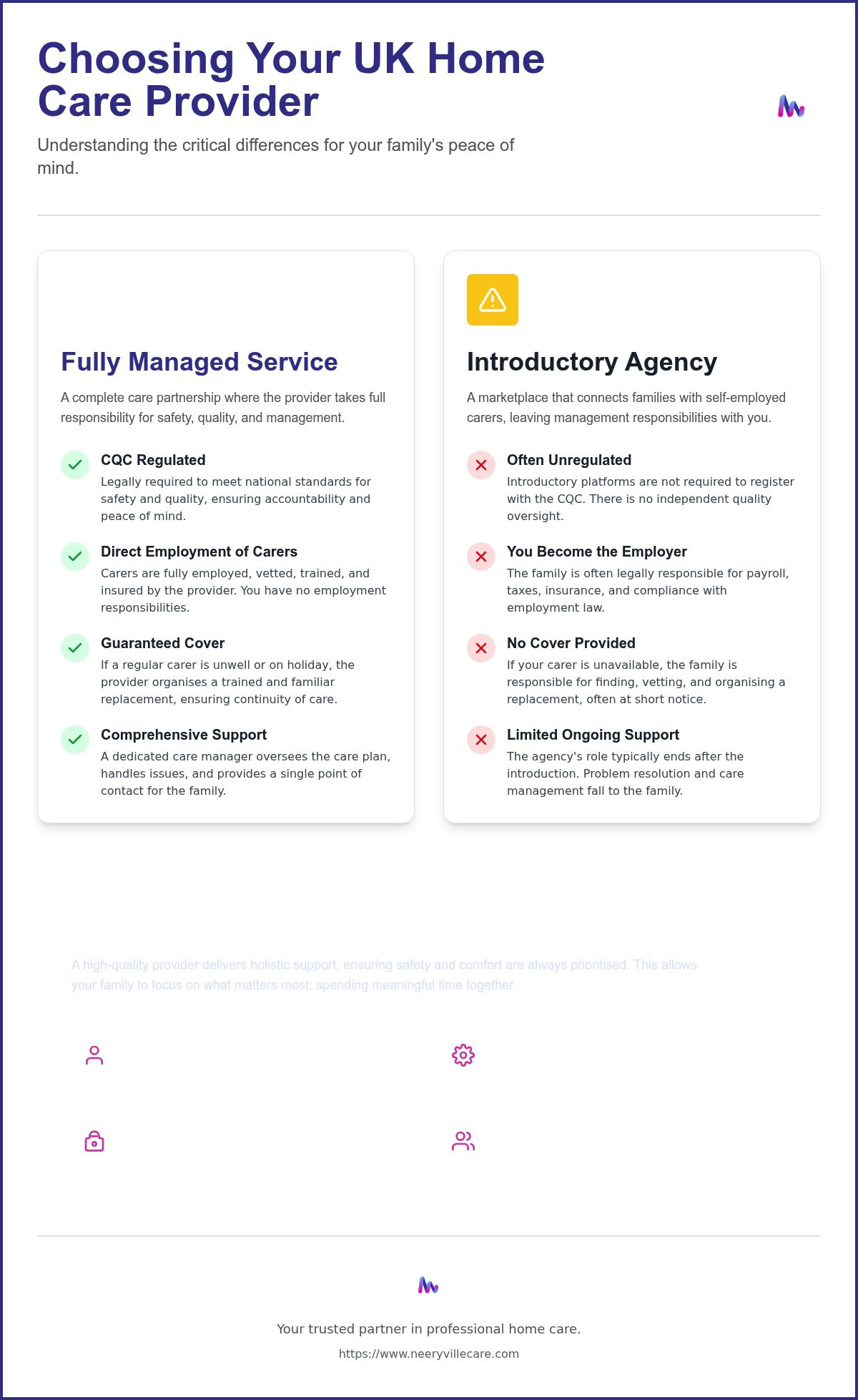
Searching for private home care providers UK often leads to a confusing mix of "care platforms" and "fully managed agencies". The difference between these two models isn't just administrative; it's a fundamental shift in where the legal and safety responsibilities lie. When you choose a provider, you're deciding who oversees the quality of care and who manages the risks. Understanding this distinction is the first step toward securing a stable future for your family.
Introductory agencies act as a marketplace. They connect you with self-employed carers but don't manage the care delivery itself. This often leaves the family as the "de facto" employer. You might find yourself responsible for payroll, checking insurance, and finding a replacement if your carer is unwell. This creates a significant emotional and legal burden during a time when you already feel overwhelmed. In contrast, a managed service handles every detail. They directly employ their staff, ensuring that your loved one receives consistent, professional support without you having to manage the logistics of employment law.
The Safety Net of CQC Regulation
Regulation is the bedrock of trust. In 2026, the Care Quality Commission (CQC) is transitioning toward new sector-specific frameworks, replacing the older assessment styles with 24 Key Lines of Enquiry (KLOEs). These inspections ensure that providers are safe, effective, caring, responsive, and well-led. Adhering to the NICE quality standards for home care ensures that the support provided is not just safe, but truly person-centred. A regulated provider must prove they meet these high bars, giving you a transparent record of their performance and safety history.
Managed Care: Why Direct Employment Matters
Direct employment creates a culture of accountability. When a provider employs their own carers, they can invest in continuous professional development and specialist training for complex conditions. This model includes a dedicated Care Manager who supervises the quality of every visit. They act as your primary point of contact, adjusting the care plan as your loved one’s needs evolve. This oversight ensures that the relationship between the carer and your family remains healthy and professional. It provides the stability of live-in care at home in England without the stress of managing staff yourself.
If you're feeling unsure about which model best fits your family's situation, we're here to help you discuss your options with a compassionate expert. Choosing the right structure today prevents a crisis tomorrow.
Specialist Care Services: Beyond Basic Companionship
Specialist care is the point where domestic help evolves into a clinical partnership. It's often the moment families realise that a friendly visitor, whilst lovely, isn't enough to manage the complexities of a chronic condition. Reliable private home care providers UK bridge this gap by offering experts trained in specific medical requirements. Whether it's managing the motor fluctuations of Parkinson’s or supporting the delicate recovery process after a stroke, the goal is always the same. We aim to keep your loved one safe in the place they love most.
Isolation is a silent challenge, particularly amongst the elderly in busy areas like Highgate and Hampstead. Companionship isn't just about presence; it's about meaningful engagement that keeps the mind active and the spirit lifted. This support also extends to you. Respite care serves as a vital safety valve for family caregivers, providing a necessary break to prevent burnout. It’s okay to step back for a few days, knowing a professional is maintaining the high standards you've set for your parent’s well-being.
Specialist Dementia Care at Home
Living with cognitive decline requires a unique blend of patience and clinical understanding. Behaviour that might seem challenging is often a form of communication, and our role is to translate those needs into comfort. Creating a safe domestic environment involves more than just removing trip hazards; it’s about establishing a predictable, calm routine that reduces anxiety. According to NICE guidelines, person-centred dementia care should involve treating the person with dementia as an individual, with dignity and respect, whilst taking account of their life history and personality. Our Dementia care at home ensures that this philosophy is lived out in every interaction, preserving the person behind the diagnosis.
Live-in Care: A Nationwide Solution for 24/7 Support
There comes a time when hourly visits can no longer guarantee the safety of a loved one, especially if they're prone to falls or confusion during the night. This is where the logistics of live-in support become a transformative solution. A professional carer resides in the home, providing an immediate presence that offers peace of mind for families who may live miles away. This model isn't just for individuals; live-in care for couples allows partners to stay together even when their health needs differ. By choosing Live-in care at home England, you ensure that high-quality, regulated support is available nationwide, maintaining the security of a familiar environment at every hour of the day.
The Cost of Private Home Care: Fees, Funding, and Value
Discussing the financial aspect of care often feels uncomfortable, yet transparency is the only way to build a sustainable plan. When you evaluate private home care providers UK, it's helpful to look beyond the initial hourly rate and consider the "Managed Care" safety net. A lower price often indicates an introductory model where the family takes on the legal risks of being an employer. In contrast, a regulated service includes the cost of specialist training, CQC compliance, and the constant oversight of a dedicated Care Manager. Paying for quality means you're investing in the stability of the relationship between the carer and your loved one.
The financial assessment process with your local authority is the first step in understanding your funding position. For the 2026-2027 financial year, the upper capital limit in England remains at £23,250. If your loved one’s assets exceed this threshold, they'll likely be responsible for self-funding their support. Whilst self-funding requires a larger initial commitment, it offers the highest level of control over who enters the home. It’s also important to recognise that the planned £86,000 care cap was cancelled in July 2024. This means there's currently no upper limit on lifetime care costs for self-funders, making it even more vital to choose a provider that offers long-term value and consistency.
Transparency in Care Fees
A professional provider should offer a clear, all-inclusive quote that leaves no room for guesswork. You shouldn't encounter hidden administration fees or unexpected charges for basic care planning. Fees generally vary based on the complexity of the medical needs and the timing of the visits. For instance, Overnight care Highgate involves a different structure than standard daytime help. Always ask if the quote includes the cost of holiday cover and whether there are premium rates for weekends. Clarity at the start prevents emotional stress later.
Exploring Funding Options in the UK
Even for those who self-fund, there are several UK benefits designed to lift the financial burden. Attendance Allowance is a non-means-tested benefit for those over state pension age who require help with personal care. It's an essential resource that many families overlook. Additionally, for individuals with complex health needs, NHS Continuing Healthcare (CHC) can cover the full cost of a care package. Although eligibility rates for CHC have fallen in early 2026, it remains a critical avenue for those with primary health needs. You can find the latest updates on social care charging and eligibility on the official gov.uk website.
Selecting Your Provider: The NeeryVille Care Partnership
Selecting a provider is more than an administrative choice. It's a commitment to your family's future. When evaluating private home care providers UK, you aren't just buying hours; you're inviting a partner into your home. We believe that care is most effective when it feels like a natural extension of your family. It starts with an initial care assessment. This isn't a simple checklist. It's a deep dive into your loved one's history, their favourite routines, and the small details that make them feel safe. By building a bespoke programme from the ground up, we ensure that the support provided is as unique as the person receiving it.
Bespoke Support in North London
Local presence is vital for effective domiciliary support. In areas like Crouch End and Camden, knowing the community helps us respond faster and more effectively. Our Visiting care Highgate service is built on this foundation of local responsiveness. If a crisis happens in the middle of the night, you need a team that knows the North London landscape as well as you do. We provide 24/7 responsiveness for local families, ensuring that you're never left to manage a sudden change in health alone. This immediate presence offers a sense of stability when you need it most.
The NeeryVille Care Promise
Our promise is built on the quality of our people. We don't use agency staff. Every carer is directly employed and rigorously vetted to ensure they share our values of dignity and compassion. We match carers to clients based on personality and shared interests, not just clinical skills. If your father loves gardening or classical music, his carer should too. This focus on emotional well-being helps prevent the isolation that often leads to a need for caregiver burnout support in London. We aren't just managing symptoms; we're supporting a life.
Taking that first step often feels like the hardest part. It's the moment you admit that things have changed. We're here to make that transition as gentle as possible. Choosing between private home care providers UK is a significant decision, and we're here to ensure you feel confident in your choice. Organising a compassionate conversation with our team isn't about signing a contract. It's about exploring what's possible. We'll guide you at a pace that feels right for you, offering the organised support you need and the caring touch your loved one deserves. Your family's peace of mind is our primary focus.
Securing a Brighter, Safer Future at Home
Choosing between private home care providers UK is a journey that begins with a single, courageous step toward support. You've explored the safety of managed care models and the peace of mind that comes from CQC regulation. You now understand that high-quality care isn't just about tasks. It's about a partnership that values your loved one's history and independence.
The right provider handles the heavy lifting of employment, training, and clinical oversight. This allows you to return to being a family member rather than a care manager. Whether you require specialist dementia support or the 24/7 security of live-in care, we're here to ensure safety never comes at the expense of domestic comfort. NeeryVille Care offers CQC-regulated excellence through our compassionate, directly employed local carers who are experts in dementia and live-in support.
You don't have to navigate these complexities alone. We're ready to walk this path with you at a pace that feels right for your family, offering a steady hand and a warm heart whenever you need us.
Frequently Asked Questions
Are all private home care providers in the UK regulated by the CQC?
No. Only managed providers that directly supervise and deliver care are legally required to be CQC-regulated. Introductory agencies and platforms that simply connect families with self-employed carers are not regulated by the CQC. NeeryVille Care is a CQC-regulated provider, ensuring we meet the fundamental standards of safety and quality. Choosing a regulated provider offers a legal safety net that unregulated platforms cannot provide, giving your family essential protection and peace of mind.
What is the difference between a care agency and a care platform?
A managed care agency like NeeryVille Care directly employs, trains, and insures its staff, taking full legal responsibility for the care provided. A care platform acts as a marketplace where you hire self-employed individuals. On a platform, you become the legal employer, handling payroll and vetting yourself. Managed agencies provide a dedicated Care Manager to oversee the service, offering a much higher level of safety and professional accountability for families across North London.
Can I get financial help from the government for private home care?
Yes, financial support is available depending on your assets and health needs. If your capital is below £23,250, your local authority may contribute via direct payments. You can also apply for non-means-tested benefits like Attendance Allowance. For those with complex health requirements, NHS Continuing Healthcare can cover the full cost. We always recommend checking the latest 2026 eligibility criteria on the official gov.uk website to understand your specific funding options.
How quickly can a private home care provider start service?
We aim to begin support as quickly as possible, often within 24 to 48 hours in urgent situations. The process starts with a comprehensive care assessment to ensure we match the right professional to your loved one’s needs. For families in Highgate or Hampstead facing a sudden hospital discharge, our local presence allows us to be highly responsive. We prioritise safety and a smooth transition, ensuring every detail is organised before professional care commences.
Is live-in care cheaper than a residential care home in London?
Live-in care is often more cost-effective than London residential homes, especially for couples who can share the cost of a single carer. Beyond the financial aspect, it offers the invaluable benefit of staying in familiar surroundings. You avoid the high overheads of a facility whilst receiving one-to-one attention. For many private home care providers UK, the fixed weekly fee for live-in support provides better long-term value and personal dignity than institutional settings.
What happens if my regular carer is unwell or on holiday?
As a managed provider, we guarantee continuity of care by providing a qualified replacement if your regular carer is unavailable. You won't be left to find cover yourself. We maintain detailed care plans so that any relief carer understands your loved one's specific routines and preferences immediately. This reliability is a core benefit of our managed service, ensuring that professional support remains constant and your family’s routine in North London is never disrupted.
How do I know if my loved one is safe with a private carer?
Safety is ensured through rigorous vetting, CQC regulation, and direct employment. Every carer at NeeryVille Care undergoes enhanced DBS checks and comprehensive training before entering a home. Because we're a managed agency, a Care Manager regularly reviews the service and conducts quality checks. This professional oversight, combined with the transparent feedback found in CQC inspection reports, provides the reassurance that your loved one is in safe, capable, and compassionate hands at all times.
Can a private home care provider help with medication and medical appointments?
Yes, our carers provide essential medication support and can accompany your loved one to medical appointments. We ensure that prescriptions are taken correctly and on time, reducing the risk of health complications. Our team also assists with the logistics of getting to GP surgeries or hospitals in North London, providing physical support and emotional reassurance throughout the journey. This holistic approach ensures that all health needs are managed professionally within a safe domestic setting.


