

Home Care in Hampstead: A Compassionate Guide for Families in 2026
- Daniel Johnson

- 1 day ago
- 12 min read
Updated: 4 hours ago

Table of Contents
What is Home Care? Understanding Domiciliary Support in Hampstead
For many families in Hampstead, the moment the need for care arises is one filled with uncertainty. You want to ensure your loved one is safe, supported, and happy, but the thought of them leaving their cherished NW3 home can be deeply distressing. This is where domiciliary care, often known as home care, offers a compassionate and empowering alternative. In essence, domiciliary care is professional, regulated support delivered within the familiar and comforting surroundings of a person’s own home. It is a service built on the belief that needing support should not mean sacrificing independence, dignity, or the life one has built in a community like Hampstead.
It’s about protecting the rhythm of a life well-lived—whether that involves a morning paper from a local newsagent, a familiar walk across Hampstead Heath, or simply enjoying the view from a window that has been looked out of for decades. For residents in the NW3 postcode, choosing home-based support over a residential facility is an increasingly common decision, driven by a desire to preserve a unique lifestyle and deep-rooted community connections.
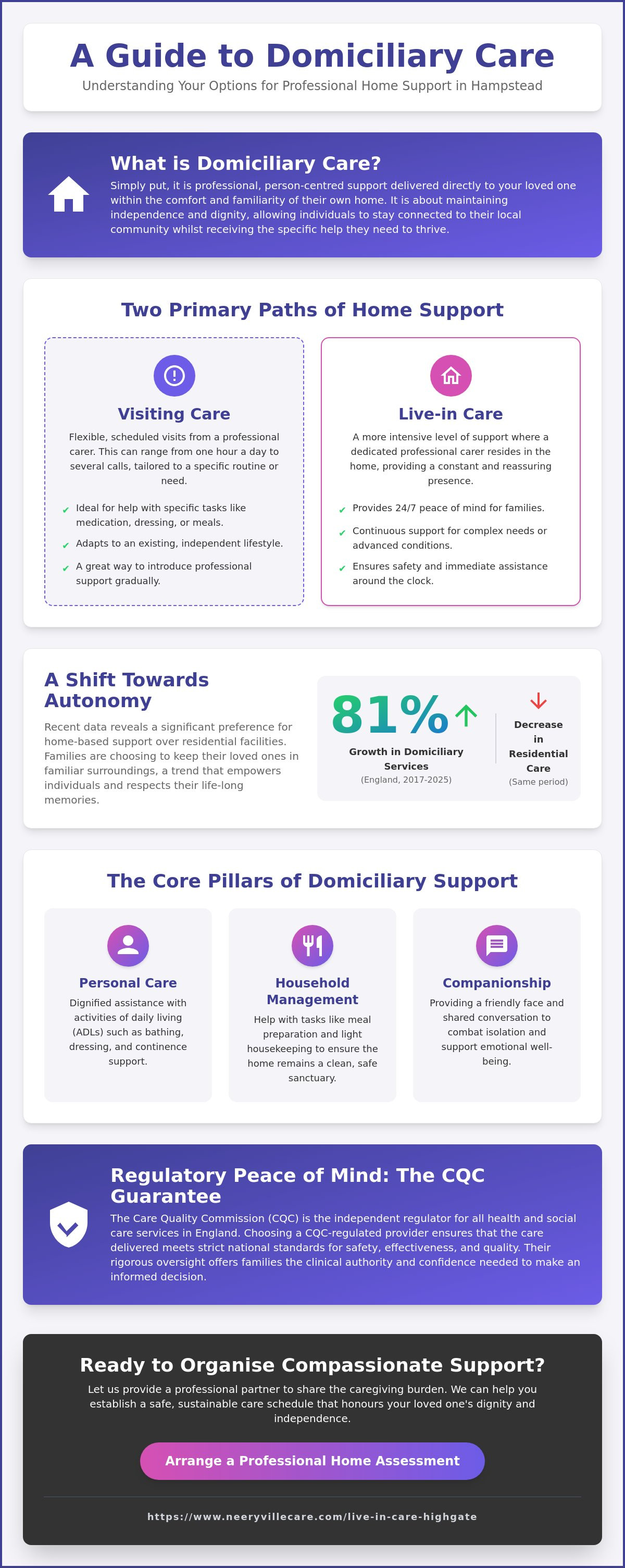
Definition of Domiciliary Care: Professional support for health and well-being, provided to an individual in their own home. This can range from a 30-minute visit to 24-hour assistance.
Visiting Care vs. Live-in Care: Visiting care involves scheduled visits from a carer at specific times of the day, whilst live-in care means a dedicated carer resides in the home, offering continuous support and companionship.
Why NW3 Residents Choose Home Care: It allows individuals to remain amongst their memories, maintain control over their daily routines, and stay connected to the vibrant Hampstead community they know and love.
The Role of the CQC: The Care Quality Commission (CQC) is the independent regulator of health and social care in England. They ensure that home care providers meet fundamental standards of quality and safety, giving families invaluable peace of mind.
The Core Pillars of Domiciliary Support
Domiciliary care is a holistic service designed to support every aspect of a person’s well-being. It is not just about managing clinical needs; it is about enhancing quality of life. The support is tailored to the individual, focusing on three core pillars:
Activities of Daily Living (ADLs): This forms the practical foundation of home care. It includes respectful and dignified assistance with personal routines such as bathing, dressing, grooming, and mobility support, ensuring comfort and safety at all times.
Household Management: A carer can help with the tasks that have become challenging, such as light housekeeping, laundry, preparing nutritious meals, and running local errands, perhaps to the shops on Hampstead High Street. This support helps maintain a clean, safe, and welcoming home environment.
Companionship and Well-being: Perhaps the most vital pillar, companionship combats the loneliness and isolation that can affect older adults. It is the shared cup of tea, the conversation about the day’s news, or the accompaniment to a local community centre that transforms care from a service into a meaningful human connection.
Regulatory Peace of Mind: Why the CQC Matters
When you invite a carer into a loved one's home, trust is paramount. The CQC provides the framework for that trust. As the official regulator, they inspect care agencies to ensure they are safe, effective, caring, responsive, and well-led. Choosing a CQC-regulated provider is non-negotiable for any family seeking quality care in Hampstead.
Understanding "Regulated Activities": The CQC monitors specific services, known as "Regulated Activities," which include personal care and medication management. This ensures that the most sensitive aspects of support are delivered to a high professional standard. For a deeper understanding, you can explore this guide to CQC regulated activities and safety standards.
How to Read a CQC Report: Every provider has a profile on the CQC website with their latest inspection report and rating—from 'Outstanding' to 'Inadequate'. This report offers transparent insights into an agency's performance, helping you identify the best home care providers in London.
The Importance of Clinical Oversight: High-quality domiciliary care involves more than just practical help. It requires clinical oversight, especially for complex conditions. This means care plans are often reviewed by a care manager or nurse to ensure they align with medical advice from local services like the Royal Free Hospital or the Hampstead Group Practice.
Tailoring Support: Home Care Services in Hampstead
The true power of domiciliary care lies in its adaptability. Unlike the one-size-fits-all approach of many residential homes, home care is meticulously tailored to the individual’s unique needs, preferences, and lifestyle. A care plan is not a static document; it is a living blueprint that evolves as a person's needs change, ensuring the support provided is always relevant, respectful, and effective. This personalised approach is crucial for integrating specialist support for conditions like dementia, Parkinson’s, or post-stroke recovery, whilst also preserving the unique "colour" of daily life that makes a person who they are.
Personal Care and Medication Management
Maintaining personal hygiene and managing medication are often the first areas where families notice a loved one needs help. Our approach is to provide this support with the utmost respect for dignity and privacy. Carers are trained to offer assistance discreetly and sensitively, empowering the individual to retain as much independence as possible. This might involve help with a morning shower or simply providing a steady hand. On the medication front, professional support ensures that complex regimes are followed correctly, preventing errors and providing families with profound peace of mind. Our carers regularly coordinate with local Hampstead pharmacies, such as the Boots on the High Street, and liaise with GP surgeries to ensure a seamless circle of care.
Respectful assistance with bathing, dressing, and grooming that always prioritises the client’s dignity.
Professional medication support, from gentle reminders to full administration, to ensure health and stability.
Close coordination with local healthcare networks, including Hampstead GP surgeries and specialists at the Royal Free Hospital.
Dementia Care at Home: A Familiar Environment
For someone living with dementia, the familiar sights, sounds, and layout of their own home can be a powerful anchor in a confusing world. Domiciliary care allows them to remain in this safe haven, which has been proven to reduce anxiety, agitation, and disorientation. A specialist dementia carer understands how to create a calm and supportive environment, using techniques to manage challenging behaviours like "sundowning" with patience and expertise. The goal is to maintain established routines that provide structure and comfort—whether it’s a daily walk across a particular part of Hampstead Heath, a visit to the Keats Community Library, or simply sitting in a favourite armchair with a view of the garden.
The therapeutic benefit of staying in a familiar home layout, reducing confusion for those with cognitive decline.
Specialist techniques to manage challenging behaviours with compassion and understanding.
Maintaining cherished local routines, such as walks to Parliament Hill or visits to nearby friends, to reduce disorientation.
Companionship and Social Well-being
Home care in Hampstead is about enabling a rich and fulfilling life, not just a safe one. Loneliness can have a devastating impact on health, which is why companionship is at the heart of our service. We take great care in matching our clients with carers who share similar interests, hobbies, and temperaments. This thoughtful pairing fosters genuine friendships built on mutual respect and shared enjoyment. A carer is more than a helper; they are a companion for a walk to a favourite café on Perrin's Court, a partner for a game of cards, or an escort for an afternoon visit to the historic Burgh House or Fenton House and Garden. This support helps maintain vital social connections and engagement with the vibrant local community.
Careful matching of caregivers and clients based on shared interests, from art and literature to gardening or history.
Supporting visits to local Hampstead landmarks, community centres, and social clubs to foster engagement.
Providing a friendly face and a listening ear, helping to lift spirits and promote positive mental health. If you are also considering support in nearby areas, you can learn more about our visiting care in Highgate and Hampstead.
Why Choose Home Care Over Residential Placement in NW3?
The decision between home care and a residential facility is one of the most significant a family can make. Whilst care homes provide a valuable service, the benefits of receiving one-to-one support in the comfort of one’s own Hampstead home are profound and far-reaching. It is a choice that prioritises emotional well-being, independence, and personal freedom, often proving to be a more flexible and cost-effective solution in the long run.
For many, their home is more than just bricks and mortar; it is a sanctuary filled with a lifetime of memories. Leaving that behind can be a traumatic experience. Home care honours this connection, allowing individuals to remain surrounded by their personal belongings, treasured photographs, and the simple comforts of their own space. It also means staying connected to the local community—the neighbours they’ve known for years, the friendly staff at the local shops, and the familiar routes to the park or the GP.
Emotional Well-being: The psychological benefit of remaining amongst one’s own belongings and memories is immeasurable.
Cost-Effectiveness: Comparing hourly domiciliary care rates to the high fixed fees of many London care homes often reveals home care as the more financially sustainable option.
Flexibility and Control: One-to-one care offers unparalleled flexibility compared to the generalised routines and fixed schedules of a residential facility.
Community Connection: Maintaining local ties and friendships in the Hampstead area is crucial for long-term happiness and a sense of belonging.
Preserving Independence and Autonomy
One of the greatest fears associated with ageing is the loss of independence. Domiciliary care is specifically designed to counter this. By receiving support at home, an individual remains in control of their own life. They decide when to wake up, what to eat for lunch, and how to spend their afternoon. This autonomy is fundamental to a person's sense of self and has a direct, positive impact on their mental and physical health. A carer is there to support their choices, not to make decisions for them. This empowers them to continue being the "master of their own home," a role that is vital for dignity and self-esteem.
The ability to choose meal times, wake-up routines, and daily activities without compromise.
How home care empowers seniors to direct their own support and live life on their own terms.
The proven link between personal autonomy, long-term mental health, and overall longevity.
One-to-One Attention vs. Staff Ratios
In a residential care home, staff must divide their attention amongst many residents, often leading to rushed interactions and a lack of personalised support. With domiciliary care, the focus is entirely on one person. This one-to-one attention allows for the development of a deep, trusting relationship between the client and their carer. The carer becomes intimately familiar with the client's needs, preferences, and personality, enabling them to provide truly person-centred support. This continuity of care is not only reassuring for the client but also for their family, who can rest assured that their loved one is in the hands of someone who genuinely knows and understands them. This consistent support is also crucial for family members, who often carry a heavy burden. We offer guidance on supporting family carers and preventing caregiver burnout.
The significant difference between a dedicated, consistent caregiver and a rotating team in a care home.
The opportunity to build a deep, trusting, and supportive relationship between the client and their carer.
The peace of mind that comes from knowing your loved one is receiving undivided attention and care.
How to Organise Domiciliary Care: A Step-by-Step Guide
Arranging home care for the first time can feel like a daunting task, especially during an emotional or stressful period. However, a reputable care provider will guide you through a clear and compassionate process, designed to make the journey as smooth as possible. The key is to start with a thorough assessment, collaborate closely with family, and understand the options available for funding and support. This structured approach ensures that the care plan is comprehensive, sustainable, and perfectly aligned with your loved one’s needs.
The Initial Assessment and Care Planning
The first step is always a detailed conversation. A professional care manager will visit your loved one’s home in Hampstead to conduct a no-obligation assessment. This is not just a clinical checklist; it is a warm and friendly discussion designed to understand the whole person—their health needs, their daily routines, their hobbies, and what matters most to them. This process is crucial for identifying not just the obvious needs, such as mobility support, but also the "hidden" ones, like nutritional gaps or potential trip hazards in the home. From this assessment, a personalised care plan is created, setting clear goals for the support, whether it's for post-operative recovery, long-term dementia care, or simple companionship.
What to expect during a professional home care assessment, which should always be collaborative and person-centred.
The importance of identifying subtle needs, such as social isolation or anxiety, alongside practical requirements.
Working together to set clear, achievable goals for the care (e.g., safely regaining the ability to walk to Hampstead Heath).
Funding and Care Costs in Hampstead
Understanding the financial aspect of care is a major concern for most families. A transparent provider will provide a clear breakdown of costs from the outset. Domiciliary care is typically charged by the hour, with different rates for weekdays, weekends, and bank holidays. It's important to ask about any additional costs, such as travel expenses. Families should also be made aware of potential state funding and benefits. This can include non-means-tested support like Attendance Allowance, which is designed to help with the extra costs of long-term illness or disability. A good care agency can signpost you to resources for navigating local authority financial assessments and understanding how concepts like the "Care Cap" might apply.
A clear breakdown of how home care is charged, whether hourly for visiting care or a fixed weekly rate for live-in care.
Information on valuable financial support, such as Attendance Allowance from the Department for Work and Pensions (DWP).
Guidance on where to find information about local authority funding and the national "Care Cap" regulations.
Selecting the Right Care Agency
Choosing the right agency is the most critical decision you will make. This is your partner in care, and you need to feel confident in their professionalism, compassion, and reliability. When you make your first call, be prepared with a list of questions. Ask about their CQC rating, their carer recruitment and training processes, and their experience with specific conditions like dementia or palliative care. Do they have deep knowledge of the Hampstead area? How do they handle emergencies or situations where the regular carer is unwell? A reputable agency will welcome these questions and answer them with transparency and confidence. They should make you feel heard, understood, and reassured from the very first interaction.
Key questions to ask a Hampstead care company during your initial enquiry.
The importance of checking for specific experience relevant to your loved one’s condition.
Exploring different types of support, such as dedicated home help services for local residents, can provide a clearer picture of what is available.
NeeryVille Care: Compassionate Domiciliary Support in Hampstead
At NeeryVille Care, we understand that arranging care is not a transaction; it is a profound act of love and trust. Our mission is to honour that trust by providing exceptional, person-centred home care to families across Hampstead and North London. We believe that domiciliary care is about protecting lifestyle and dignity, enabling our clients to continue living joyful, independent lives in the homes they cherish. As a CQC-regulated provider with deep local roots, we combine clinical excellence with a heartfelt, compassionate approach.
We see our role as lifting the burden from family carers, allowing them to step back from the practical demands of caregiving and simply be a daughter, a son, a partner, or a friend again. We handle the logistics, the planning, and the delivery of care with unwavering professionalism, so you can focus on what truly matters: spending quality time with your loved one. Our local presence means we can offer rapid response times, implementing care swiftly and efficiently in urgent situations to provide immediate safety and reassurance.
The NeeryVille Difference: Professionalism with Heart
What sets NeeryVille Care apart is our commitment to providing care that is not only safe and effective but also genuinely warm and kind. We are meticulous in our caregiver selection, choosing only those individuals who demonstrate natural empathy, patience, and a true passion for helping others. Every member of our team undergoes rigorous background checks and receives ongoing, specialist training in areas such as dementia care, medication management, and end-of-life support. We place as much emphasis on a client's emotional well-being as their physical needs, understanding that a friendly chat and a reassuring presence are just as important as practical assistance. The positive feedback and testimonials from families in Hampstead and Highgate are a testament to this compassionate, professional approach.
Our rigorous caregiver selection process and continuous specialist training programmes.
A philosophy that balances practical, professional assistance with genuine emotional support and companionship.
A proven track record of positive testimonials from families across the NW3 and N6 postcodes.
Starting Your Journey with Us
Taking the first step is often the hardest part, and we are here to make it as simple and stress-free as possible. We invite you to contact our friendly team to discuss your family’s situation. We can answer your questions, listen to your concerns, and arrange a no-obligation home consultation at a time that is convenient for you. During this meeting, we will get to know you and your loved one, understand your unique needs, and explain how we can help. We operate with complete transparency regarding our fees and care delivery, ensuring you have all the information you need to make the right decision for your family. Let us be your trusted partner in care, providing the compassionate support your loved one deserves.
Book a no-obligation home consultation today to discuss your needs with our compassionate care team.
Our promise of complete transparency regarding fees, care plans, and service delivery.
Explore our full range of services, including dedicated live-in care services for Highgate and Hampstead for those requiring 24-hour support.


Comments