

London Care Costs: Highgate Home Care Pricing Guide
- Daniel Johnson

- 8 hours ago
- 12 min read
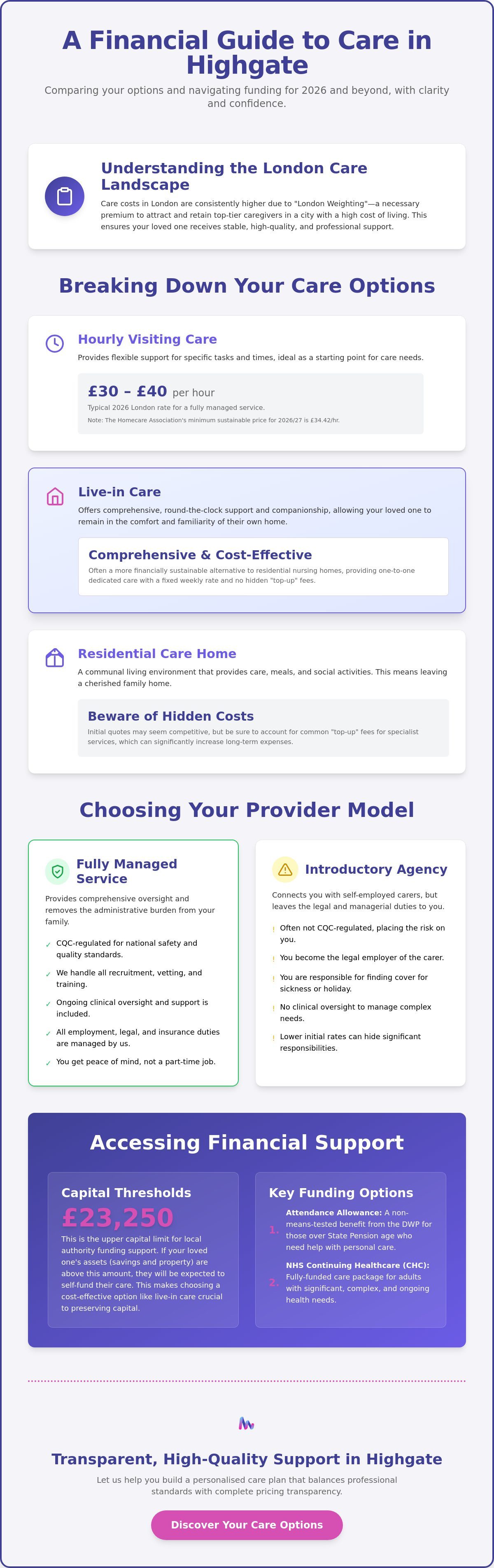
Choosing a residential care home in Highgate might seem like the only practical path when a loved one's needs increase, yet for many families, managed live-in care is often the more sustainable way to preserve both your family's capital and your parent's dignity. We understand that researching London care costs feels overwhelming, especially with the 2026 means-testing thresholds and the fear of hidden agency fees that can suddenly appear. It is a time of significant worry; you deserve a guide that offers clarity instead of confusion.
We agree that the current social care system feels complex and high-pressure. You want to keep your loved one safe in the home they love, but the financial path isn't always clear. This guide provides an expert breakdown of home care fees, residential comparisons, and the essential financial support available to Highgate residents. We will explore the differences between weekly and hourly costs, explain how the £23,250 capital limit affects your choices this year, and show you how to access Attendance Allowance or NHS funding to ensure your family stays together safely.
Table of Contents
Understanding the London Care Landscape in 2026
Finding care for a family member in North London isn't just about finding a service; it's about finding peace of mind in a city where everything moves fast. It is a reality that London care costs consistently track higher than the rest of the UK. This isn't a random surcharge. It is driven by the "London Weighting" needed to attract and keep the very best caregivers in a city with exceptional living expenses. With the National Living Wage rising to £12.71 in April 2026, professional providers must ensure staff are fairly compensated to maintain the quality of life your loved one deserves. You aren't just paying for a set of tasks. You're investing in a person's presence, their skill, and their commitment to your family's safety.
Local demand in Highgate and Hampstead often influences service availability. These are sought-after areas where the standard of support is expected to be high. At NeeryVille Care, we distinguish ourselves from introductory agencies. While those platforms might offer lower initial rates, they often leave the legal and financial burdens of being an employer on your shoulders. We provide a fully managed, CQC-regulated service. This means we take care of everything. We handle the recruitment, the training, and the ongoing clinical oversight, so you can simply be a daughter or a son again.
The Cost of Living Factor in North London
Highgate presents unique logistical challenges. In the N6 postcode, property values and local amenities influence everything from travel times to caregiver availability. When care is priced suspiciously low, it often points to high staff turnover. This creates a cycle of strangers entering your home. For a senior, this is the opposite of the stability they need. Choosing a provider that understands the local landscape ensures your carer isn't just a visitor. They are a consistent, familiar presence who knows your kitchen, your routine, and your history. High property values in North London also correlate with higher care home fees, making live-in care in Highgate a financially savvy alternative that keeps your loved one in their cherished environment.
Regulatory Standards and Fee Transparency
When you review a quote, you're paying for more than just time. You're investing in clinical oversight and rigorous training. This is a vital distinction. For a clearer picture of how these systems are structured, you can read this Overview of Social Care in England. CQC regulation is your primary protection. It ensures that the care provided meets strict national standards for safety and effectiveness. We believe in absolute transparency. We strip away the anxiety of hidden costs. You won't find unexpected assessment fees or confusing mileage premiums here. Whether you need support with personal care or medication, you deserve a partner who prioritises emotional well-being. Safety isn't just about physical help. It's about the security of knowing exactly what you're paying for, with no surprises on the horizon.
Breaking Down Home Care Fees: Hourly vs Live-in Support
Deciding between visiting support and full-time assistance is a significant milestone for any family. It requires a delicate balance of emotional readiness and financial planning. Understanding the structure of London care costs is the first step toward reclaiming a sense of control during what can be an overwhelming time. Whether your loved one needs a few hours of help with meal preparation or the constant security of a familiar face, the pricing model should always be transparent and easy to digest.
Hourly Care: Flexibility and its Costs
For many in Highgate, visiting care provides the perfect starting point. In 2026, the cost for a fully managed agency in London typically ranges from £30 to £40 per hour. It's important to note that the Homecare Association has set a minimum sustainable price of £34.42 per hour for the 2026/27 period. This rate ensures that caregivers receive the National Living Wage and the professional support they need to provide safe, high-quality care. While some platforms offer lower rates, they often lack the clinical oversight that protects your loved one's well-being.
You may encounter the "minimum call" rule. Many agencies require at least one hour per visit. This is because 30-minute calls often feel rushed, leaving little room for the meaningful companionship that defines person-centered care. If your family is managing complex conditions, specialist dementia care at home can range from £20 to £35 per hour for visiting support. This premium covers the advanced training required to manage changing behaviours with dignity and patience.
Live-in Care: The All-Inclusive Alternative
When safety becomes a 24-hour concern, live-in care in Highgate often emerges as the most stable and cost-effective choice. The average weekly cost for live-in care in London currently sits between £1,200 and £1,500. For individuals with advanced dementia or complex medical needs, this can rise to £1,800 or more. This fixed weekly rate covers everything from personal care and medication support to light housekeeping and meal preparation. It removes the unpredictability of hourly billing and ensures a single, dedicated carer is always present.
This model is particularly beneficial for couples. Staying together at home with one live-in carer is significantly more affordable than paying for two separate rooms in a residential facility. It preserves the bond of a lifetime in the comfort of their own surroundings. For a broader perspective on budgeting, you might find Age UK's guide to homecare costs a helpful resource. If you're feeling unsure about which path suits your family best, we invite you to speak with our compassionate team for a gentle, no-pressure conversation about your options.
Budgeting for overnight care also requires clarity. A "sleeping night" involves a carer being present to provide peace of mind, whereas a "waking night" requires them to be active throughout the night to assist with medication or mobility. Respite care is another vital consideration. It provides short-term relief for family carers, ensuring your loved one remains safe whilst you take a necessary break to recharge.
Home Care vs Residential Care: The Financial Comparison
Choosing between a residential care home and staying at home is often the most difficult conversation a family will have. It is a choice between a facility and a legacy. When we look at London care costs, the financial gap between these two paths is often narrower than people realise. In 2026, the average cost for self-funded residential care in London is approximately £1,548 per week. For those requiring nursing or specialist dementia nursing care, this figure rises to around £1,759 per week. These are significant sums that can quickly deplete a family's hard-earned savings.
The Care Home "Premium" in London
Highgate and North London represent some of the most expensive care markets in the UK. Beyond the base weekly rate, corporate care home chains frequently include hidden extras that can catch families off guard. You might find yourself facing additional charges for social outings, basic toiletries, or even "top-up" fees if the local authority funding doesn't cover the full cost of a premium room. These costs are often subject to annual increases that outpace inflation, creating long-term financial uncertainty. In contrast, live-in care in Highgate offers a fixed, transparent rate that covers 24/7 support without the overheads of a large facility.
The "Emotional ROI" of home care is equally vital. In a residential home, a single carer might be responsible for ten residents at once. At home, your loved one receives one-to-one attention. This dedicated focus often leads to better health outcomes and a slower decline in cognitive conditions. For couples, the value is even more pronounced. Paying for two separate rooms in a nursing home can cost upwards of £3,500 per week, whereas a single live-in carer can often support both partners for a fraction of that price.
Asset Protection and Home Care
The financial assessment for social care is a source of great anxiety. Under the 2026 rules, the upper capital limit remains at £23,250. If your assets exceed this, you're expected to self-fund. When a person moves into a residential home, the value of their property is usually included in this means-test, which often necessitates selling the family home. Choosing home care often allows families to keep their property out of the local authority means-test for longer because the value of your primary residence is generally disregarded whilst you or a qualifying relative still live there. This provides a vital safety net, allowing you to preserve the family home whilst ensuring your loved one receives professional, dignified support in familiar surroundings. Whether you need visiting care or full-time companionship, staying at home keeps the control in your hands.
Funding Options and Financial Assessments in 2026
Understanding how to pay for support is often the most stressful part of the journey. In 2026, the rules for London care costs remain strict but manageable if you have the right map. The capital limits for local authority funding in England are currently set at an upper limit of £23,250 and a lower limit of £14,250. If your loved one's assets, including savings and potentially their home, exceed that upper threshold, they'll likely be responsible for self-funding their care. It's a daunting figure. However, there are pathways to support that don't depend on your bank balance.
Attendance Allowance is a vital, non-means-tested benefit that every senior with care needs should claim. It isn't based on what you earn or own. It's based on the level of support you require. For those with complex medical needs, NHS Continuing Healthcare (CHC) can provide full funding for care at home, though the criteria are rigorous. Highgate residents usually interface with Camden or Haringey councils, each of which has its own rhythm for processing applications and conducting reviews. We understand the pressure this puts on families. You aren't alone in this process.
Navigating the Financial Assessment
The process begins with a "Needs Assessment" to determine what help is required. Only after this is established does the "Financial Assessment" take place. This looks at assets like savings and property. If a person is moving into residential care, the "12-week property disregard" can offer temporary relief, but for those choosing visiting care, the home is typically excluded from the calculation. If you feel a decision doesn't reflect the reality of your situation, you have the right to challenge it. We've seen many families find success by providing detailed evidence of escalating needs. It's about ensuring the system works for you, not against you.
Personal Budgets and Direct Payments
You don't have to settle for council-commissioned providers. If you qualify for support, you can request "Direct Payments." This gives you a personal budget to spend on the care you prefer. It allows you to choose a CQC-regulated partner like NeeryVille Care, ensuring you maintain the high standards of live-in care in Highgate whilst using state funding. We regularly assist families in managing these budgets. We strip away the administrative burden so you can focus on your loved one's happiness. Taking control of your funding means taking control of your family's future. If you need help understanding how these thresholds apply to your specific situation, please contact our expert team today for a confidential discussion.
NeeryVille Care: Transparent, High-Quality Support in Highgate
Choosing a care partner is a profound act of trust. It is the moment you transition from being a primary caregiver back to being a son, a daughter, or a spouse. At NeeryVille Care, we believe that whilst London care costs are undeniably a significant factor in your decision, they should never be a source of mystery or hidden stress. We strip away the ambiguity that often surrounds the social care sector. Our commitment is to provide a simple, safe, and deeply professional solution that prioritises the emotional well-being of your entire family. We don't just provide a service; we build a partnership based on calm reliability and clinical excellence.
Every personalised care plan we create is a reflection of the individual. We don't believe in one-size-fits-all pricing. Instead, we work methodically with you to design a schedule of support that fits your specific budget and your loved one's unique needs. Our Highgate-based team offers more than just proximity. We bring local expertise and a network of community knowledge that ensures your loved one remains connected to the neighbourhood they call home. Navigating the reality of London care costs is easier with a partner who values honesty as much as they value health.
The NeeryVille Difference
Safety is our definitive promise. As a CQC-regulated provider, we adhere to rigorous professional standards that ensure every aspect of our support is monitored and audited for quality. Our expertise is particularly focused on complex needs, including specialist Dementia Care and meticulous medication support. We understand the specific anxieties that come with cognitive decline. Our carers are trained to manage these challenges with domestic warmth and professional patience. For those requiring more intensive assistance, our Live-in Care in Highgate provides a constant, reassuring presence that ensures your loved one is never alone.
Next Steps for Your Family
The transition to home care shouldn't feel rushed or high-pressure. We guide families through this change at a pace that feels right for them. Whether you are just beginning to explore Visiting Care in Highgate or you find yourself in a moment of crisis, our local team is here for a sensitive, supportive conversation. We take the burden of organisation off your shoulders, allowing you to focus on the moments that matter. We invite you to contact us today to organise a free, no-obligation care assessment. It's a chance for us to listen, to understand your family's story, and to show you how we can keep your loved one safe, dignified, and comfortable in their own home.
Securing Your Family's Future in Highgate
Deciding how to manage London care costs is more than a financial calculation; it's a commitment to your loved one's dignity and comfort. We've explored how staying at home in Highgate can protect your family's assets whilst providing a level of one-to-one attention that residential facilities simply cannot match. By understanding the 2026 capital thresholds and the benefits of managed live-in support, you've taken the first step toward a more stable and reassuring future. You don't have to face these complexities alone.
As a CQC Regulated Provider and local North London experts, we're here to lift the burden of caregiving from your shoulders. We specialise in specialist dementia support and transparent, person-centred care plans that respect your family's needs and budget. We're ready to guide you through every transition with patience and professional care. When you're ready to talk, we're here to listen.
Book a free care assessment with our Highgate team today and let us help you create a plan that keeps your loved one safe and happy in the home they love.
Frequently Asked Questions
How much does an average home carer cost per hour in London?
In 2026, a fully managed home care agency in London typically charges between £30 and £40 per hour. This rate ensures that professional carers receive the National Living Wage whilst allowing the agency to provide essential clinical oversight and training. The Homecare Association recommends a minimum price of £34.42 per hour to maintain the high standards of safety and reliability that your family deserves.
Is live-in care cheaper than a London care home?
Managed live-in care is often more cost-effective than residential placement, especially in North London. With London care costs for nursing homes averaging approximately £1,759 per week in 2026, the typical live-in care rate of £1,200 to £1,500 represents significant value. This is particularly beneficial for couples, as staying together at home is far more affordable than paying for two separate care home rooms.
Will the council pay for my home care in Highgate?
Local authority support depends on a formal financial assessment of your assets and income. If your capital is below the upper limit of £23,250, you may be eligible for funding from Camden or Haringey councils. Even if you're above this threshold, we recommend requesting a needs assessment to ensure you have a professional roadmap for the level of support required to keep your loved one safe.
What is the Attendance Allowance rate for 2026?
Attendance Allowance is a non-means-tested benefit designed to help with the extra costs of living with a long-term health condition. Whilst the specific weekly rates are set by the government each financial year, this benefit is available to anyone over State Pension age who requires help with personal care. It's a vital source of support that isn't affected by your savings or property value.
Can I get funding for dementia care at home?
Yes, funding for dementia support is available through several different channels. You may qualify for NHS Continuing Healthcare if your needs are primarily health-related, which covers the full cost of support. Alternatively, local authorities can provide a personal budget through Direct Payments, allowing you to choose a specialist dementia care provider that understands the emotional and physical nuances of the condition.
Do I have to sell my house to pay for live-in care?
You generally don't have to sell your home to fund care that is delivered within it. When you receive support at home, the value of your primary residence is typically disregarded during the council's financial assessment. This is a major advantage over moving into a residential care home, where property value is usually included in the means-test and often leads to the sale of the family house.
What is the difference between private care and social care?
Private care is funded and chosen by the individual, offering greater flexibility and control over who enters your home. Social care refers to support that is organised and funded by the local authority after they've assessed your needs and finances. Many families choose a middle path by using council-funded Direct Payments to hire a private, CQC-regulated agency that meets their specific standards for quality and companionship.
Are there extra charges for care on bank holidays in London?
Most professional agencies do apply a premium for visits scheduled on bank holidays. It's common practice to charge either time-and-a-half or double-time for these days to ensure that dedicated carers are fairly compensated for working during holiday periods. We prioritise absolute transparency and will always detail these specific costs in your personalised care plan so you can manage your budget with confidence.


Comments