

NHS CHC Funding Explained: A Compassionate Guide to Continuing Healthcare in 2026

Updated: 12 hours ago

What if the difference between an unwanted nursing home placement and the dignity of staying at home came down to a single, misunderstood assessment? Many families find themselves trapped in a cycle of worry, unable to tell where social care ends and healthcare begins. You're likely feeling the weight of this uncertainty, fearing that the process for chc funding is a trap designed to catch you out. It's a heavy burden to carry whilst you're simply trying to protect a loved one's wish to remain in their own familiar surroundings.
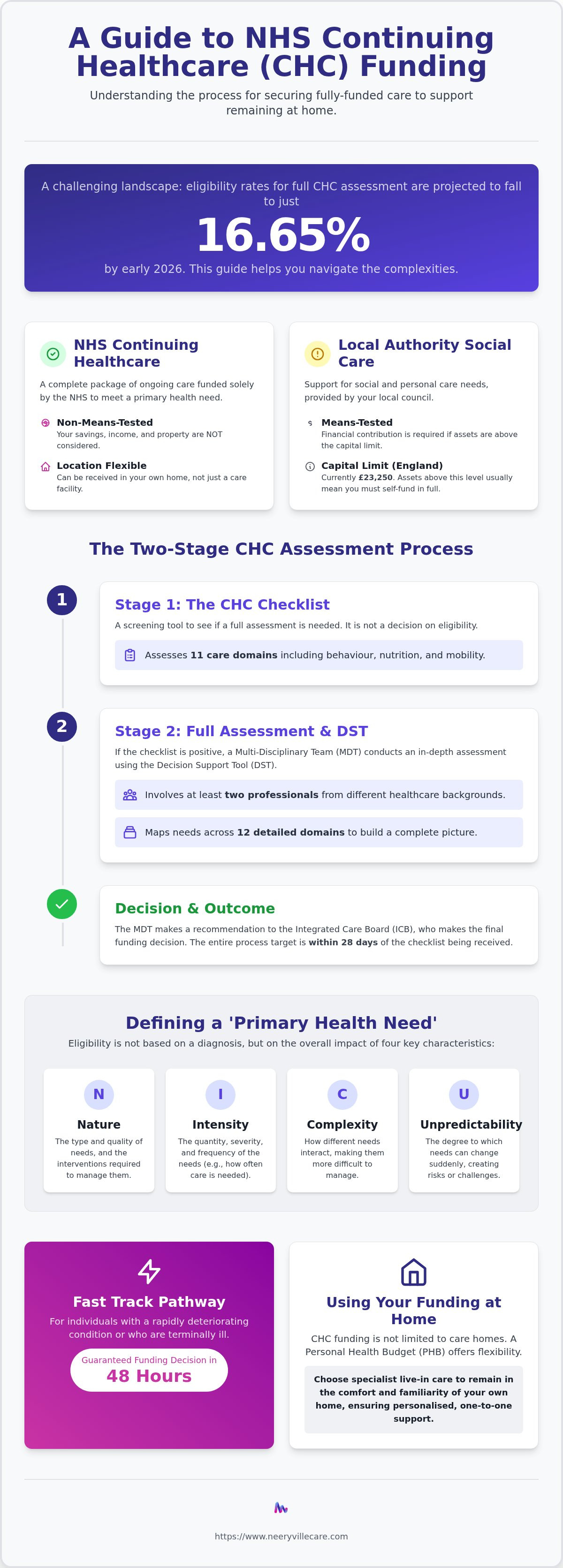
We understand that these complexities feel overwhelming, especially with eligibility rates at full assessment falling to just 16.65% in early 2026. This guide is your roadmap to clarity. We'll show you exactly how the process works, from the initial checklist to the multidisciplinary assessment. By the end of this article, you'll know how to advocate for your family, keep your loved one at home, and find the peace of mind that comes with financial and clinical security.
Table of Contents
What is NHS Continuing Healthcare (CHC) Funding?
Finding the right support for a loved one is a journey often clouded by paperwork and jargon. NHS Continuing Healthcare is a package of ongoing care that is arranged and funded solely by the NHS. Unlike social care provided by local authorities, chc funding covers the full cost of your care, including personal care and healthcare requirements. It's a lifeline for families. It provides safety when everything else feels uncertain. Applying for chc funding can feel like a daunting task, but understanding these definitions is the first step toward a supportive partnership.
Crucially, this funding is free at the point of use. It's not means-tested. This means your loved one's savings, property, or income are never taken into account. In England, the upper capital limit for local authority social care is £23,250. If you have assets above this, you're usually expected to self-fund your care in full. However, if you qualify for this NHS support, those financial barriers disappear. You can find a detailed history of this framework and its legal basis in this guide to NHS Continuing Healthcare (Wikipedia).
Many people assume that receiving this level of support requires a move into a nursing home. This is a common misconception. You can receive this funding whilst remaining in the comfort of your own home, supported by live-in care that adapts to your family's rhythm. This allows for a person-centred approach that prioritises emotional well-being alongside clinical safety. It's about dignity. It's about home.
The Primary Health Need Concept
Eligibility isn't determined by a specific medical diagnosis. Instead, the NHS looks for a primary health need. This means the main reason for care must be related to health rather than social needs. Assessments focus on four key indicators: nature, intensity, complexity, and unpredictability. Families managing conditions like dementia or Parkinson's often find these criteria reflect their daily reality. It's about the total impact of the condition on a person's life and the skill required to manage it safely.
Who is Eligible for CHC Funding?
This support is designed for adults with significant, ongoing physical or mental health needs. It's for those whose requirements go beyond what a local council can legally provide. You don't need to be in a hospital or a care home to qualify. Whether your loved one needs elderly care at home or specialist support for a complex condition, the focus remains on the scale of their clinical needs. Securing this support is about more than just the money; it's about the security of a professional guide during a difficult time.
The CHC Assessment Process: A Step-by-Step Guide
Approaching the assessment for chc funding often feels like standing at the foot of a mountain. It's natural to feel protective and anxious. You aren't just a bystander in this process; you're the expert on your loved one's daily life. Your voice matters. The assessment is designed as a two-stage journey to ensure those with the highest needs receive the support they deserve. It's built on the Official CHC National Framework, which mandates a fair and consistent approach across England. This framework ensures that clinical decisions are made with transparency and care.
Stage 1: The CHC Checklist
The first step is a simple screening tool called the Checklist. Usually completed by a nurse or social worker, this isn't a final decision. Its purpose is to "screen in" people who might be eligible for a full assessment. It looks at 11 domains of care, including breathing, nutrition, continence, and behaviour. If your loved one meets the required threshold in these categories, they move forward. It's a vital first gate. It ensures that complex health needs are recognised early, preventing families from slipping through the cracks of the system.
Stage 2: The Full Assessment and DST
If the checklist is positive, a multi-disciplinary team (MDT) will carry out a full assessment. This team usually includes at least two professionals from different healthcare backgrounds. They use the Decision Support Tool (DST) to map out levels of need across 12 domains. They'll look for "Priority" or "Severe" needs that signal a primary health need. The MDT makes a recommendation, but the final decision rests with the Integrated Care Board (ICB). Their target is to complete this entire process within 28 days of the initial request.
Accurate care records are your strongest ally during these meetings. Detailed notes on "unpredictable" events or "intense" support sessions provide the evidence the MDT needs. They see the clinical data; you provide the human context. This partnership ensures the assessment reflects the reality of life at home. If you're feeling overwhelmed by the paperwork or unsure how to prepare, you can always speak with our compassionate team for guidance on how to navigate these steps with confidence.
Navigating the Primary Health Need: Nature, Intensity, and Complexity
Deciding if a health need is 'primary' is the most critical part of the assessment. It isn't about a label. It's about the daily reality of your loved one's life. The NHS uses four specific characteristics to weigh this up. These terms can feel cold and clinical, but they're actually designed to capture the nuances of care that a standard social care assessment might miss. When applying for chc funding, understanding these definitions helps you tell the story of your loved one's needs with clarity and impact.
Understanding the Four Key Indicators
Nature describes the overall quality and type of the individual's needs. It looks at the physical and mental health requirements as a whole. Intensity focuses on the degree of need. It asks how often support is required and whether care must be provided around the clock. Complexity arises when multiple needs interact, making it much harder to manage the person's health safely. Finally, unpredictability is perhaps the most emotive category for families. It captures those moments when a condition changes without warning, creating risks that require immediate, skilled intervention. You can find more detail on these categories in NHS England's Guide to CHC.
A common fear is that if a condition is 'well-managed,' the funding will be withdrawn. This shouldn't be the case. The assessment must consider the level of skill required to keep the person stable. If the care is only successful because of highly specialised support, the underlying health need remains. We see this often with post-stroke care, where intensive monitoring prevents further complications. The fact that a condition is stable doesn't mean the need has vanished; it means the care is working.
CHC and Specialist Conditions
Specific conditions often highlight these indicators in different ways. For example, dementia care at home frequently meets the threshold for unpredictability. A person might be calm one moment and distressed the next, requiring a carer who understands their history and triggers. This level of emotional and clinical awareness is a hallmark of professional support.
Similarly, Parkinson’s care often involves high complexity. Managing fluctuating mobility alongside strict medication regimes requires a level of coordination that goes far beyond basic domestic help. It's this intersection of health needs that defines eligibility for chc funding. By focusing on how these needs interact, families can present a complete picture of the support their loved one deserves to remain safely at home.
Fast Track Funding for Urgent and End of Life Care
There are moments when time is the most precious resource a family has. When a loved one’s health declines rapidly, the standard 28-day assessment process for chc funding can feel impossibly slow. You shouldn't have to wait for support when every day counts. This is where the Fast Track pathway becomes essential. It’s a compassionate, accelerated route designed specifically for those who are entering a terminal phase of life. It ensures that the focus remains on comfort and dignity rather than administrative hurdles. This pathway acts as a safety net, catching families during their most vulnerable moments and providing immediate clinical security.
When is Fast Track Appropriate?
Eligibility relies on a "rapidly deteriorating" condition that’s entering a terminal phase. A clinician, such as a GP or hospital registrar, must complete the Fast Track Pathway Tool to confirm the urgency. This process bypasses the standard Checklist and Decision Support Tool stages entirely. Integrated Care Boards target a fully funded care package within 48 hours of receiving the tool. This speed ensures clinical safety is established immediately, providing security during a crisis.
The Fast Track process is intentionally simple to reduce the burden on families. It prioritises the individual's comfort over the usual bureaucratic rigour. Once the clinician identifies the need, the system moves quickly to arrange the necessary resources. This rapid response is vital for maintaining the quality of life at home, especially when clinical needs are changing by the hour.
Compassionate End of Life Support
Most people wish to spend their final days in the comfort of their own home. Securing chc funding quickly provides the emotional relief families need to focus on being a family again. Through 24/7 live-in care, we provide the specialist clinical support and dignity that palliative care requires. At NeeryVille Care, we can often implement a bespoke care plan within 24 hours, ensuring your loved one is never without support.
Choosing home-based palliative care allows for a level of intimacy that hospital settings can't replicate. It’s about the small things, like the sound of a familiar voice or the comfort of a favourite chair. We believe that professional care should feel like a partnership, offering both clinical expertise and domestic warmth. By securing this funding, you aren't just managing a health condition; you're protecting the sanctity of your loved one's final environment.
Using Your CHC Funding for Home Care and Live-in Support
Securing chc funding is a significant milestone, but the next question is often: where will this care happen? For many, the instinctive wish is to remain at home. It's where memories live. It's where your loved one feels safest. Fortunately, the system is designed to support this choice through Personal Health Budgets. This mechanism transforms the way families interact with the NHS, moving away from a "one size fits all" approach toward a partnership that respects your domestic life. It's about maintaining the rhythm of a life well-lived whilst receiving the clinical support required for safety.
The Power of Personal Health Budgets (PHBs)
Since 2014, individuals eligible for Continuing Healthcare have a legal "right to have" a Personal Health Budget (PHB). This isn't just a financial account; it's a tool for empowerment. By opting for a direct payment, you gain the authority to hire the providers you trust. This flexibility allows you to tailor every aspect of the care, from the timing of morning routines to the specific way a favourite meal is prepared. It ensures the care fits the person, rather than forcing the person to fit a rigid institutional schedule. In the year ending March 2026, 17.8% of eligible adults used a PHB, showing a growing trend toward personalised, home-based solutions.
Why Choose Live-in Care over a Nursing Home?
Choosing live-in care over a nursing home offers a level of continuity that residential settings often struggle to match. With the same carer everyday, a deep bond of trust is formed. This is particularly vital for elderly care at home, where familiar surroundings provide a sense of stability that wards off confusion and distress. Institutional settings, no matter how well-run, cannot replicate the quiet dignity of one's own living room or the comfort of a private garden. It's these small, domestic details that often define a person's quality of life.
At NeeryVille Care, we specialise in bridging the gap between clinical necessity and home comfort. Whether you're in Highgate, Hampstead, or across North London, we act as your steady guide. We work alongside the NHS to ensure your chc funding delivers the dignified, person-centred support your family deserves. Our role is to lift the burden of caregiving, allowing you to return to being a daughter, a son, or a spouse whilst we manage the clinical complexities.
Secure the Dignity Your Loved One Deserves at Home
Securing chc funding is about more than just navigating a checklist; it's about protecting a loved one's right to live with dignity in their own familiar environment. You now understand that eligibility is based on the intensity and complexity of health needs, not just a diagnosis. You also know that Personal Health Budgets offer the freedom to choose specialist home care over a nursing home placement. These tools allow you to keep your family together in the place they love most, ensuring that clinical safety never comes at the cost of personal comfort.
As a CQC-regulated provider, we specialise in managing complex conditions like dementia and Parkinson’s with clinical precision and domestic warmth. We act as your steady guide, lifting the administrative and clinical burden from your shoulders. Our 14-day satisfaction guarantee ensures that your transition to professional home care is safe, simple, and supportive. You don't have to face this complex journey alone. We're here to help you secure the partnership and support your family deserves.
Take that first step toward peace of mind today. Your loved one's comfort and safety are our absolute priority.
Frequently Asked Questions
Is NHS Continuing Healthcare means-tested?
NHS Continuing Healthcare is not means-tested. Unlike social care provided by local councils, your loved one's savings, property, and income are completely ignored during the assessment. Eligibility is determined solely by whether their primary need is health-based. This provides significant financial relief for families in areas like Highgate and Hampstead, where property values often exceed the £23,250 capital limit. It ensures those with complex clinical requirements receive the support they deserve without depleting their life savings.
Can I get CHC funding if I have dementia?
You can certainly receive support if you have dementia, provided the condition creates a "primary health need." Eligibility isn't based on the diagnosis itself but on the complexity, intensity, and unpredictability of the symptoms. Many families we support with dementia care at home find that the fluctuating nature of the condition meets the threshold for chc funding. It’s about the level of skilled intervention required to keep your loved one safe and stable in their own environment.
What happens if my application for CHC funding is rejected?
If your application is rejected, you have the right to appeal the decision. The first step is to request a local resolution meeting with your Integrated Care Board (ICB). If this doesn't resolve the issue, you can ask for an independent review by NHS England. It's helpful to gather detailed care records and evidence that highlight the clinical nature of the needs. Many families find that having a professional guide during this process provides the clarity needed to succeed.
Can I use CHC funding to pay for a live-in carer at home?
Yes, you can use this funding to pay for a live-in carer within your own home. The NHS provides this through a Personal Health Budget, which gives you the flexibility to choose a provider that aligns with your family’s values. This allows your loved one to remain in familiar surroundings in North London whilst receiving 24/7 support. It’s an ideal solution for those who want to avoid a residential care home while ensuring their complex clinical needs are met.
What is the difference between CHC and FNC (NHS-funded Nursing Care)?
The main difference lies in the level of coverage. chc funding covers the entire cost of your care, including personal care and accommodation. In contrast, NHS-funded Nursing Care (FNC) is a fixed weekly contribution, currently £267.68 for 2026, paid directly to a nursing home to cover registered nurse time. FNC is only for those who don't qualify for full CHC but still require nursing support in a residential setting. It doesn't cover home care costs.
How long does a CHC assessment take?
The NHS aims to complete the full assessment process within 28 days of receiving a completed Checklist or a request for assessment. This timeline includes the multi-disciplinary team meeting and the final decision by the Integrated Care Board. If your loved one's condition is deteriorating rapidly, the Fast Track pathway is much quicker, with a target of just 48 hours for a decision. Staying organised with medical records can help prevent unnecessary delays during this period.
Will CHC funding pay for my care forever?
Funding isn't necessarily for life; it's subject to regular reviews to ensure the support still matches the person's needs. An initial review usually happens after three months, followed by annual reviews. If a health condition improves significantly, the funding might be withdrawn. However, if the needs remain complex and intense, the support continues. It’s about ensuring the right level of care is always in place as your loved one's health journey evolves over time.
Can I choose my own care agency if I have CHC funding?
You have the right to choose your own care agency if you use a Personal Health Budget (PHB). This allows you to select a CQC-regulated provider, like NeeryVille Care, that specialises in the specific conditions your loved one faces. Whether you're in Crouch End or Hampstead, you can opt for a direct payment to hire a team that understands your domestic routines. This control ensures the care is truly person-centred and fits seamlessly into your family life.


