

Managing Dementia Medication at Home: A Family Guide

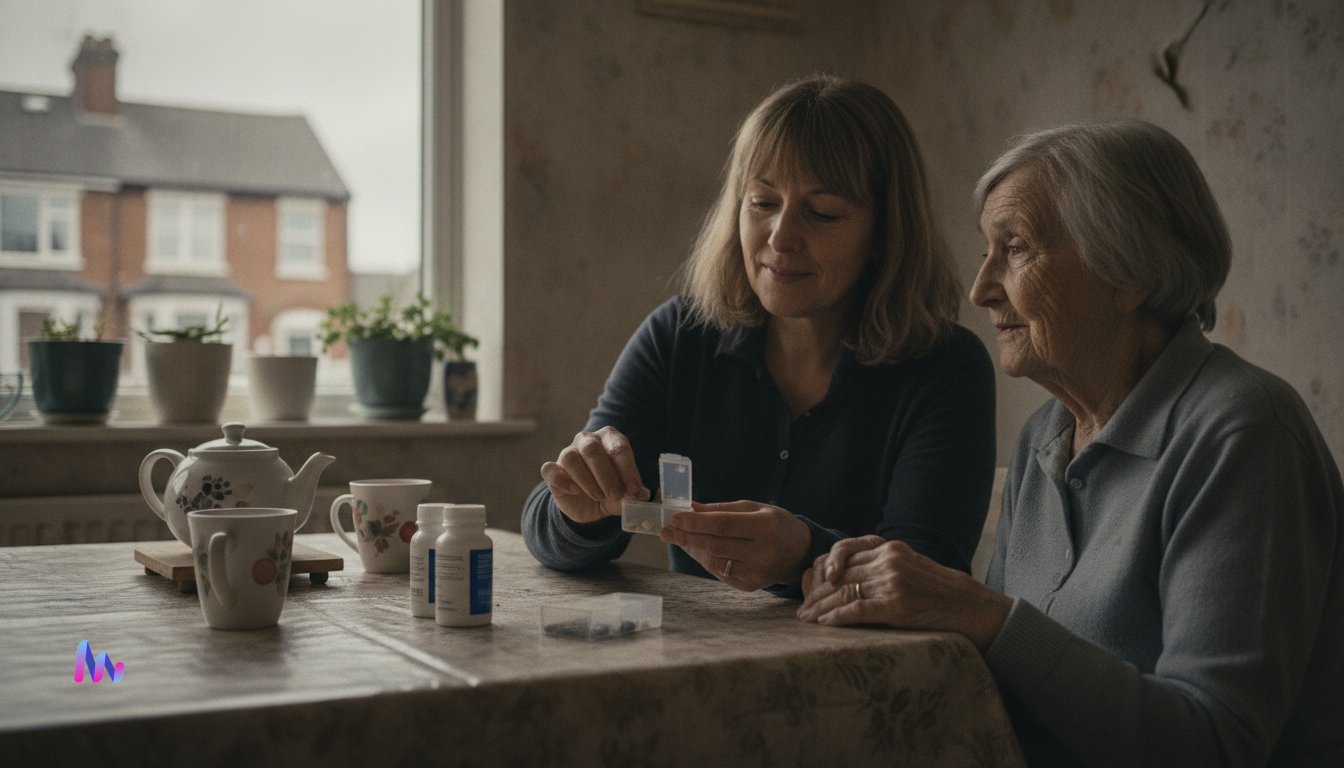
It is 2:00 am and you are staring at a half-empty blister pack, trying to remember if your mother took her evening dose or if the tablet you found on the rug was the one she missed. This quiet moment of panic is a reality for many families managing medication for dementia at home. It's a heavy responsibility that often leads to sleep deprivation and a constant fear of making a dangerous mistake. You want to keep your loved one safe. Quietly, carefully, and consistently. Yet, the complexity of multiple prescriptions can feel utterly overwhelming.
We understand your goal is to maintain your loved one's health and dignity without sacrificing your own well-being. This guide offers a steady hand, providing practical strategies and safety protocols to ensure every dose is administered correctly. You'll discover how to create a reliable system for medication safety, whilst learning techniques for handling refusal with compassion. We'll also explore when to seek professional live-in support. A partnership of care. By the end, you'll have a clear roadmap to reduce anxiety and restore a sense of calm to your daily routine.
Table of Contents
The Challenges of Managing Dementia Medication at Home
Medication management is more than just a schedule of tablets. It's the foundation of safety for those living with memory loss. When a loved one experiences cognitive decline, the simple act of following a doctor's order becomes a complex hurdle. The nuances of dementia caregiving involve balancing clinical needs with the shifting reality of a person's cognitive state. Effectively managing medication for dementia at home requires a deep understanding of how memory impairment alters a person's relationship with their health regime. It's a delicate dance between maintaining health and preserving dignity.
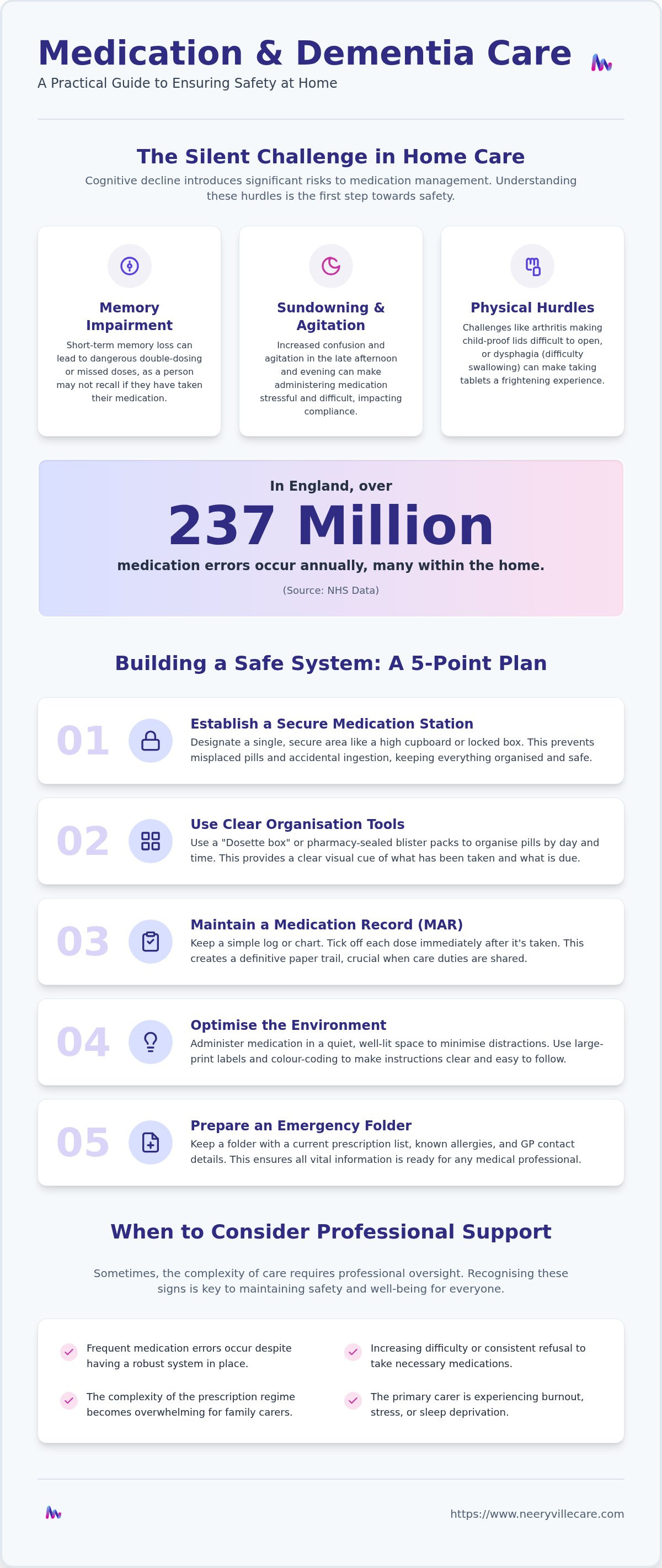
One of the most persistent hurdles is "sundowning," a phenomenon where agitation and confusion increase as the sun sets. For many families, the evening dose becomes the most stressful part of the day. A loved one who was cooperative at breakfast may become combative or suspicious by 6:00 pm. This evening distress directly impacts compliance. It makes it difficult to ensure evening medications are taken safely; often at the very time when the person's anxiety is at its peak.
Why Memory Loss Impacts Medication Safety
Short-term memory loss creates a dangerous cycle of uncertainty. A person may take their morning pill and, five minutes later, have no recollection of doing so. This leads to the "double-dosing" trap. Conversely, they might assume they've already taken it and skip a vital dose. Instructions that seem straightforward, such as "take with food" or "twice daily," require executive function that dementia often strips away. There are physical barriers too. Arthritic hands struggle with child-proof lids, whilst late-stage dementia can lead to dysphagia, making swallowing large tablets a frightening experience for the individual.
Identifying the Risks of Poor Management
The stakes are high. According to the NHS, over 237 million medication errors occur in England every year, and many of these happen within the domestic setting. Accidental overmedication is a leading cause of emergency hospital admissions amongst elderly patients. When doses are missed, the very symptoms you're trying to manage, such as anxiety or memory loss, can accelerate. This instability often triggers a cascade of further health issues.
For seniors in Highgate or Hampstead, the most immediate physical risk is a fall. Many medications for dementia or related conditions can cause dizziness if not managed perfectly. A single missed dose or incorrect timing can lead to increased disorientation, heightening the risk of a domestic accident. This is why many families eventually look toward specialised dementia care at home to provide the constant, professional oversight required for safety.
Practical Tools and Systems for Medication Safety
Creating a structured environment is the most effective way to reduce the stress of managing medication for dementia at home. A centralised medication station serves as the heart of this system. This should be a single, dedicated area, ideally a high cupboard or a locked box, kept away from high-traffic zones like the kitchen sink where moisture can damage pills. By keeping all prescriptions in one secure place, you eliminate the risk of tablets being misplaced or accidentally ingested by a confused loved one. Safety is your priority; keeping medications locked away is a simple but vital step in preventing accidental overmedication.
Clarity is essential for daily success. Many families find that a "Dosette box" or pharmacy-sealed blister packs are transformative. These tools organise pills by day and time, providing a clear visual cue of what has been taken. To mirror professional standards, you should also maintain a Medication Administration Record (MAR) at home. This is a simple log where every dose is ticked off immediately after it is swallowed. It provides a definitive paper trail, which is incredibly helpful if you are sharing care duties with other family members or professional carers.
Organising the Home Environment
The physical space where medication is given matters deeply. Choose a quiet, well-lit area to minimise distractions during the process. You can use large-print labels and colour-coded charts to make instructions easier to read for both the carer and the individual. It is also wise to keep a dedicated "emergency folder" in this station. This folder should contain a current list of all prescriptions, known allergies, and your GP's contact details, ensuring you are prepared for any unexpected health queries.
Leveraging Modern Health Technology
Technology offers a modern safety net for families. Automatic electronic dispensers can be programmed to rotate and open only at the correct time, often accompanied by a flashing light or a gentle alarm. These devices are particularly useful for those in the earlier stages of dementia who still value their independence. Current trends in social care, supported by the Care Quality Commission (CQC), show a significant shift towards digital systems like Electronic Medication Administration Records (eMAR) to improve accuracy and auditability. If you find that the technical or emotional weight of these systems is becoming too much to carry alone, you might consider speaking with a specialist about professional support options.
Smart sensors are another discreet layer of protection. These can be fitted to medication cabinets to alert a family member's smartphone if the door is opened at an unusual time. Whilst technology cannot replace human compassion, it provides a sense of security that allows you to breathe a little easier at night.
Collaborating with North London Health Professionals
Managing medication for dementia at home requires a robust network of professional support. You don't have to carry the clinical weight alone. Across North London, from the GP surgeries in Highgate N6 to the specialist clinics in Hampstead, health professionals are ready to partner with you. Your local GP acts as the central coordinator, ensuring that every prescription aligns with the latest clinical standards. They provide the necessary oversight to balance multiple health needs whilst prioritising the individual's comfort.
One vital tool in the UK health system is the "Yellow Card" scheme, managed by the Medicines and Healthcare products Regulatory Agency (MHRA). It allows carers to report suspected side effects directly. This is particularly important for those with dementia, as they may not always be able to articulate why they feel unwell. By collaborating with your GP and local Memory Clinics, you ensure that specialist drugs are adjusted precisely as the condition evolves. These clinics offer expert insight into how memory-enhancing medications can be optimised for better daily outcomes.
The Importance of Regular Medication Reviews
The National Institute for Health and Care Excellence (NICE) updated its dementia guidelines in August 2026. This update reinforces the need for regular, person-centred reviews. For someone with cognitive decline, a medication review should occur at least every six months. This helps manage "polypharmacy," where multiple medications might interact in ways that increase confusion or the risk of falls. It's a chance to simplify the regime and ensure every tablet serves a clear purpose.
When you meet with the GP, be proactive. Ask if certain pills are still necessary or if a new behaviour might actually be a side effect rather than a symptom of dementia. Safety is a moving target. Regular reviews ensure the regime remains effective, safe, and respectful of the person's changing needs.
Working with Local Pharmacies in Highgate and Hampstead
Your local pharmacist is often the most accessible expert in the community. If you find that opening standard bottles is becoming a struggle, ask for compliance aids. These are pharmacy-sealed blister packs that organise tablets by time and day, removing the guesswork for family carers. Many pharmacies across North London also offer prescription delivery services. This is a vital lifeline for housebound seniors, ensuring that treatments are never interrupted by a missed trip to the high street.
If swallowing becomes an issue, don't wait for a crisis. Pharmacists can often suggest liquid alternatives or dispersible tablets that are much easier to administer. This small change can transform a stressful morning into a calm, dignified routine. If the complexity of these medical appointments and pharmacy liaisons becomes overwhelming, our live-in care in Highgate provides a professional presence to manage these interactions on your behalf. We act as the steady bridge between the home and the clinic, ensuring your loved one’s health regime is followed with clinical precision and domestic warmth.
Navigating Medication Refusal with Compassion
Managing medication for dementia at home often reaches a difficult peak when a loved one simply says "no". This refusal is rarely a sign of stubbornness. Instead, it is frequently rooted in fear, a lack of insight into their illness, or a deep-seated confusion about what the tablet is for. When a person no longer recognises the purpose of their treatment, a small pill can look like a threat. Understanding this "why" is the first step toward a more compassionate approach. It requires us to step into their reality with patience and empathy. A gentle hand. A quiet word. A patient heart.
The "Gentle Persuasion" approach is often the most effective strategy. This involves timing doses for when the person is most relaxed and receptive. If you remember the challenges of sundowning mentioned earlier, you'll know that late afternoon is rarely the best time for complex tasks. Try to align medication with a favourite routine, such as a morning cup of tea or a familiar television programme. If they refuse, don't force the issue. Step back, wait fifteen minutes, and try again with a fresh, calm perspective. Avoiding power struggles is vital; once agitation sets in, health safety becomes much harder to maintain.
Person-Centred Communication Strategies
Communication should be simple and reassuring. Use short, direct sentences rather than long explanations. Instead of saying, "You need to take your blood pressure medication now so you don't have a stroke," try a softer approach: "It’s time for your morning tablet to help you feel well." Validating their feelings is equally important. If they say the pill tastes bad, acknowledge that. Small, positive reinforcements and maintaining a familiar, dignified routine can transform a moment of conflict into a moment of connection.
The Legal Framework: Mental Capacity Act 2005
There may come a time when a loved one lacks the "capacity" to make decisions about their health. The Mental Capacity Act 2005 provides the essential legal framework for these moments. It ensures that any decisions made on their behalf are in their "Best Interests". This is where having a Lasting Power of Attorney (LPA) for health and welfare becomes invaluable, allowing a trusted family member to coordinate with doctors on treatment plans whilst respecting the individual’s prior wishes.
It is also crucial to understand the strict regulations regarding covert medication. Hiding tablets in food or drink is a serious step and must never be done without professional guidance. Both the Care Quality Commission (CQC) and NICE guidelines state that covert administration should only be a last resort, following a formal "Best Interests" meeting with a GP or pharmacist. Protecting a person's dignity means being transparent and legal in every aspect of managing medication for dementia at home.
When Professional Support is the Safest Choice
There comes a point where love and dedication aren't enough to ensure clinical safety. Admitting this is an act of courage, not a failure. When managing medication for dementia at home becomes a source of constant anxiety rather than a routine, it's time to look at professional solutions. Safety isn't just about the right pill; it's about the right environment. A partnership of care. A steady hand when yours is tired.
The transition from family-led care to professional support often feels like a significant step, but it's one that prioritises the individual’s dignity and health. CQC-regulated carers bring a level of clinical authority that simplifies complex regimes. They don't just "give pills"; they manage the entire process, from monitoring side effects to liaising with North London health professionals. This professional oversight provides a safety net that is often impossible for a family member to maintain alone whilst balancing other life responsibilities.
Signs You Need Professional Medication Support
Watch for frequent "near misses". Perhaps you found a tablet on the floor or noticed a dose was missed entirely. If your loved one has had increased hospital admissions due to falls or sudden disorientation, these are often linked to medication errors. Total refusal of life-sustaining drugs is another clear signal. Carer burnout is equally critical. If the stress of the health regime is affecting your own mental or physical health, you can't provide the calm, steady care your loved one needs. It's okay to ask for help.
The Live-in Care Solution for Dementia
For many families in North London, live-in care in Highgate offers a sustainable, safe answer. Unlike visiting care, a live-in professional provides a constant, reassuring presence. They monitor side effects in real-time, track changes in appetite, and ensure every dose is administered with clinical precision. This level of specialist dementia care at home allows your loved one to remain in familiar surroundings whilst benefiting from 24/7 safety.
Having a medication support expert on hand doesn't mean a loss of independence. It means having the security to enjoy daily life without the shadow of a health crisis. At NeeryVille, we specialise in this delicate balance. Our staff are trained to manage complex dementia needs with domestic warmth and professional rigour. We understand the Highgate and Hampstead community. We know the local GPs. We're here to lift the burden, providing the professional oversight that keeps your family whole and your loved one safe in the home they love.
Restoring Safety and Peace of Mind to Your Home
Managing medication for dementia at home is a complex journey that requires a balance of practical organisation and deep emotional resilience. By establishing secure systems and working closely with your Highgate GP, you create a foundation of safety. You've learned how to navigate refusal with compassion and why regular clinical reviews are non-negotiable for long-term health.
There may come a time when the weight of these responsibilities becomes too heavy to carry alone. Recognising this is a commitment to your loved one's well-being. NeeryVille Care stands as a steady guide across North London. As a CQC-regulated provider, our specialist dementia care trained professionals bring clinical precision into the comfort of your domestic environment. We provide the professional oversight needed to ensure every dose is safe whilst maintaining the dignity your family deserves.
You don't have to face these worries in isolation. With local support in Highgate N6 and a national standard of quality, we are here to walk this path with you. Peace of mind is possible.
Frequently Asked Questions
What should I do if my loved one with dementia refuses their medication?
If your loved one refuses, the first step is to remain calm and avoid a power struggle. Often, waiting fifteen minutes and trying again when they are in a different mood can be effective. You might also try pairing the dose with a favourite activity or a quiet cup of tea. If refusal becomes a regular occurrence, it’s vital to consult their GP to explore alternative formats or to check for underlying discomfort.
Is it safe to crush dementia pills if they have trouble swallowing?
You should never crush medication without first consulting a pharmacist or doctor. Many dementia drugs are designed with a special coating for slow release; crushing them can cause the full dose to enter the bloodstream too quickly, which is dangerous. Instead, ask your local Highgate pharmacist if a liquid or dispersible version is available. They can provide safer alternatives that are much easier for those with swallowing difficulties to manage safely.
How often should a person with dementia have their medication reviewed?
According to NICE guidelines updated in August 2026, individuals with dementia should have their medication reviewed at least every six months. These regular check-ups with a GP or specialist in North London ensure the regime remains effective as the condition progresses. It is also an opportunity to manage "polypharmacy" and reduce any drugs that are no longer providing a clear benefit or are causing unnecessary side effects that impact daily life.
Can a home carer legally give medication to a person with dementia?
Yes, professional home carers from a CQC-regulated provider like NeeryVille Care can legally support with medication administration. Our staff undergo specialist training and annual competency assessments to ensure they follow strict safety protocols. They maintain a Medication Administration Record (MAR) to document every dose. This provides families in Highgate and Hampstead with a reliable audit trail and ensures that life-sustaining treatments are managed with clinical precision and domestic warmth.
What are the most common side effects of dementia medications to watch for?
Common side effects often include nausea, loss of appetite, and dizziness, which can unfortunately increase the risk of falls amongst seniors. Some medications may also cause vivid dreams or digestive issues. Because people with dementia may struggle to describe these feelings, you should watch for subtle changes in behaviour or physical coordination. Reporting these concerns through the "Yellow Card" scheme or directly to a North London GP is essential for long-term safety.
How can I tell if my loved one has accidentally taken too much medicine?
Signs of accidental overmedication include sudden, extreme lethargy, increased confusion, or physical symptoms like vomiting and shallow breathing. If you suspect an overdose, you should contact 111 or 999 immediately. To prevent this, always keep medications in a locked cabinet. A professional carer can help by managing medication for dementia at home using a secure, double-checked system that eliminates the risk of a loved one accessing tablets independently or at the wrong time.
What is a Dosette box and how do I get one in the UK?
A Dosette box is a multi-compartment container that organises tablets by the day and time they need to be taken. In the UK, you can request these directly from your local pharmacist in areas like Highgate or Hampstead. Many pharmacies now provide "compliance aids," which are factory-sealed blister packs. These are often safer and more hygienic than manual boxes, as they are prepared by professionals to reduce the chance of errors during the week.
When should we consider live-in care for medication management?
Consider live-in care if you notice frequent "near misses," such as missed doses or double-dosing. If your loved one requires 24/7 monitoring due to disorientation or nighttime health crises, a dedicated carer provides the highest level of safety. For families in North London, this transition often happens when the stress of the medical regime begins to cause carer burnout, ensuring your loved one remains safe and comfortable in their familiar home environment.


