

Live-in Care Across London: A Compassionate Guide to 24/7 Support at Home
- Daniel Johnson

- Jul 22
- 13 min read
Updated: Jul 23

Imagine waking up to the familiar sound of your own kettle boiling, in the same kitchen you've loved for forty years, even when you require constant support. For many families, the thought of a residential home feels like a surrender of history and independence. You likely feel a heavy weight of responsibility, perhaps even guilt, whilst trying to balance a loved one's safety with their desire to stay in the city they call home. Securing high-quality live-in care across London is a daunting task, especially when trying to understand CQC regulations and the unique costs of the capital.
We believe that care should be a partnership that preserves dignity. It is about more than just clinical needs; it is about the comfort of a familiar routine. This guide will show you how live-in care allows your family member to remain independent, safe, and happy in their own familiar surroundings. We'll explore how to find a trustworthy, CQC-regulated agency that respects existing habits and provides the peace of mind your whole family deserves. Discover a simpler path to 24/7 support that keeps your loved one right where they belong.
Table of Contents
Understanding Live-in Care Across London’s Unique Neighbourhoods
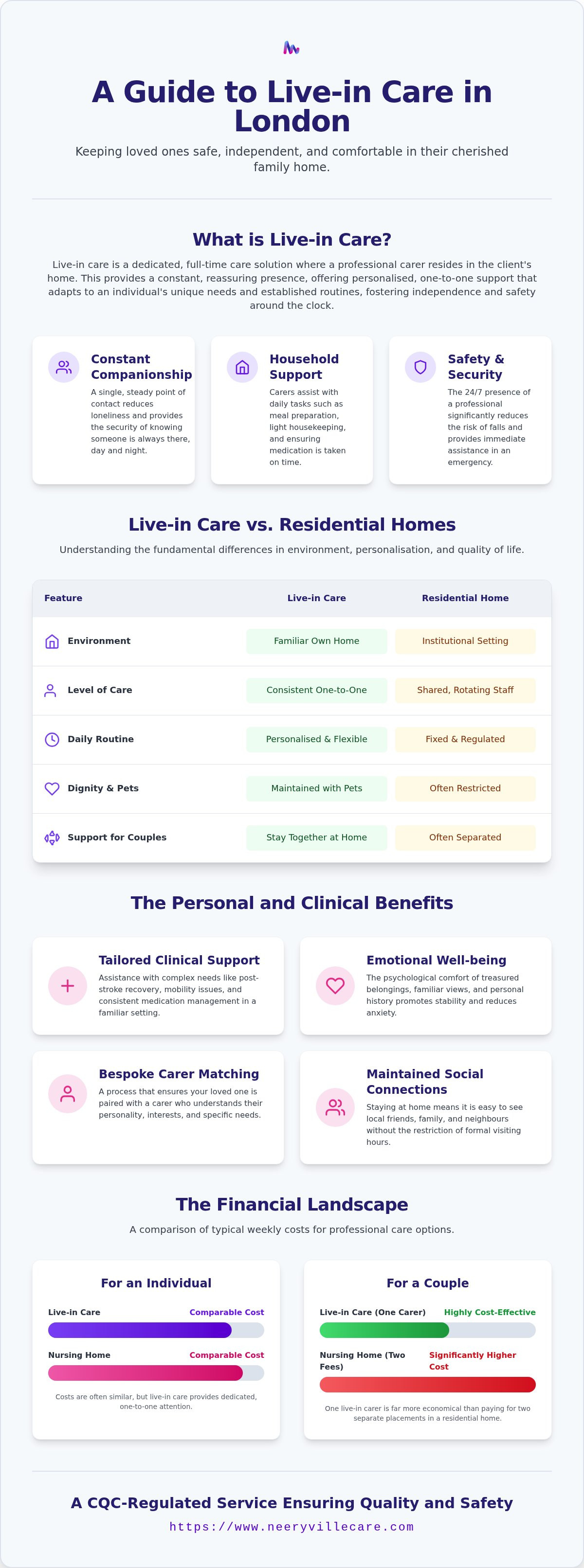
London is a city of distinct characters, from the leafy lanes of Highgate to the bustling streets of Hampstead. For many, these neighbourhoods aren't just addresses; they're the backdrop of a lifetime's memories. Choosing live-in care across London means choosing to stay connected to these roots. It is a decision that prioritises the person over the process. Families are increasingly moving away from traditional residential care homes because they want to preserve the dignity of their loved ones in the places they know best. This approach offers a sense of continuity that an institutional setting simply cannot replicate.
To understand the shift, we must ask: What is a live-in caregiver? Essentially, it is a dedicated professional who resides within the home to provide constant support. This isn't just about clinical assistance; it's about the security of knowing someone is there during the quiet hours of the night. As a CQC-regulated service, we ensure that every carer meets rigorous standards of safety and professionalism. Unlike a care home, where staff rotate frequently, a live-in arrangement offers a single, steady point of contact. Live-in care is a bespoke alternative to residential placement that keeps the front door key in the hands of the individual.
What is Live-in Care and How Does it Work?
A resident carer offers a level of presence that hourly visits simply cannot match. Whilst elderly care at home often starts with short calls, live-in support evolves into a full-time partnership. The carer manages household tasks, prepares meals, and ensures medication is taken on time. More importantly, they provide companionship. This 24-hour presence bridges the gap between independence and safety. Securing live-in care across London provides a safety net that adapts to the unique rhythm of city life. It works in any setting, whether it's a spacious Victorian house in Highgate or a compact city apartment. Every London home has its own layout, and a professional carer integrates seamlessly into that space, respecting privacy whilst maintaining a watchful eye.
Why Staying at Home Wins: The Emotional Advantage
The heart of the home is found in its details. It's the "treasured belongings" on the mantelpiece, the specific way the light hits the garden, and the comfort of a well-worn armchair. Institutional settings often struggle to replicate this personal "rhythm of life." Staying at home allows for the continued presence of pets and the ease of seeing local friends without formal visiting hours. It removes the clinical coldness of a facility, replacing it with the warmth of familiar surroundings and the psychological stability of staying amongst one's own history. This sense of continuity is vital for emotional well-being, especially when navigating the complexities of ageing in a fast-paced city. For those looking for high-quality, person-centred support to achieve this, providers such as bloomfield-care.com offer a range of services designed to help individuals thrive in their own homes.
The Personal and Clinical Benefits of 24/7 Home Support
Choosing live-in care across London provides more than just a presence; it offers a high level of clinical safety tailored to the individual. For those recovering from a stroke or managing chronic mobility issues, having a professional at home ensures that rehabilitation is consistent and personal care is handled with dignity. Carers play a pivotal role in medication management and nutritional support, ensuring that meals are both healthy and appetising. This constant oversight significantly reduces the risk of falls, which is a leading cause of hospital admissions amongst the elderly. By understanding your rights under the Care Act 2014, you can ensure that the care plan provided is legally sound and person-centred.
The value of companionship cannot be overstated. In a city as fast-paced as London, having a friendly face to share a cup of tea or a conversation with is vital. It transforms a house back into a home. This level of support is essential for those needing post-stroke care at home, where emotional recovery is just as important as physical healing. Live-in care across London ensures that no one has to face the challenges of ageing alone. It provides a sense of security that allows the whole family to breathe a little easier.
Specialist Dementia Care at Home
Dementia care at home thrives on stability. A familiar environment helps manage confusion and distressing behaviours that often escalate in unfamiliar clinical settings. Unlike residential homes, where staff-to-resident ratios are often high, live-in care provides dedicated one-to-one attention. This means the carer notices the subtle changes in mood or health that others might miss. It is about creating a calm, reliable partnership that prioritises emotional well-being alongside physical safety.
Maintaining Independence and Social Connections
Living in the capital offers incredible opportunities for social engagement, yet urban isolation is a real challenge for those with limited mobility. Professional carers facilitate trips to local London parks, favourite cafes, and community centres, ensuring that life doesn't stop at the front door. Through elderly care at home, daily tasks like light housekeeping and meal preparation are managed quietly in the background. This allows your loved one to focus on what they enjoy most. If you're feeling overwhelmed by these choices, you can always reach out for a friendly conversation about your options.
Navigating the Logistics of Live-in Care in a London Home
Many families hesitate to explore 24/7 support because they worry their home isn't "grand" enough to accommodate a professional. London living often means making the most of every square foot. Whether you reside in a multi-storey townhouse or a modern city apartment, live-in care across London is designed to be remarkably flexible. It isn't about having a spare wing or a vast estate; it's about creating a safe, respectful environment for a professional to reside. We find that most London homes are perfectly suitable once a few practical considerations are addressed.
Preparing for a new arrival is as much about mindset as it is about physical space. We recommend a settling-in period where routines are discussed openly. It's helpful to talk about who likes the radio on, what time breakfast is served, and which rooms remain private. This transparency builds a foundation of trust. Establishing these boundaries early ensures a harmonious household where the carer becomes a welcome addition rather than an intrusion. It's a partnership built on mutual respect and the shared goal of keeping your loved one safe in the surroundings they love.
Practical Requirements for a Live-in Carer
A suitable room for a carer should be a clean, private bedroom with a door that closes. It needs a bed, storage for clothes, and adequate lighting. In our digital age, reliable internet access is essential, as it allows the carer to maintain their own social connections and complete necessary care logs. Food arrangements are usually simple; the carer typically eats the same meals they prepare for the client, though some families provide a separate grocery budget. Rest breaks are vital too. A carer generally needs a two-hour break during the day to recharge. Professional carers are there to support your existing lifestyle, not to take over your home or change your cherished habits.
Addressing London-Specific Challenges
The logistics of home help in Highgate or other busy boroughs often involve navigating Controlled Parking Zones. If your carer drives, arranging a visitor's permit is a practical first step. However, many carers in the capital rely on our excellent public transport network. We also consider the physical layout of London properties, particularly multi-storey Victorian homes where mobility might be a challenge. When exploring funding for these arrangements, it's helpful to consult the UK government's official guidance on NHS healthcare funding to see if your loved one qualifies for Continuing Healthcare support. Adapting live-in care across London to fit smaller urban dwellings is something we do every day with care and sensitivity.
Evaluating Costs, Funding, and Quality Standards in London
Financial transparency is the foundation of a trusting partnership. When exploring live-in care across London, many families are surprised to find that 1:1 support is often comparable in cost to high-end residential nursing homes. The value, however, is significantly higher. In a care home, staff must divide their attention amongst dozens of residents. With a live-in arrangement, your loved one is the sole priority. For couples, the financial benefit is even more pronounced. Staying together at home with one carer is typically much more affordable than paying for two separate placements in a residential facility, preserving both their savings and their shared life.
We understand that navigating the financial landscape of the capital is complex. As of February 2026, the upper capital limit for local authority funding stands at £23,250. If your loved one's assets are above this amount, they will likely be responsible for the full cost of their care. However, those with assets below £14,250 may receive significant financial support. It is a methodical process, but one that ensures everyone receives the dignity of support they require. By choosing a managed service, you're investing in a structure that handles all the background complexities, from carer training to holiday cover, allowing you to focus on being a family again.
Understanding Live-in Care Fees and Financial Planning
Weekly rates for professional support are comprehensive. They cover the carer's expertise, ongoing management, and the security of a CQC-regulated framework. Many families successfully access funding through Local Authority Direct Payments or Attendance Allowance to help manage these costs. For those with complex health needs, such as advanced dementia or recovery from a major stroke, NHS Continuing Healthcare (CHC) may be available. This is a package of care that is fully funded by the NHS, provided the individual meets specific clinical criteria. We recommend starting these conversations early to ensure all available avenues are explored.
The Role of CQC Regulation in Ensuring Safety
The Care Quality Commission (CQC) is the independent regulator of health and social care in England. Their standards are non-negotiable. A CQC-regulated provider is held to strict benchmarks regarding safety, effectiveness, and how well-led the service is. This is a vital distinction from "introductory agencies," which simply match you with a carer and then step away. A fully managed, regulated provider takes legal responsibility for the care delivered. They conduct rigorous background checks and provide ongoing training. High standards in professional development, such as the manual handling training provided by Canavan Byrne, are vital for ensuring that carers can safely support those with mobility needs. You can, and should, check an agency's latest inspection report on the CQC website to ensure they meet the "Good" or "Outstanding" ratings that signify a high-quality, reliable service.
Arranging Your Live-in Care Journey with NeeryVille Care
Deciding to bring a professional into your home is a significant emotional step. It represents a transition from managing alone to embracing a partnership built on safety and mutual respect. At NeeryVille Care, we understand the weight of this decision. Our commitment is to offer simplicity in a process that often feels overwhelming. We provide live-in care across London that doesn't just meet clinical standards but prioritises the emotional well-being of the entire family. From the first phone call, our focus is on listening to your story and understanding the unique rhythm of your household.
Our presence in the capital is deeply rooted in local communities. Whether you require support in the leafy streets of Highgate or a city apartment in central London, we bring a steady, compassionate hand to your door. We believe that the relationship between a client and their carer is the most vital component of high-quality support. It's why we position ourselves as more than just a provider; we are a steady guide through a complex time. Our goal is to ensure that your loved one remains the centre of their own world, surrounded by their own memories.
Our Person-Centred Matching Process
Finding the right person to live in your home requires more than just a check of clinical qualifications. We look for a shared spark of personality. During our matching process, we consider hobbies, favourite foods, and even the temperament of the household. Does your father enjoy historical biographies? Is your mother a fan of classical music? We find a carer who truly resonates with those interests. This bespoke approach is what defines our live-in care in Highgate N6 and beyond. To ensure everyone feels comfortable, we also implement a trial period. This allows the relationship to develop naturally, giving you the peace of mind that the match is exactly right.
Taking the First Step: From Assessment to Active Care
We know that care needs can change in an instant. Sometimes a crisis requires a rapid response, and we are organised to meet that urgency. Our journey begins with a free, no-obligation home care assessment where we discuss every detail of the required support. Once care is active, our management team provides ongoing oversight. We don't just "place and forget." We support our carers so they can support you, maintaining the high standards expected of a CQC-regulated agency. This continuous partnership ensures that the quality of care remains high as needs evolve. Let us lift the burden of caregiving from your shoulders, allowing you to return to your role as a daughter, son, or spouse. Choosing live-in care across London is the first step toward a safer, more settled future for your loved one.
Embracing a Brighter Future in Your Own Home
Transitioning to 24/7 support shouldn't feel like an end to independence. It is actually a way to reclaim it. We've explored how staying in your own neighbourhood maintains the rhythm of life, from local walks to the comfort of a familiar armchair. By choosing a CQC-regulated provider with specialist dementia care expertise, you ensure that clinical safety never comes at the cost of personal dignity. This balance allows your loved one to remain safe whilst keeping their front door key and their cherished memories intact.
Securing live-in care across London is about more than just managing logistics; it is about protecting the heart of the home. Our compassionate, person-centred matching ensures that the professional who arrives is a true companion who understands your loved one's personality, history, and favourite habits. This partnership brings peace of mind to the whole family, knowing that support is always present but never intrusive. It is a simple solution to a complex worry.
You don't have to carry this worry alone. We're here to guide you every step of the way toward a safer, happier, and more settled home life for your family.
Frequently Asked Questions
Is live-in care cheaper than a care home in London?
Live-in care is often comparable in cost to residential nursing homes in the capital, especially when you consider the one-to-one attention provided. For couples, it is significantly more cost-effective than paying for two separate care home beds. You're paying for a dedicated professional who focuses solely on your loved one's needs, rather than a shared staff team. This ensures a higher level of personal attention whilst allowing the individual to remain in their cherished home.
Do I have to provide food for a live-in carer?
Yes, you are generally expected to provide meals for your carer. Most families find it simplest for the carer to eat the same meals they prepare for the client, which encourages a sense of companionship. Alternatively, some families choose to provide a separate weekly grocery budget. This arrangement is usually discussed during the initial assessment to ensure that the carer's dietary needs and preferences are respected within the household routine.
Can a live-in carer help with dementia behaviour?
Yes, specialist carers are trained to manage dementia-related behaviours with patience and empathy. Maintaining a familiar environment is one of the most effective ways to reduce confusion and agitation in those living with memory loss. By providing live-in care across London, we ensure that your loved one stays in a setting where they feel safe. This stability, combined with one-to-one support, helps to de-escalate distressing situations and promotes emotional well-being.
What happens if the carer and my parent don't get along?
We understand that personality matches are vital, so we will arrange a different carer if the relationship doesn't feel right. Our matching process is thorough, but we know that sometimes chemistry isn't perfect. Your loved one's comfort and happiness are our primary concerns. We'll work closely with your family to identify a more suitable professional who shares the client's interests and temperament, ensuring the transition is handled with sensitivity and care.
Is live-in care available for couples in London?
Yes, live-in care for couples is a very popular option throughout the city. It allows partners to stay together in their own home rather than being separated by different care needs in a residential setting. This is often a much more affordable solution, as one carer can support both individuals. It preserves their shared life and routines, providing a compassionate way to navigate the challenges of ageing whilst remaining side-by-side.
How quickly can live-in care be organised in an emergency?
We can often organise support within 24 to 48 hours in urgent situations. We understand that hospital discharges or sudden health changes can create a crisis for families. Our team is organised to respond quickly, conducting a thorough home assessment to ensure safety and quality are never compromised by speed. This responsiveness provides immediate peace of mind during moments of significant worry, ensuring that professional support is in place when it is needed most.
Does a live-in carer work 24 hours a day without a break?
No, a carer requires a daily break and a full night's sleep to provide high-quality support. Typically, a carer will have a two-hour break during the day to recharge. Whilst they live in the home and are present for emergencies, they are not expected to work through the night without rest. This structure ensures that your carer remains alert, compassionate, and capable of delivering the clinical and emotional support your loved one deserves.
Is NeeryVille Care regulated by the Care Quality Commission (CQC)?
Yes, NeeryVille Care is a fully CQC-regulated provider. This means we are independently monitored to ensure our services are safe, effective, and well-led. Regulation is a non-negotiable standard for us because it provides families with the security of professional accountability. By choosing live-in care across London through a regulated agency, you are guaranteed that all staff have undergone rigorous background checks and receive ongoing specialist training to meet national quality benchmarks.


