

Dementia Care in London: A Compassionate Guide to Support at Home in 2026
- Daniel Johnson

- 4 hours ago
- 12 min read
What if the safest, most dignified place for your loved one to receive specialist support isn't a clinical facility, but the very home they've spent a lifetime building? You've likely spent countless nights balancing the roles of child, spouse, and full-time carer. You feel the heavy weight of 24/7 responsibility and the quiet fear that a residential home is the only answer. Finding reliable live-in dementia care London families can trust is often the first step toward reclaiming peace of mind. It's a path often paved with exhaustion, yet you want nothing more than for them to remain amongst their own memories.
We understand the pressure of these decisions. This guide will help you navigate specialist support whilst ensuring your loved one remains safe, dignified, and comfortable in their own home. Safety. Dignity. The simple peace of a familiar routine. We will explore how to understand the latest CQC inspection frameworks, the practical benefits of one-to-one assistance, and how to build a sustainable plan that finally lifts the burden of caregiver burnout from your shoulders.
Table of Contents
Navigating Dementia Care in London: Understanding Your Options
The decision to seek professional help often arrives in the quiet, exhausted hours of the morning. You've likely spent months, perhaps years, managing the shifting tides of a loved one's memory. In a city as vibrant and fast-paced as London, the challenges of dementia are amplified. The sensory landscape of the capital, with its sudden sirens and crowded pavements, can quickly turn a familiar street into a source of profound anxiety for someone living with cognitive decline. This environmental stress often falls squarely on the shoulders of family members, leading to a level of caregiver burnout that feels impossible to sustain.
Choosing between a residential care home and staying at home is a heavy emotional crossroads. Many families feel a sense of guilt when they first consider outsourcing care, yet familiarity is a powerful clinical asset. Remaining in a known environment helps manage symptoms like "sundowning," where agitation increases as the sun sets. When the furniture, the smells, and the view from the window remain constant, the person's world feels safer. Professional Dementia caregiving involves more than just safety; it's about preserving the continuity of a life already well-lived.
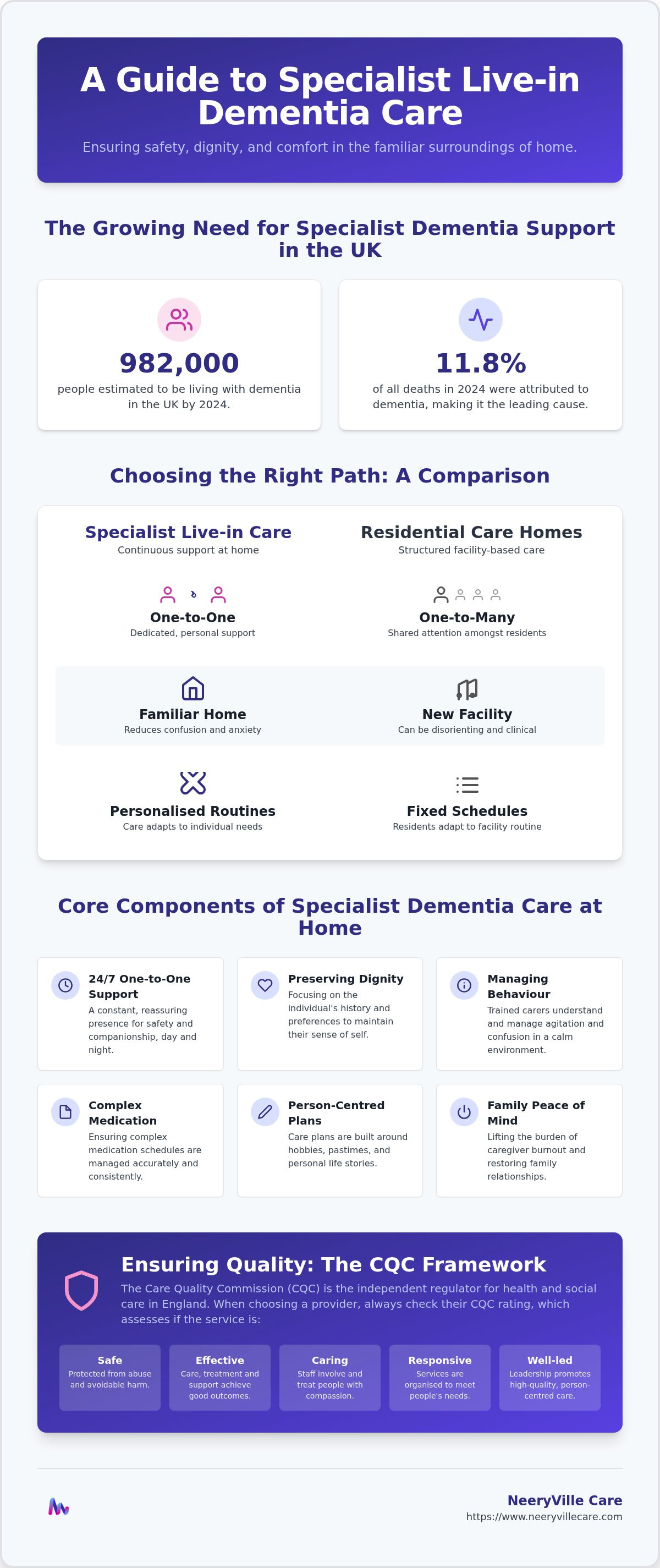
Safety and quality are anchored by the Care Quality Commission (CQC), the independent regulator for all health and social care in England. In 2026, the CQC utilizes the Single Assessment Framework to monitor providers. They ensure care is safe, effective, and well-led. Understanding these ratings is vital for London families, as it provides a transparent benchmark for the professional support entering your home. It offers the clinical authority needed to feel confident in your choice.
The Growing Need for Specialist Support in the Capital
By 2024, an estimated 982,000 people in the UK were living with dementia. It became the leading cause of death that same year, accounting for 11.8% of all deaths. These aren't just statistics; they represent families across London reaching a breaking point. General home care, whilst helpful for basic tasks, often lacks the depth required for complex memory needs. This is where live-in dementia care london services become essential. When family caregiving becomes unsustainable, a specialist live-in carer provides the constant, watchful presence that prevents accidents and reduces the isolation often felt in the middle of a busy city.
Person-Centred Care: More Than Just a Buzzword
True person-centred support means the care adapts to the individual, not the other way around. In London, this might mean ensuring a client can still enjoy their favourite morning walk through Hampstead Heath or visit a specific local bakery in Highgate they've frequented for decades. These small routines are the anchors of identity. We believe in matching caregivers based on personality and history, ensuring the relationship is built on genuine companionship. Our approach to dementia care at home focuses on these personal details, ensuring that even as memory fades, the person’s dignity and preferences remain at the very centre of their daily life.
What is Specialist Dementia Care at Home?
Specialist dementia care at home is a dedicated support model where a professional carer resides within your loved one’s house to provide continuous, one-to-one assistance. Unlike hourly visiting care, which involves brief calls for specific tasks, live-in dementia care london offers a constant presence. This level of support is vital for families who find that their loved one requires oversight during the night or struggles with the disorientation that follows a change in routine. A live-in carer becomes a steady anchor, managing everything from complex medication schedules to personal care and nutritious meal preparation.
The core of this service is the preservation of dignity. When a person living with dementia experiences a loss of executive function, they may feel vulnerable or frustrated. A specialist carer is trained to look beyond the symptoms, focusing on the individual’s history and preferences. While NHS guidance on dementia care homes outlines the structure of residential facilities, many families find that the one-to-one ratio at home allows for a more responsive and calm environment. It ensures that the person remains the protagonist in their own life story, rather than one of many residents in a busy ward.
Managing Behavioural Changes and Safety
Agitation and confusion are often responses to an environment that no longer makes sense. Professional carers use specific de-escalation techniques, such as validation therapy and gentle redirection, to soothe distress without the need for clinical intervention. In the context of a London terrace or flat, creating a dementia-friendly environment might involve improving lighting to reduce shadows or removing trip hazards. Live-in dementia care is a 24/7 professional partnership that prioritises safety without sacrificing the warmth of home. If you are currently struggling to manage these changes alone, you can speak with our compassionate team for guidance on the next steps.
The Role of Companionship in Memory Care
Social interaction is a powerful tool in slowing cognitive decline during the early and middle stages of the condition. Isolation often leads to depression, which can mimic or worsen memory problems. Specialist dementia care at home prioritises meaningful engagement. This might involve safe walks in local London parks, listening to favourite music, or simply sharing a cup of tea whilst discussing old photographs. These moments of connection help maintain neural pathways and provide the emotional security that is so often lost when a person is moved into an unfamiliar institutional setting.
Dementia Care Homes vs. Live-in Care in London
When comparing care options, the most striking difference lies in the level of individual attention. In a traditional residential care home, staff members are often responsible for multiple residents at once. This can lead to a reactive style of care where support is only provided when a need becomes urgent. Choosing live-in dementia care london ensures a dedicated 1:1 ratio. Your loved one receives the undivided attention of a professional who understands their specific triggers, preferences, and history. This constant presence allows for proactive support, catching small changes in health or mood before they escalate into a crisis.
Safety is a common concern for families, yet a move to an unfamiliar facility can often increase the risk of falls and confusion. A person living with memory loss relies on the "muscle memory" of their own home. They know the height of the steps, the location of the light switches, and the layout of the hallway. Removing these familiar anchors can lead to "transfer trauma," a period of intense distress and physical decline often seen during a move to institutional care. By maintaining a familiar environment, we provide a sense of continuity that a clinical ward simply cannot replicate.
Why Staying at Home Wins for Memory Loss
The "Anchor effect" is a vital clinical consideration in dementia support. Familiar sights, such as the view of a garden or the texture of a favourite armchair, act as sensory cues that reduce anxiety. Staying at home also preserves a person’s autonomy and sense of self. They can keep their cherished pets, choose their own meal times, and remain amongst the belongings that tell the story of their life. This independence is often the first thing lost in a residential setting, yet it is essential for maintaining a sense of purpose and emotional well-being.
Evaluating the Financial Investment
London remains the most expensive region for care in the UK, and understanding the investment is a key part of your planning. Research from 2026 shows that the average weekly cost for a residential dementia care home in London is £1,599, whilst a dementia nursing home averages £1,767 per week. Specialist live-in care often sits within a similar price bracket but offers the superior benefit of one-to-one support. For couples, the financial advantage is even more significant. Instead of paying for two separate beds in a care home, a single live-in carer can often support both individuals. This allows partners to stay together in their own home for much longer. Our specialist elderly care at home is designed to offer this level of high-quality, domestic stability whilst managing the practicalities of daily life.
How to Choose a Quality Care Agency in North London
Selecting an agency is about more than just signing a contract; it's about inviting a professional into the most private corners of your family life. You need clinical assurance and emotional compatibility. When interviewing potential providers, look for those that prioritise specialised training over general care certificates. Ask specifically: "How often is your staff updated on the latest dementia-specific techniques?" and "What is your protocol for managing night-time agitation?" A quality provider of live-in dementia care london should offer transparent, detailed answers that demonstrate a deep understanding of cognitive decline.
The Care Quality Commission (CQC) ratings are your primary tool for verifying safety and quality. For a home care agency, an "Outstanding" or "Good" rating focuses on whether the service is responsive and well-led. Don't just look at the overall grade. Read the specific report sections on "Safety" and "Caring" to see how the agency handles complex memory needs. This regulatory oversight provides the clinical authority you need to feel confident that your loved one is in capable hands.
Local knowledge is an underrated asset in the capital. An agency that understands the specific layout of North London boroughs can coordinate more effectively with local GPs in Hampstead or specialist pharmacies in Highgate. This familiarity ensures that practical logistics never get in the way of emotional support. When the agency knows the local community, they can better facilitate safe, meaningful outings that keep your loved one connected to the world they know.
Navigating the Assessment Process
A professional needs assessment should be a collaborative conversation. It typically takes place within the home, involving both the family and the person living with dementia. This process isn't just about clinical requirements; it's about life history. We look at everything from medication schedules to how they like their morning tea. For families facing a sudden decline or a hospital discharge, a rapid 24-hour response for care implementation is a vital marker of a responsive and highly organised agency.
Red Flags to Watch Out For
Consistency is the foundation of effective dementia support. If an agency has high staff turnover, it's a significant red flag. Frequent changes in personnel lead to confusion and distress for the client, who relies on familiar faces for a sense of security. Be wary of vague responses regarding emergency protocols or medication management. You deserve a partner who is as methodical as they are compassionate. Our specialist live-in care in Highgate is built on this foundation of stability and local expertise.
Compassionate Dementia Support in Highgate, Hampstead, and Beyond
NeeryVille Care is deeply rooted in the North London community. Our presence in Highgate, Hampstead, and across the N6, N8, and NW3 postcodes is more than just a service area; it's a commitment to our neighbours. We've built a local network of caregivers who don't just provide live-in dementia care london families can rely on; they understand the rhythm of life here. They know the quietest times for a stroll in Waterlow Park and the best accessible spots for a coffee in Hampstead Village. This local expertise ensures that even as a loved one’s cognitive world changes, their connection to their physical community remains intact.
The NeeryVille promise is simple: we provide professional clinical standards wrapped in domestic warmth. We believe that a carer shouldn't feel like a clinical visitor. They should feel like a steady, supportive partner who understands how to maintain a home’s soul whilst managing the complexities of medication and personal safety. Our CQC-regulated approach ensures that every procedure is robust, yet every interaction is gentle. We prioritise the individual over the process, ensuring that the relationship between the provider and your family is built on a foundation of trust and calm reliability.
Supporting the Whole Family
Caring for a relative with memory loss is a profound act of love, but it's also physically and emotionally exhausting. We often meet families at the point of collapse, where the 24/7 demands of caregiving have led to profound fatigue. Our role is to step in as the primary burden-lifter, allowing you to return to being a daughter, son, or spouse. By providing regular updates and maintaining transparent communication, we offer the peace of mind that has likely been missing for some time. If you feel you are reaching your limit, our guide on caregiver burnout support London offers practical advice on reclaiming your own well-being.
A Gentle Start to Your Care Journey
We know that in moments of crisis, every hour counts. NeeryVille offers a 24-hour commitment to responsiveness for families in North London. From your initial enquiry, we move at a pace that feels right for you, organising a no-obligation consultation in the comfort of your own home. This is a time for us to listen, to understand your loved one's story, and to begin building a plan that prioritises their dignity. You don't have to navigate this transition alone. We are here to provide the live-in dementia care london families trust, ensuring that the next chapter of your loved one's life is defined by safety, comfort, and the enduring warmth of home.
Reclaiming Peace of Mind for Your Family
Choosing the right support is a journey of reclaiming stability for both you and your loved one. We've explored how staying at home preserves dignity and how a one-to-one care ratio offers safety that traditional residential homes often struggle to match. By focusing on specialist live-in dementia care london families can ensure their relatives remain in the environment they love most. This continuity is a powerful clinical asset in managing symptoms and maintaining a sense of self.
NeeryVille Care stands as a steady guide in this process. We are CQC-regulated and fully insured, providing specialist dementia-trained caregivers who understand the specific needs of Highgate, Hampstead, and the wider North London area. Our commitment is to offer clinical excellence without losing the domestic warmth that makes a house a home. We are here to lift the burden of caregiving, allowing you to return to your role as a family member rather than a full-time carer.
You don't have to carry this weight alone. We are ready to partner with you, offering a simple solution to a complex emotional challenge. Let's start this conversation at a pace that feels right for your family.
Frequently Asked Questions
Is live-in dementia care safer than a residential care home in London?
Live-in care is often safer because it provides a dedicated one-to-one ratio that a busy residential home cannot match. By receiving live-in dementia care london residents avoid the confusion of new surroundings and frequent staff rotations. The carer learns the individual's specific habits and triggers, allowing them to anticipate needs and prevent falls or agitation before they occur.
How do London dementia care agencies screen their live-in caregivers?
Reputable agencies use a rigorous screening process that includes Enhanced DBS checks and thorough reference verification. We look for specialist dementia training and a genuine aptitude for compassionate companionship. This ensures that the professional entering your home is not only clinically capable but also emotionally suited to providing long-term, stable support within a domestic setting.
Can dementia care at home manage aggressive behaviour or wandering?
Specialist carers are trained in de-escalation techniques that safely manage agitation and wandering within the home. By using validation therapy and gentle redirection, they can soothe distress without the need for clinical intervention. Staying in a familiar environment reduces the primary triggers for these behaviours, making it easier to maintain a calm and secure atmosphere.
Will my loved one have to move if their dementia symptoms become severe?
A primary benefit of live-in support is its ability to adapt as symptoms progress. Most people can remain in their own homes even as their needs become more complex, as the care plan is updated to include increased personal care or medication support. This continuity prevents the trauma of a late-stage move, ensuring they stay amongst their cherished belongings and memories.
How much does private dementia care cost in North London compared to a home?
While costs vary, private live-in care in London is often comparable to the fees of high-quality residential facilities. In 2026, the average weekly cost for a London residential dementia home is £1,599, whilst a nursing home averages £1,767. Choosing home-based support means your investment goes directly into one-to-one care rather than the overheads of a large institutional building.
What is the role of a CQC-regulated agency in dementia support?
A CQC-regulated agency provides an essential layer of safety and clinical authority. The Care Quality Commission monitors providers to ensure they meet strict standards for being safe, effective, and well-led. This regulation means your agency is held accountable for the quality of training and the safety of the care delivered in your loved one's home.
Can I get live-in dementia care for a couple staying together in London?
Live-in dementia care for couples is a practical and compassionate way to keep partners together. It is often significantly more cost-effective than paying for two separate beds in a residential home. A single carer can often support both individuals, allowing them to maintain their shared life and routines within the comfort of their own property.
How quickly can dementia care be set up in areas like Highgate or Hampstead?
In areas like Highgate and Hampstead, specialist support can be implemented very quickly. We offer a rapid 24-hour response for care implementation following an initial enquiry. This speed is vital for families facing a sudden decline in health or a hospital discharge, ensuring that professional help is in place exactly when it's needed most.


