

NHS CHC in London: A Compassionate Guide to Continuing Healthcare Funding
- Daniel Johnson

- 3 hours ago
- 12 min read
You've spent weeks balancing hospital visits and sleepless nights, only to be met with a mountain of paperwork that feels impossible to climb. It's a heavy, quiet burden. Many families across the capital share this exact anxiety. You might worry that the only way to afford essential support is by selling a cherished family home, or you may feel lost in the gap between social care and healthcare. We understand that the wait for answers feels long when your loved one's comfort is at stake.
Securing NHS CHC in London should be a path toward peace of mind, not a source of further distress. We are here to help you move through this complex system with clarity and compassion, ensuring you understand exactly how to trigger an assessment and meet the primary health need criteria. This guide explains the current 2026 frameworks, the 28 day decision timeline, and how to use a Personal Health Budget to provide high-quality care at home. We will walk you through the eligibility process and the practical steps to keeping your loved one safe, dignified, and exactly where they belong.
Table of Contents
What is NHS CHC in London and Who is Eligible?
NHS Continuing Healthcare (CHC) is a complete package of ongoing care that is arranged and funded solely by the NHS. Unlike standard social care, which is often managed by local councils, CHC is designed for adults who have significant, long-term health needs. If your loved one is eligible, the NHS covers the full cost of their care, whether that support is provided in a nursing home or through specialised live-in care in Highgate. This funding is not a benefit; it is a legal entitlement for those whose needs have reached a specific clinical threshold.
Eligibility for NHS CHC in London is not determined by a specific diagnosis or a particular condition. Having dementia, for example, does not automatically guarantee funding. Instead, the decision rests on whether the individual has what is known as a "primary health need." This assessment is conducted within the NHS Continuing Healthcare framework, which ensures that decisions are made based on the nature of the care required rather than the name of the illness.
The Primary Health Need Test
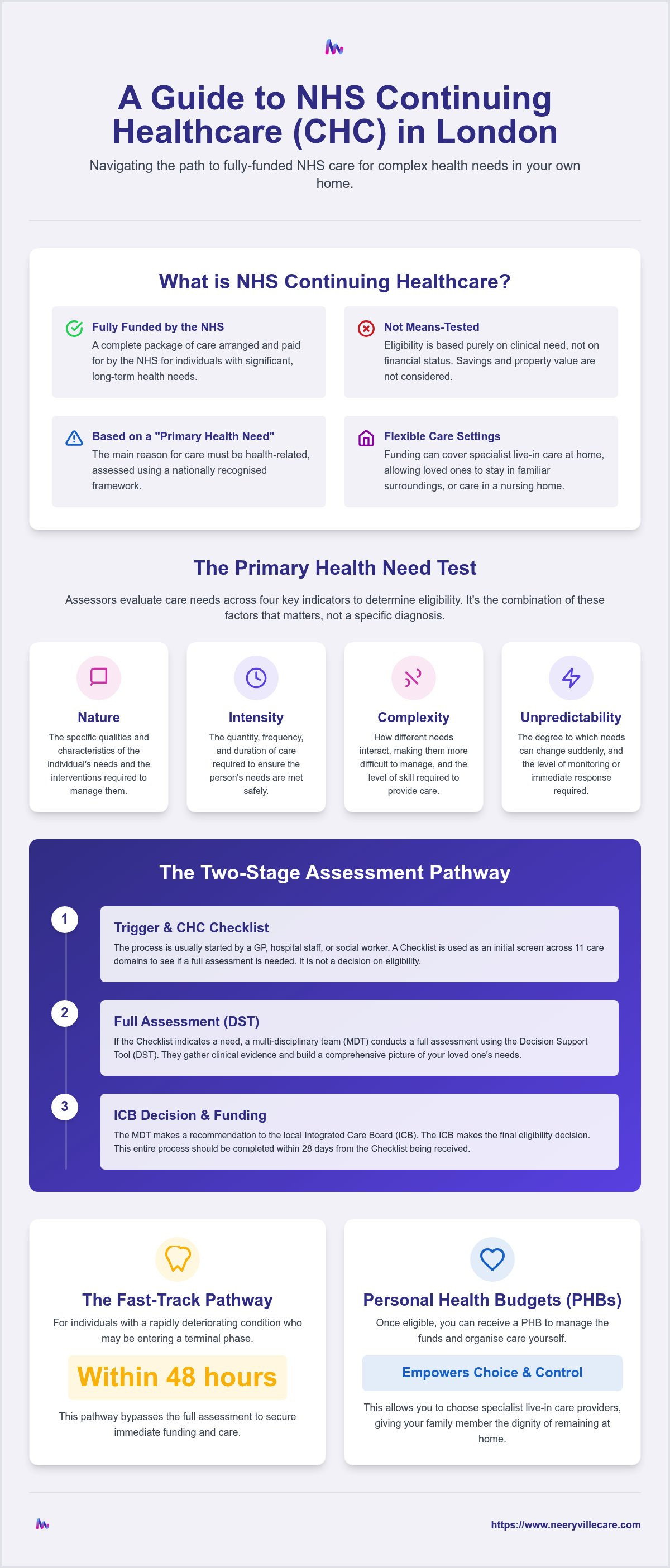
A primary health need exists when the main aspects of a person's care are focused on managing their health rather than social needs. To determine this, assessors look at four key indicators: nature, intensity, complexity, and unpredictability. They want to understand the "nature" of the condition and how it affects the person. They measure the "intensity" by looking at how often care is needed. "Complexity" refers to how different symptoms interact, whilst "unpredictability" looks at how quickly a person's health can change.
Consider a family seeking post-stroke care at home for a parent. If that parent requires frequent, specialised intervention to manage swallowing difficulties, alongside unpredictable cognitive changes and complex medication regimes, they may meet the threshold. It is the combination of these factors that creates a health need that goes beyond what social services typically provide.
CHC Funding vs. Social Care: The London Context
In our capital, healthcare is managed by Integrated Care Boards (ICBs). As of April 2026, there are 36 ICBs across England, with bodies like the North Central London ICB overseeing high-cost areas such as Highgate and Hampstead. Understanding which board manages your area is vital. This is because CHC funding is entirely separate from local authority social care. Social care is means-tested, meaning if your loved one has assets or savings above a certain limit, they must pay for their own support.
Securing CHC is a significant relief for families because it bypasses the means test entirely. It ensures that the cost of care is met by the state, regardless of your financial situation or the value of your home. In London's expensive property market, this protection offers a sense of security and stability. It allows you to focus on your role as a daughter, son, or partner, rather than a financial manager; it prioritises the individual's dignity over their bank balance.
The CHC Assessment Pathway: From Checklist to Decision
The journey toward securing support is often paved with uncertainty, but understanding the steps can offer a much-needed sense of control. The process of applying for NHS CHC in London typically begins when a health or social care professional notices that a person's needs have become more complex. This might be triggered by a GP, a social worker, or hospital staff during discharge planning. It's a structured journey designed to ensure that those with the highest needs receive the funding they deserve. For many families, this process feels like a test. It's better to view it as a collaborative effort to map out your loved one's daily reality and ensure they are fully heard.
Stage 1: The CHC Checklist
The Checklist is a screening tool used to decide if a full assessment is necessary. It isn't a final decision. Instead, it looks at 11 different care domains, such as mobility, nutrition, and behaviour. Assessors use a scoring system of A, B, or C to indicate the level of need. If the scores suggest a high level of complexity, you move forward to the next stage. Having a professional carer present during this screening can be invaluable. They provide specific, evidence-based examples of daily challenges that might otherwise be overlooked. You can find more detail on this in the official government guidance on CHC.
Stage 2: The Full Assessment and the MDT
If the checklist is positive, a Multidisciplinary Team (MDT) will carry out a full assessment. This team usually includes at least two professionals from different healthcare backgrounds. They use the Decision Support Tool (DST) to look deeply into 12 domains of care. This is where your voice is most vital. As a family member, you know the nuances of your loved one's health better than anyone. You see the small shifts in mood or the subtle difficulties in communication that a brief clinical visit might miss.
Preparation is key here. Gathering evidence like care logs, medication charts, and specialist reports from dementia care at home providers creates a clearer picture for the MDT. The Integrated Care Board (ICB) aims to make an eligibility decision within 28 calendar days of receiving a positive checklist. This timeframe is a national target, ensuring that families aren't left waiting indefinitely for the support they need. If you feel overwhelmed by the evidence-gathering process, our team can offer gentle guidance and support during these discussions.
Securing Care at Home: Personal Health Budgets in London
Once eligibility is confirmed, the focus shifts to the practicalities of daily life. For many families, the ultimate goal is to avoid residential care and remain in the comfort of their own home. This is entirely possible. NHS CHC in London can be used to fund comprehensive live-in care in Highgate or visiting support, ensuring that clinical needs are met without sacrificing the warmth of a familiar environment. When care is delivered at home, it preserves the routines that provide safety and meaning. It allows for the quiet dignity of sleeping in one's own bed and the comfort of being surrounded by lifelong memories.
CHC funding is designed to cover the full cost of your care package when provided by a regulated agency. This means you don't have to worry about hourly rates or hidden fees. The NHS budget is allocated to meet the specific health needs identified during your assessment, providing a simple, safe solution for complex care requirements.
How Personal Health Budgets (PHBs) Work
In London, there is a significant drive toward giving families more choice. This is achieved through Personal Health Budgets. As of early 2026, nearly 30,000 adults eligible for CHC in England were using a PHB to tailor their support. According to NHS guidance on Continuing Healthcare, there are three main ways to manage these funds:
Notional Budget: The NHS health team arranges the care directly. You have less administrative work but also less choice over specific providers.
Third Party: An organisation, such as a regulated care agency, manages the money and the care for you. This is a popular choice because it removes the burden of payroll and employment law whilst maintaining high standards.
Direct Payment: You receive the funds and manage the care yourself. This offers the most control but requires significant time to handle the legalities of being an employer.
Many families in North London prefer the Third Party model. It offers a straightforward path through a complex system. It provides the flexibility to choose care that respects specific cultural or personal preferences whilst ensuring all clinical requirements are managed by experts.
Choosing a CQC-Regulated Provider in North London
Safety must always be the priority. When using CHC funding, selecting a provider regulated by the Care Quality Commission (CQC) is a non-negotiable step. This regulation serves as a definitive promise of quality and domestic well-being. For those requiring specialist dementia care at home, CQC oversight ensures that the support is not just kind, but clinically sound. At NeeryVille Care, we collaborate closely with London ICBs to ensure the transition to funded care is seamless. Our local presence in Highgate and Hampstead means we understand the community and the high standards of care our neighbours expect.
Fast-Track CHC and Navigating Eligibility Disputes
Sometimes, the need for care is sudden. It's urgent. In these moments of crisis, the standard 28-day assessment timeframe is simply too long. The Fast-Track pathway exists to ensure that families facing the most difficult circumstances receive immediate support without administrative delay. It's a vital safety net. It provides a sense of stability when everything else feels uncertain. Securing NHS CHC in London through this route prioritises human dignity over process, ensuring that clinical support is in place exactly when it's needed most.
When is Fast-Track CHC Appropriate?
This pathway is reserved for individuals with a "rapidly deteriorating condition" who may be entering the terminal phase of their life. In such cases, the priority is comfort. It's about peace. A single clinician can authorise funding immediately, bypassing the need for a full Multidisciplinary Team meeting. The national target for implementing end of life care through this route is just 48 hours. This rapid response provides families with instant peace of mind. It allows you to focus on being a family again, rather than a care coordinator, whilst ensuring professional support is present in the home.
Challenging a 'Not Eligible' Decision
Receiving a "not eligible" letter can be devastating. It often feels like a rejection of your loved one's daily struggle. However, a rejection is not necessarily the final word. Many families successfully challenge these decisions through the appeals process. Common reasons for rejection include a failure to capture the "unpredictability" of a condition or downplaying the "intensity" of the care required. You have the right to be heard. You have the right to challenge the findings if they don't reflect the reality of your domestic life.
The first step is the "Local Resolution" stage. This is a formal conversation with your Integrated Care Board (ICB) to address specific disagreements. If this doesn't resolve the issue, you can request an Independent Review. During this time, your loved one might be eligible for NHS-Funded Nursing Care (FNC). For the 2026/27 period, the standard FNC rate is £267.68 per week. Whilst this doesn't cover the full cost of NHS CHC in London, it provides some financial relief whilst you pursue a full appeal. Seeking advice from advocacy groups like Beacon or Age UK can provide the expert backing you need to navigate these disputes with confidence.
How NeeryVille Care Supports Your CHC Journey in London
The path toward securing NHS CHC in London is often an emotional one. It's a journey that requires patience, resilience, and a clear understanding of clinical needs. At NeeryVille Care, we see ourselves as more than just a provider; we are your steady guide through these complexities. Our commitment is to balance clinical excellence with a gentle, domestic touch. We understand that whilst the funding is essential, the quality of the daily interaction is what truly matters to your family. We help you gather the necessary evidence for assessments and reviews, ensuring that every nuance of your loved one's health is documented with precision and care.
Transitioning into a funded care package is a significant milestone. We organise companionship care at home alongside necessary medical support, creating a holistic environment where your loved one feels safe and valued. This partnership is built on transparency and a shared goal: maintaining dignity in the place they love most. We work alongside families to lift the administrative and emotional burden, providing a simple solution to what often feels like an overwhelming problem.
Expertise in Complex Conditions
Our team is specifically trained to manage health needs that meet the "primary health need" threshold. We provide specialised post-stroke care at home, focusing on rehabilitation and the management of complex symptoms. Our caregivers are highly trained to perform clinical tasks under the supervision of healthcare professionals, ensuring safety is never compromised. Despite the medical nature of the support, our approach remains deeply person-centred. We see the individual first, focusing on their preferences and personality rather than just their diagnosis.
Starting Your Care Journey with Us
Moving from an NHS assessment to active support should be a smooth, patient process. We have streamlined this transition to ensure there is no gap in care. Our local presence in Highgate, Crouch End, and Hampstead allows us to be incredibly responsive to the needs of North London families. We understand the local landscape and the specific requirements of the North Central London ICB. If you are ready to discuss how we can support your family, contact us today. We are here to offer a reassuring conversation, a listening ear, and a promise of constant, reliable support throughout your care journey.
Taking the Next Step for Your Family's Comfort
Securing the right support for a loved one is a journey of deep love and quiet resilience. You now have the tools to identify a primary health need and navigate the assessment pathway with clarity. By understanding how Personal Health Budgets work, you can ensure your family member remains in the familiar surroundings of their own home. Accessing NHS CHC in London is a legal right. It protects your family's future whilst providing the high-quality care your loved one deserves.
NeeryVille Care has been serving families in Highgate, Hampstead, and North London since 2022. As a CQC-regulated provider and specialists in live-in and dementia care, we offer more than clinical assistance. We provide a partnership built on safety and personal dignity. We are here to lift the heavy burden of caregiving, allowing you to focus on the relationships that matter most.
You don't have to walk this path alone. We are ready to guide you at a pace that feels right for your family.
Frequently Asked Questions
Is NHS Continuing Healthcare means-tested?
No, NHS Continuing Healthcare is not means-tested. Unlike local authority social care, which considers your savings and property value, CHC is funded entirely by the NHS based on your clinical requirements. This means your financial situation has no impact on your eligibility. It is a vital safeguard for families in high-cost areas who want to protect their assets whilst ensuring their loved one receives professional support.
Can I get CHC if I have dementia?
You can receive CHC if you have dementia, but the diagnosis itself doesn't guarantee funding. Eligibility depends on whether your care needs are primarily health-based rather than social. For instance, if a person's dementia leads to unpredictable behaviour, complex medication management, or severe mobility issues, they are more likely to meet the threshold for NHS CHC in London. Assessors look at the intensity and complexity of the daily support required.
What is the difference between NHS CHC and NHS Funded Nursing Care (FNC)?
The main difference lies in the level of funding and where it applies. NHS CHC covers the full cost of all your care, whether at home or in a care facility. In contrast, NHS Funded Nursing Care (FNC) is a weekly contribution paid directly to a nursing home to cover the cost of registered nursing care. For the 2026/27 period, the standard FNC rate is £267.68 per week. FNC only applies if you are in a care home and do not qualify for full CHC.
How long does an NHS CHC assessment take in London?
The national target for an eligibility decision is 28 calendar days from the moment the Integrated Care Board (ICB) receives a positive Checklist. In London, ICBs like North Central London work to this timeframe to ensure families aren't left in limbo. Whilst some complex cases may take longer, you should expect a clear answer or a progress update within this one-month window to help you plan for the future.
Can I top up my NHS CHC funding if I want a more expensive care package?
No, you cannot usually "top up" CHC funding for essential health needs because the NHS is responsible for meeting the full cost of your assessed care. However, you may be able to pay for additional "lifestyle" services that aren't part of your clinical care plan, such as a larger room in a facility or extra companionship hours. It is important to discuss these options with your ICB to ensure any private arrangements don't conflict with your funded package.
What happens if my health improves? Will I lose my CHC funding?
Your eligibility is regularly reviewed, typically three months after the initial decision and then annually. If your health improves significantly and you no longer meet the "primary health need" criteria, your funding may be withdrawn. This can be a worrying time for families. If this happens, your care will transition to a joint-funded model or local authority social care, which may then be subject to a financial means test.
Can I choose my own care agency if I have CHC funding?
Yes, you have the right to choose your own provider by using a Personal Health Budget (PHB). This is a common way to manage NHS CHC in London, allowing families to select a CQC-regulated agency that matches their personal preferences and cultural needs. You can opt for a "Third Party" arrangement where the agency manages the budget for you; this provides a simple, safe way to keep your loved one at home with specialist support.
How do I apply for Fast-track CHC for a terminal relative?
You don't apply for Fast-track CHC yourself; instead, a clinician, such as a GP or hospital consultant, must trigger the process. They use a specific Fast-Track Pathway Tool for individuals with a rapidly deteriorating condition who may be entering the terminal phase. Once authorised, the target for implementing the care package is just 48 hours. This ensures that families in crisis receive immediate, professional help without the stress of a lengthy assessment.


