

CQC Regulated Activities: A Guide to Safety Standards in Home Care
- Daniel Johnson

- May 27
- 13 min read
Updated: May 29
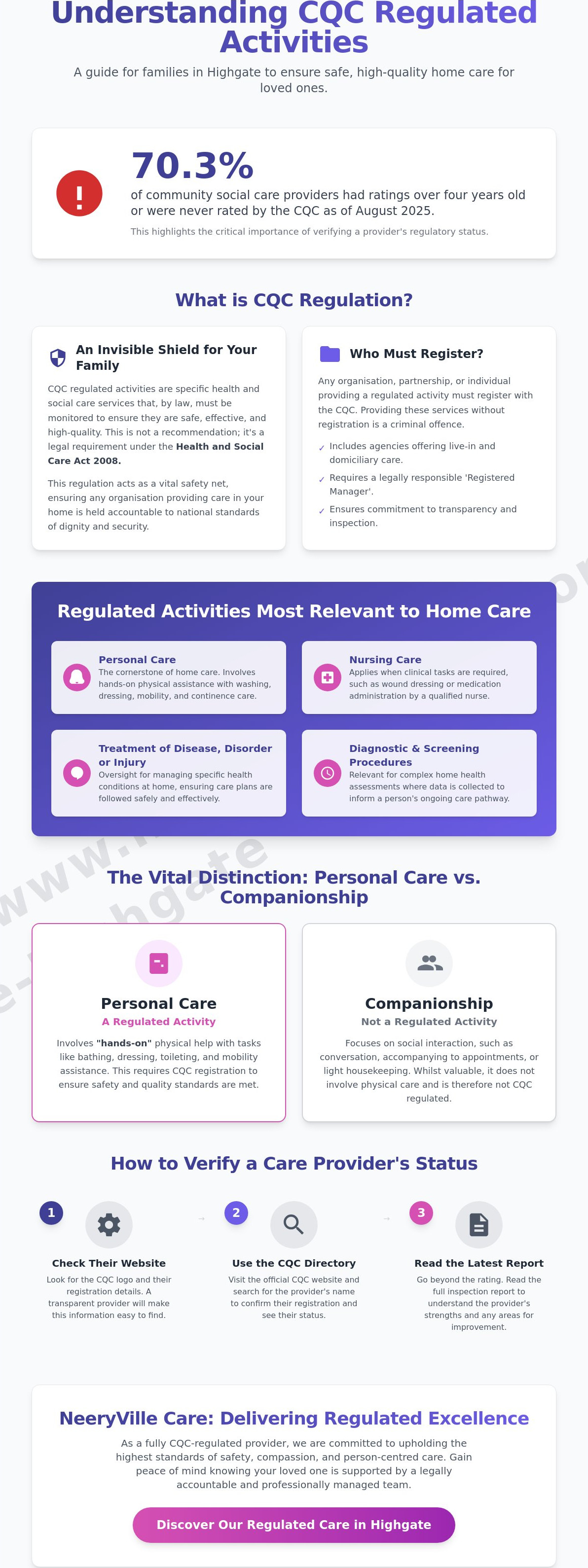
Did you know that as of August 2025, a staggering 70.3% of community social care providers had either never been rated by the CQC or were operating with ratings over four years old? This statistic is understandably startling when you're searching for reliable support. Understanding cqc regulated activities is the first step in ensuring your family receives the professional, safe care they need. It's about more than just a certificate; it's a clinical commitment to your loved one's dignity and security.
We know the confusion that comes with care terminology. You're likely feeling anxious about the safety of a vulnerable relative, perhaps even fearing you might accidentally choose an unregistered agency. It's a heavy burden to carry alone. This guide will show you how these essential safety standards protect your family whilst you choose home care in Highgate. We'll explore the 14 regulated activities and the CQC's move toward continuous assessment, giving you the confidence to identify a high-quality provider. By the end, you'll have a clear understanding of the legal safety nets designed to keep your loved ones safe at home.
Key Takeaways
Understand the legal framework that ensures home care providers are held to high standards of safety and clinical oversight.
Learn how to identify which cqc regulated activities, such as personal care, are essential for your loved one’s specific needs in a domestic setting.
Discover practical steps to research local London providers and look beyond simple ratings to find truly safe, well-led care.
Gain peace of mind by understanding how rigorous inspections act as an invisible shield for families choosing live-in or domiciliary care.
Find out how a person-centred approach transforms regulatory compliance into a warm, supportive partnership for Highgate residents.
Table of Contents
What Are CQC Regulated Activities? Defining the Standard of Care
When you first begin looking for support for a parent or spouse, the terminology can feel like a maze. At its heart, the term cqc regulated activities refers to a specific list of health and adult social care services that, by law, must be monitored to ensure they are safe. These aren't just suggestions. They're strict requirements set out in the Health and Social Care Act 2008 (Regulated Activities) Regulations 2014. The law makes a clear distinction between the 'provider', which is the organisation or person delivering the care, and the 'regulated activity', which is the specific type of help being given. Think of the regulation as an invisible shield. It ensures that whilst a carer is in your home, they're backed by a system of accountability that prioritises your relative's dignity above all else.
The Legal Framework for Care in England
The Care Quality Commission (CQC) acts as the independent regulator for all health and social care services in England. Their primary goal is simple: to make sure care is safe and high-quality. To achieve this, they've established 'Fundamental Standards' that no provider should ever fall below. These standards cover everything from safety and respect to the suitability of staff. It's a serious matter; providing these activities without being registered is actually a criminal offence. This legal weight provides a vital safety net for families, ensuring that unregistered agencies cannot operate without oversight.
Who Needs to Register for Regulated Activities?
Any organisation, individual, or partnership that carries out a regulated activity must register. This includes agencies providing live-in care Highgate families rely on for long-term support. A key part of this process is the appointment of a Registered Manager. This person is legally responsible for the day-to-day quality of the service. They're the steady hand at the helm. When you're browsing for help, always look for the CQC tick-mark on a provider's website. It's a symbol of transparency. It tells you that the provider has opened their doors to inspectors and is committed to being held to account for the safety of your loved ones.
The 14 Regulated Activities: Which Ones Matter for Home Care?
Whilst the CQC monitors fourteen distinct categories of care, most families in Highgate will only ever need to navigate a small handful of them. These specific cqc regulated activities form the legal boundary between a friendly visit and professional clinical support. In a home setting, the focus narrows to the activities that ensure safety, dignity, and health are maintained within your own four walls. Understanding these helps you see exactly where the regulator's protection begins. It's about ensuring that the help your loved one receives isn't just kind, but also clinically sound and legally compliant. For those interested in how these professional clinical standards apply to other areas of health and wellness, you can find out more about the protocols used for luxury infusions.
Personal care: This is the cornerstone of home and visiting care Highgate residents rely on. It involves physical assistance with the most private aspects of daily life.
Nursing care: This applies when clinical intervention is required. It's often necessary for those with complex health needs that go beyond social support.
Treatment of disease, disorder, or injury: This provides oversight for specialist medical support, ensuring that care plans for specific conditions are managed safely.
Diagnostic and screening procedures: Whilst less common, this is relevant for certain complex home health assessments where data is collected to inform a care path.
Personal Care vs. Companionship: The Vital Distinction
It's a common misconception that all help at home is the same. Personal care is a regulated activity that involves "hands-on" help. This includes assistance with washing, dressing, and toileting. Because these tasks involve physical contact and a high level of vulnerability, the CQC's oversight is non-negotiable. Companionship, on the other hand, often involves chatting, sharing a cup of tea, or light housekeeping. These are often unregulated activities. The risk arises when families use unregulated "introductory agencies" for complex personal care needs. Without the CQC's shield, there's no independent body checking that carers are properly trained or that safety protocols are followed. It's a gamble that few families can afford to take when a relative's safety is at stake.
Nursing and Specialist Medical Activities
Sometimes, a care plan needs to move from gentle social support to more clinical oversight. This transition happens when a loved one's health needs become more complex, requiring a different level of expertise. In these moments, the requirement for qualified oversight becomes vital. Regulated activities like nursing care ensure that every medical aspect of the plan is reviewed with clinical precision. We focus on making this transition feel seamless and safe for everyone involved. If you're feeling overwhelmed by these choices, you can always reach out for a quiet conversation about your family's needs. We're here to help you understand how these standards apply to your specific situation, ensuring that the care your relative receives is always appropriate, legal, and deeply respectful.
Why CQC Regulation is Essential for Highgate Families
Inviting a stranger into your home to care for a vulnerable parent is an act of immense trust. It's a decision often made during moments of crisis or exhaustion, where the primary concern is simply finding someone reliable. This is where the framework of cqc regulated activities becomes your greatest ally. Rather than relying on gut feeling alone, regulation provides a structured, clinical guarantee that the service you choose is held to national standards. It transforms a private arrangement into a professional commitment. For families in Highgate, this oversight acts as a constant, watchful eye, ensuring that the warmth of domestic support is always balanced by the rigour of professional safety.
The Five Key Questions Every Inspector Asks
The CQC doesn't just glance at paperwork. They dig deep into the daily reality of care by asking five fundamental questions. First, they ask: is the service safe? This means protecting people from abuse and avoidable harm. Second, they look at effectiveness. They want to see that the care is achieving good outcomes and actively maintaining a person's quality of life. Finally, they assess if the service is truly caring. This goes beyond the tasks themselves. It's about whether staff treat people with kindness, dignity, and respect. These questions ensure that the heart of the service remains focused on the individual, not just the process.
To ensure they remain responsive and safe 24/7, many high-quality care providers partner with Contesto for expert out-of-hours management and operational support.
Accountability and Your Right to Complain
Regulation gives your family a powerful voice. It provides a clear, legal pathway for feedback and formal complaints that unregistered agencies simply cannot match. If standards ever slip, you aren't alone. You have a governing body to report to, and the CQC has the authority to take enforcement action against providers who fail to meet the mark. This accountability is the foundation of true peace of mind. Knowing that your live-in care in Highgate meets these national benchmarks allows you to step back from the role of "inspector" and return to being a supportive daughter, son, or spouse. It's about letting us carry the regulatory burden whilst you focus on the relationship that matters most.
How to Verify and Research a Care Provider’s Status
Taking control of your relative's care begins with a simple search. The CQC online directory is a powerful tool for families in Highgate, allowing you to filter by postcode and specific service types. When you find a potential agency, your first task is to check their "Scope of Registration". This section lists the specific cqc regulated activities the provider is legally authorised to perform. If you require personal care or medication support, but the agency isn't registered for these, they are operating outside their legal remit. It's a clinical boundary that exists solely for your family's protection.
Professional accountability is anchored by the Registered Manager. This individual is legally responsible for the safety and quality of the service. On the CQC website, you should see their name clearly listed. If an agency cannot name their Registered Manager or if the position is vacant for a long period, it's a sign that leadership oversight might be lacking. Identifying "unregistered" providers is equally vital. Some organisations act as "introductory agencies", merely matching you with a carer without taking responsibility for the care provided. Whilst this might seem simpler, it removes the regulatory safety net that ensures staff are vetted, trained, and supervised.
Understanding CQC Ratings: What Do They Mean?
The CQC uses four main ratings: Outstanding, Good, Requires Improvement, and Inadequate. In January 2026, the CQC published 181 care home and community reports; only 7 were Outstanding, whilst 87 were rated Good and 72 were told they required improvement. A "Good" rating is the gold standard for reliable visiting care in Highgate. It confirms the service is safe, well-led, and effective. If a provider is "Newly Registered", they may not have an inspection report yet. In these cases, look at their registration date and the experience of their management team to build a picture of their reliability.
Questions to Ask Your Potential Care Agency
Don't be afraid to ask direct questions during your initial phone call. A transparent provider will welcome your diligence. You might consider asking:
"Are you registered for the activity of personal care, and can I see your CQC certificate?"
"When was your last inspection, and what were the specific findings regarding safety?"
"How do you ensure your staff follow CQC fundamental standards during every home visit?"
We believe that every family deserves total transparency when making these life-changing decisions. If you're unsure how to interpret a report or need help understanding the registration status of a local service, we're here to guide you. You can contact our Highgate team today for a straightforward, supportive conversation about finding the right path for your loved one.
NeeryVille Care: Delivering Regulated Excellence in Highgate
At NeeryVille Care, we don't view regulation as a hurdle. We see it as a promise. Our commitment to cqc regulated activities goes beyond simple compliance; we strive to set a benchmark for excellence in every Highgate home we enter. We understand that you're looking for more than a service. You're looking for a partner who values your relative's history, preferences, and personal dignity. Our person-centred approach ensures that we organise care around the individual, not just a list of tasks. Whether it's help with morning routines or complex medication support, every action is guided by the same clinical precision and domestic warmth.
Staying at home is often the safest and most comforting choice for a loved one. It provides a sense of continuity that a residential setting simply cannot replicate. To support this, our London team undergoes rigorous training and continuous professional development. We invest in our staff because we know they're the ones delivering on our promise of safety every day. This culture of constant learning means our carers are always up to date with the latest safety protocols and best practices in adult social care; to learn more about how these professional standards are maintained, you can check out IntegraSense. It's about providing a level of reliability that lets you breathe a little easier.
This commitment to professional development is a standard shared by other leading London institutions; for instance, you can visit Nadirah London Beauty Clinic & Academy to see how they maintain high standards in beauty education and clinical practice.
Similarly, the Beautiful World Training Academy is dedicated to raising professional benchmarks through specialised vocational training, ensuring that high standards of clinical practice are met across the UK.
Our Approach to Personal and Domiciliary Care
Maintaining professional dignity is at the heart of how we manage home help in Highgate. Our Registered Manager plays a vital role here, acting as a bridge between clinical requirements and social well-being. They provide the leadership oversight that CQC inspectors look for, ensuring that every care plan is safe and effective. We believe in total transparency. That's why we provide continuous monitoring and regular family updates. You'll never be left wondering about the quality of care your relative is receiving; you'll have the evidence of it in every interaction.
Starting Your Care Journey with Confidence
The transition to professional support should feel like a relief, not a stressor. When you first reach out, we'll arrange a regulated assessment in your home. This is a quiet, methodical process where we listen to your concerns and map out a plan that feels right for everyone. We take great care in matching caregivers based on both their clinical skills and their personality. It's about finding that right "fit" whilst always maintaining clear professional boundaries. We're here to lift the burden from your shoulders. Contact us today for a reassuring conversation about your family's needs, and let's find a path forward together.
Choosing Safety and Dignity for Your Loved One
Deciding on the right path for a relative's support is a profound act of love. It's a transition that deserves clarity, safety, and a steady hand to guide the way. We have explored how the framework of cqc regulated activities acts as a vital safety net; this ensures professional help is always anchored by clinical accountability. This knowledge is equally valuable when seeking other specialist clinical support, such as choosing a CQC-approved ADHD Clinic for a family member's diagnostic assessment. By understanding how to verify a provider's status and the importance of the five key inspection questions, you've gained the tools to protect your family from unregulated risks. Knowledge is the first step toward peace of mind.
As a CQC Regulated Provider and specialist dementia and live-in care experts, we take this responsibility seriously. We offer tailored support across Highgate and North London, prioritising the emotional well-being of our clients alongside their physical needs. You don't need to navigate this complex landscape alone. Our compassionate team is here to listen, support, and provide the professional excellence your family deserves. We are ready to help you create a safe, supportive environment where your loved one can thrive.
Speak with our Highgate care experts about regulated support for your family
The right care doesn't just change a routine; it restores a sense of security and home. We look forward to helping you find that balance.
Frequently Asked Questions
What are the 14 CQC regulated activities?
The 14 activities include personal care, nursing care, and the treatment of disease, disorder, or injury. Other categories cover specialized medical functions such as surgical procedures, ambulance services, and diagnostic and screening procedures—this includes specialized services like a private pregnancy scan Mansfield. Whilst many of these apply to hospitals or clinics, home care providers focus predominantly on personal care and, where necessary, nursing support to ensure safety within a domestic setting.
Is personal care a regulated activity?
Yes, personal care is one of the primary cqc regulated activities performed in a home environment. It involves "hands-on" physical assistance with tasks such as washing, dressing, toileting, or eating. Because these activities involve a high level of vulnerability, any agency providing them must be registered. This ensures they are held to national standards of safety, dignity, and professional conduct.
Does a companionship service need to be CQC registered?
No, companionship services typically don't require CQC registration if they don't involve "hands-on" personal care. Activities such as chatting, light housekeeping, or meal preparation are considered unregulated. However, many families still prefer to use a registered provider for companionship. This choice offers peace of mind that staff are rigorously vetted, professionally trained, and supervised by a Registered Manager.
Can I hire an unregistered carer privately in Highgate?
You can hire a private carer directly, but this means you become the legal employer and take on all responsibility for their vetting and supervision. Hiring privately removes the safety net of CQC oversight. Without registration, there's no independent body checking that the carer follows safety protocols or maintains clinical standards. It's often a significant burden for families already facing the stress of caregiving.
How do I know if a care agency is CQC regulated?
You can verify an agency's status by searching the CQC's online directory or checking for the CQC tick-mark on the provider’s website. Every registered agency is legally required to display their latest rating and provide a direct link to their most recent inspection report. This transparency allows you to see exactly how the regulator has assessed their safety and leadership before you make a commitment.
What happens if a care provider performs regulated activities without registration?
Performing regulated activities without CQC registration is a criminal offence in England. The CQC has the authority to take enforcement action, which can include issuing fixed penalty notices or prosecuting the provider. These strict rules exist to protect families from "cowboy" agencies that might bypass essential safety checks. Choosing a registered provider ensures your loved one is protected by a professional, legal framework.
Does the CQC regulate live-in care differently from visiting care?
The CQC applies the same fundamental standards to both live-in care and visiting care. They use a Single Assessment Framework to judge if a service is safe, effective, caring, responsive, and well-led. Regardless of whether a carer stays in the home or visits for a few hours, the provider must demonstrate the same level of clinical oversight and person-centred support to maintain their registration.
How often does the CQC inspect home care providers in London?
Inspection frequency has shifted toward a model of continuous assessment rather than fixed periodic visits. The CQC now collects evidence from families, staff, and digital records throughout the year to update ratings more frequently. As of August 2025, the regulator is working through a backlog, aiming to complete 9,000 assessments by September 2026. This move ensures that a provider's rating reflects their current performance.


Comments