

Choosing Home Care in London: The Definitive Guide for Families in 2026
- Daniel Johnson

- 15 hours ago
- 12 min read

You are sitting at a kitchen table in Hampstead, watching your father struggle with a simple kettle, knowing that the conversation about support can no longer be delayed. It's a quiet, heavy moment. You worry that bringing in help means a loss of his independence, yet the fear of an accident keeps you awake at night. Choosing home care in London shouldn't feel like a betrayal of your loved one's dignity. It's a deeply personal decision; it's natural to feel overwhelmed by technical jargon and the fear of picking an unreliable provider.
We understand that you're looking for more than just a checklist of tasks. You're looking for a partnership built on trust and clinical excellence. This guide provides the clarity you need to make an informed choice with absolute confidence, ensuring your loved one receives personalised, high-quality support whilst remaining in their own home. We'll demystify the 2026 CQC assessment frameworks, clarify the distinctions between visiting and live-in care, and offer a clear path toward securing reliable help. You'll gain a roadmap to ensure your loved one remains safe, happy, and respected.
Table of Contents
Navigating the Search: Why Choosing Home Care in London is a Significant Milestone
Understanding Your Options: Domiciliary Care vs. Live-in Care in London
The Essential Criteria: How to Evaluate Care Agencies in London
Managing the Transition: Preparing Your Loved One and Home for Care
NeeryVille Care: Your Compassionate Partner in London Home Care
Navigating the Search: Why Choosing Home Care in London is a Significant Milestone
The moment you realise a parent or spouse needs help, the world feels slightly different. It's a significant milestone. It marks a transition from independent living to a new chapter of supported safety. For many families, choosing home care in London is fraught with a unique blend of anxiety and hope. You aren't just looking for someone to help with the shopping; you're seeking a way to preserve the life your loved one has built. It's about finding a steady guide to navigate this change.
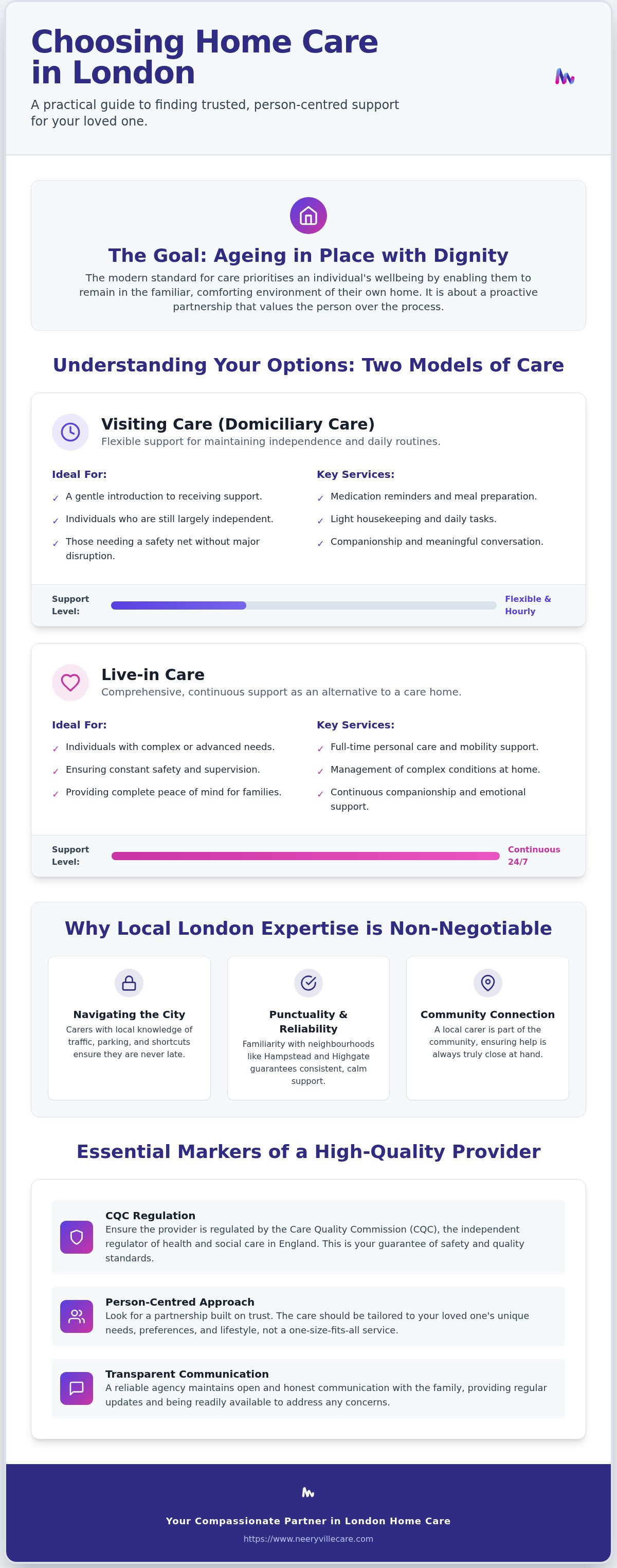
The concept of 'ageing in place' has become the gold standard for modern support. It prioritises the individual's dignity by keeping them in the environment they know best. This isn't just about reacting to a crisis or a fall. Instead, there's a vital shift toward proactive wellbeing. This means identifying needs before they become emergencies. By understanding the fundamentals of Home care in the United Kingdom, families can move away from the stress of reactive care and toward a structured, supportive partnership that values the person over the process.
The Emotional Landscape of Caregiving in London
Guilt is often the first guest at the table. You might feel you should be doing more, or perhaps you worry that introducing a carer feels like an admission of defeat. These feelings are common amongst families in North London who value their independence. It's important to remember that professional elderly care at home isn't a replacement for family; it's a foundation that allows you to be a daughter, son, or partner again. Finding a provider who shares your family values ensures that the support feels like a natural extension of your own care, not an intrusion into a private sanctuary.
London-Specific Challenges for Families
London presents a specific set of logistical hurdles. Traffic congestion, parking restrictions, and the sheer pace of the city can impact the reliability of care. This is why local expertise is non-negotiable. When choosing home care in London, the proximity of the care team matters. Carers who live and work in areas like Highgate and Hampstead understand the local shortcuts and the rhythm of the neighbourhood. This familiarity ensures punctuality and reliability. A carer who knows the Tufnell Park backstreets or the specific layout of a mansion block in Camden is better equipped to provide consistent, calm support. They aren't just visitors; they are part of the local community, ensuring that help is always close at hand. This model of mobile, home-based clinical support is gaining traction globally; for example, REVĪV provides mobile concierge regenerative medicine for spine and joint pain, illustrating how specialised healthcare can be delivered in the comfort of one's own home.
Deciding on the right level of support is a process of balancing safety with independence. When choosing home care in London, you'll likely encounter two primary models: domiciliary and live-in care. Both offer a person-centred alternative to the rigid schedules of residential homes. The NHS guide to homecare highlights that staying at home can significantly improve emotional health. It allows your loved one to remain amongst their cherished memories whilst receiving professional assistance. This domestic warmth is something a clinical facility simply cannot replicate.
Visiting Care: Flexible Support for Daily Life
Visiting care, often called domiciliary care, is an ideal starting point for those who need a helping hand but remain largely independent. It’s a gentle introduction to support. A carer might visit for an hour or two to assist with meal preparation, medication support, or light housekeeping. For many, visiting care in Highgate provides that essential safety net without disrupting the daily rhythm of life. Beyond the practicalities, companionship care plays a vital role in mental wellbeing. It offers a friendly face and meaningful conversation, which is often the most valued part of the visit for those living alone.
Live-in Care: The Ultimate Alternative to a Care Home
As needs become more complex, the comprehensive nature of 24/7 support becomes necessary. This is where live-in care in London excels. Unlike a residential setting, where staff must divide their attention amongst dozens of residents, a live-in carer provides dedicated 1-to-1 attention. This level of focus is impossible to achieve in a care home. It ensures that your loved one’s specific preferences, from their favourite tea to their preferred waking time, are always respected. For those who wish to stay with their partners, live-in care for couples allows families to remain together in their own home, avoiding the heartbreak of separation that often accompanies residential placement.
Needs often evolve over time. What starts as a few hours of home help a week can naturally transition into full-time support as health requirements change. This inherent flexibility is the hallmark of choosing home care in London; the service grows at a pace that feels right for your family. If you're currently weighing up these options and need a steady guide, speaking with a care coordinator can help clarify the most supportive path forward for your situation.
The Essential Criteria: How to Evaluate Care Agencies in London
Evaluating an agency requires a balance of intuition and evidence. When choosing home care in London, the official record of a provider's performance is your most reliable starting point. In 2026, the Care Quality Commission (CQC) continues to evaluate services against five core questions: is the service safe, effective, caring, responsive, and well-led? These ratings aren't just bureaucratic markers; they are a window into the daily reality of the care provided. You're looking for a partner that doesn't just meet standards but actively champions the dignity of those they support.
Reading Between the Lines of CQC Reports
The CQC provides four distinct ratings: Outstanding, Good, Requires Improvement, and Inadequate. Whilst an 'Outstanding' rating is the gold standard, don't ignore the nuances within a 'Good' report. Pay close attention to the 'responsiveness' and 'safety' sections. These areas reveal how an agency handles emergencies and whether they truly listen to client feedback. It's also vital to check the date of the last inspection. A report from several years ago might not reflect current management or staffing levels, especially as the CQC moves toward more continuous, data-driven monitoring in late 2026. A transparent agency will always be happy to discuss their most recent feedback with you.
Specialist Care Capabilities
General support is a great start, but specific health conditions require a deeper level of clinical understanding. You should ask potential agencies how they train their staff for complex needs. For instance, dementia care at home requires carers who understand the nuances of sun-downing and the emotional weight of memory loss. Similarly, Parkinson's support isn't just about mobility; it involves precise medication timing to manage 'on-off' periods effectively. If your loved one is recovering from a hospital stay, a structured plan for post-stroke care can be the difference between a stalled recovery and a return to independence.
Local expertise is the final piece of the puzzle. An agency with a strong presence in Camden or Tufnell Park isn't just a name on a map. They have a local pool of carers who don't rely on a temperamental Northern Line to reach your door. This local focus ensures that medication management and clinical oversight are never compromised by city-wide transport delays. It's about building a safe, reliable circle of support around your loved one that feels both professional and neighbourly.
Managing the Transition: Preparing Your Loved One and Home for Care
Transitioning to professional support is as much about emotional readiness as it is about physical safety. When choosing home care in London, the transition phase is where person-centred support truly begins. It's a delicate dance between providing necessary safety and respecting a lifetime of independence. A successful start depends on a steady, methodical approach that prioritises your loved one's feelings at every step.
The Delicate Art of the Care Conversation
Talking about care can feel like navigating a minefield. Many elderly individuals fear that accepting help is the first step toward losing their home. To alleviate this, try using "we" language. Frame the support as a family system that helps everyone stay connected and relaxed. It's often helpful to start with small, non-intrusive amounts of home help. This might involve someone coming in for a few hours to assist with the laundry or a light weekly shop. This low-pressure introduction builds trust. It allows your loved one to see the carer as a supportive ally rather than a stranger intruding on their privacy. Over time, these small visits create a foundation of domestic warmth that makes more intensive support feel like a natural progression.
Practical Home Preparations
Safety is the silent partner of independence. Before care begins, a care manager will conduct an initial assessment. This isn't just a clinical checklist; it's a collaborative review of the home environment. Simple modifications can make a profound difference. Improved lighting in hallways and the strategic placement of grab rails in the bathroom prevent falls before they happen. For families worried about the "what ifs" of the dark hours, overnight care provides immediate security. Knowing a professional is present to assist with late-night mobility offers immense peace of mind. Technology also plays a supportive role. Discreet sensors or wearable devices can monitor wellbeing without being intrusive, ensuring help is always a moment away.
The first visit is a bridge. It's the moment where the plan becomes reality. Your care manager should facilitate a warm introduction, ensuring the carer understands your loved one's specific boundaries and routines. This careful matching process is central to choosing home care in London that lasts. It ensures the relationship is built on mutual respect and shared understanding from day one.
NeeryVille Care: Your Compassionate Partner in London Home Care
After exploring the practicalities and emotional weight of support, the final step is finding a partner who embodies the values you hold dear. NeeryVille Care is that partner. We provide a steady guide through the complexities of choosing home care in London, offering a sanctuary of calm reliability in moments of significant worry. As a CQC-regulated provider, our clinical authority is anchored by a deep commitment to regulatory compliance; however, our heart remains firmly person-centred. We believe that the relationship between a carer and a client is just as vital as the practical assistance provided.
Our local expertise is concentrated in the North London neighbourhoods of Highgate, Hampstead, and Camden. This geographic focus ensures our team is never just a voice on a phone; we are a present, active part of your local community. Whether you require a few hours of support to maintain your routine or are looking for nationwide live-in care, our service transitions seamlessly with your needs. We are here to lift the burden of caregiving from your shoulders, allowing you to focus on being a family again.
Our Person-Centred Philosophy
We don't believe in a one-size-fits-all approach. Our matching process is methodical and patient, pairing carers with clients based on shared interests, personality traits, and lifestyle preferences. This ensures that the person entering your home is not just a professional, but a compatible companion. We also take a proactive stance on health. By utilising digital care records and consistent health monitoring, we identify subtle changes in wellbeing before they escalate into crises. This clinical rigour is always balanced by domestic warmth. We prioritise your loved one’s personal dignity, ensuring they feel safe, respected, and truly seen within their own four walls.
Taking the Next Step with Confidence
The path to professional support should be simple and transparent. Our process begins with a quiet, supportive conversation to understand your family's unique challenges. From there, we conduct a comprehensive, no-obligation home assessment. This allows us to create a bespoke care plan that respects your loved one’s boundaries and routines. We move at a pace that feels right for you, ensuring every transition is handled with sensitivity and care. There is no pressure; only a promise to provide the highest quality of domestic well-being. Your loved one deserves to remain in the home they love, surrounded by the things that make them who they are. We are here to make that possible.
Securing a Future of Dignity and Peace of Mind
The journey toward professional support is often paved with worry; however, it's also the start of a safer, more supported chapter. By focusing on CQC-regulated standards and local expertise in North London, you ensure that help is both reliable and clinically sound. Whether you're considering visiting care or 24/7 live-in support, the right provider acts as a steady guide. They lift the burden of daily caregiving so you can return to your role as a family member. Choosing home care in London is a significant step toward preserving your loved one’s dignity whilst providing the specialised support they need for conditions like Dementia or Parkinson's.
NeeryVille Care remains deeply rooted in Highgate and the surrounding areas, offering the domestic warmth and professional rigour your family deserves. You don't have to navigate these complexities alone. We are here to offer simplicity, safety, and a sense of partnership when you need it most. Our team is ready to help you transition to a model of support that prioritises the person over the process.
Your loved one’s comfort and independence are within reach, and we're ready to walk this path with you at a pace that feels right for your family.
Frequently Asked Questions
How do I know if my loved one needs live-in care or just visiting care?
The decision depends on the level of risk and the frequency of support required throughout the day and night. Visiting care is ideal for those needing help with specific tasks like meal preparation or medication. If your loved one is prone to falls, experiences confusion, or shouldn't be left alone, choosing home care in London that offers 24/7 live-in support ensures constant safety. It provides a level of 1-to-1 attention that visiting care cannot match.
Is home care in London more expensive than moving into a care home?
Home care costs vary based on individual needs, but it often provides better value than residential placement. For couples, live-in care is frequently more cost-effective than paying for two separate rooms in a care home. Beyond the financial aspect, staying at home preserves your loved one’s lifestyle and belongings. You only pay for the specific support required, whether that's hourly visiting care in Highgate or full-time support that prioritises personal dignity.
What should I look for in a CQC inspection report for a London agency?
Focus on the five key questions: is the service safe, effective, caring, responsive, and well-led? When choosing home care in London, look for a "Good" or "Outstanding" rating. Read the "Caring" section to see how the agency treats clients with respect. Check for recent inspection dates to ensure the report reflects current management. A transparent provider will proactively discuss their latest CQC feedback and explain how they maintain high standards across North London.
Can home care agencies support complex conditions like advanced dementia?
Yes, specialised agencies provide comprehensive support for complex health needs within a domestic setting. NeeryVille Care employs carers with specific training in dementia care and Parkinson's support. This expertise allows your loved one to manage symptoms in a familiar environment, which often reduces the distress and agitation associated with memory loss. We focus on personalising the support to match the individual’s routine, ensuring they feel safe and understood as their condition evolves.
How quickly can home care be arranged in an emergency hospital discharge?
Care can often be implemented within 24 to 48 hours for urgent situations. We understand that care after hospital discharge is a critical time for recovery and preventing readmission. Our care managers in Highgate and Hampstead act quickly to conduct home assessments and match a suitable carer. This rapid response provides a safety net for families, ensuring that the transition from a clinical ward to the comfort of home is seamless and supportive.
What happens if our regular carer is unwell or on holiday?
A managed agency like NeeryVille Care takes full responsibility for ensuring continuity of support. If your regular carer is unavailable, we provide a qualified replacement who is fully briefed on your loved one’s care plan and preferences. We aim to introduce the replacement carer beforehand whenever possible to maintain a sense of domestic warmth. This reliability removes the stress of self-managing staff and ensures that medication and personal care routines are never interrupted.
Do I need to make major structural changes to my house for home care?
Major renovations are rarely necessary for home care to be effective. Most safety improvements involve minor, non-intrusive modifications such as installing grab rails in the bathroom, improving lighting in hallways, or removing trip hazards like loose rugs. During our initial home assessment, we provide a steady guide on practical adjustments that enhance mobility. These simple changes allow your loved one to navigate their home safely while maintaining the familiar environment they cherish. To explore how professional consultation can help you adapt your home with both style and accessibility in mind, learn more about Neil Norton Design.
Safety is our primary commitment, and every carer undergoes a rigorous vetting process before entering a client's home. This includes an enhanced DBS check, thorough reference verifications, and an in-depth interview to assess their empathy and values. Our carers receive ongoing training in safeguarding, medication management, and specialist conditions. This professional clinical oversight, combined with a warm, person-centred approach, ensures that your family can trust the person providing support in areas like Camden and Tufnell Park.


