London Hospitals Near Highgate: A Guide for Families

Updated: Jul 14
Imagine sitting in a quiet corridor at the Whittington or the Royal Free, watching the clinicians move with purpose whilst you feel a heavy sense of uncertainty about the future. It's a moment many families in Highgate face: the relief of medical stability mixed with the sudden anxiety of what happens when the ward doors close behind you. Finding your way through the list of Named London hospitals and the complex web of NHS Trusts shouldn't be your priority when you're focused on a loved one's recovery.
We understand that the recent 2026 merger of regional health boards and the "Discharge to Assess" model can feel overwhelming during a crisis. It's natural to worry that a hospital stay might lead to a permanent loss of independence at home. This guide will help you understand the local healthcare landscape and show you how to bridge the gap between clinical treatment and compassionate care. We'll look at the specific roles of the Royal Free London and the Whittington Health NHS Trust, explain your rights during the discharge process, and explore how tailored support ensures the transition home is a stable, gentle process.
Table of Contents
A Directory of Named London Hospitals: Navigating Major Healthcare Hubs
London’s medical map is a vast, intricate network designed to provide every level of support, from routine check-ups to life-saving surgery. When your loved one is admitted, the name on the building is only part of the story. Each facility operates within a specific NHS Trust, which governs everything from clinical protocols to discharge planning. Identifying the specific Named London hospitals involved in your relative's journey is the first step toward a stable recovery. It allows you to speak the same language as the medical teams and ensures you know exactly who to contact when it's time to transition back to the comfort of home.
The Royal London Hospital, located in Whitechapel, stands as a global leader in trauma care. It's home to one of the busiest emergency departments in the capital and serves as a vital hub for complex surgical interventions. Conversely, Guy’s and St Thomas’ NHS Foundation Trust manages iconic sites in central London that blend historical heritage with cutting-edge research. These institutions often lead the way in specialist treatments for heart and lung conditions. A comprehensive directory of hospitals in England reveals the sheer scale of this system, but for families in Highgate, the focus usually rests on how these central hubs coordinate with local services.
Major Teaching and Specialist Hospitals
Teaching hospitals like University College London Hospital (UCLH) do more than treat patients; they train the next generation of clinicians. This academic environment means your loved one often has access to the latest clinical trials and innovative therapies. Specialist centres also play a unique role. Great Ormond Street Hospital (GOSH) focuses entirely on children, whilst Moorfields Eye Hospital provides world-renowned ophthalmic care. These hubs don't work in isolation. They frequently collaborate with local social care providers to ensure that highly specific clinical needs are met once a patient leaves the ward. This partnership is what makes a safe return to domestic life possible.
While NHS specialist centres provide essential acute treatment, those interested in a more proactive approach to long-term health and preventive care may also wish to check out Concierge Medicine Europe for their comprehensive longevity programmes.
Understanding Integrated Care Systems (ICS)
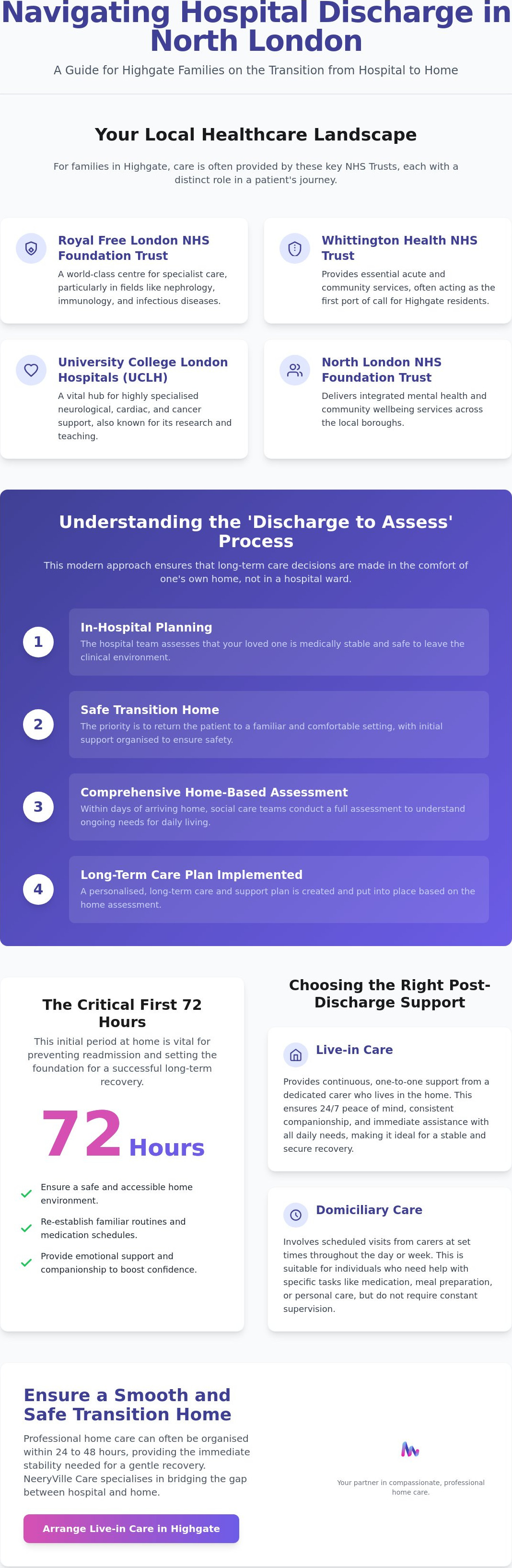
In April 2026, the healthcare landscape in our area evolved with the merger of regional boards to form NHS West and North London. This is part of the Integrated Care Systems (ICS) model, which organises funding and resources across five distinct London regions. The goal is simple: to create "joined-up" care. This shift moves away from a system where hospitals and home support operate separately. Instead, it prioritises a smooth flow from a clinical setting to live-in care in Highgate. When the NHS and home care providers work in tandem, the risk of readmission drops. It creates a safety net that catches your loved one the moment they leave the hospital doors, ensuring they're never left to manage their recovery alone.
Key NHS Trusts and Hospitals in North Central London
Families in Highgate are uniquely positioned amongst some of the most prestigious Named London hospitals. The Whittington and the Royal Free aren't just clinical landmarks; they're the primary guardians of health for the N6 community. The Whittington Health NHS Trust provides essential acute and community services, acting as a reliable first port of call for many residents. Meanwhile, the Royal Free London NHS Foundation Trust offers world-class specialist care in areas like nephrology and infectious diseases, ensuring that even complex needs are met close to home.
For those requiring highly specialised neurological or cardiac support, University College London Hospitals (UCLH) remains a vital part of the local healthcare journey. Additionally, the North London NHS Foundation Trust, which was created in November 2024 through the merger of Barnet, Enfield and Haringey Mental Health NHS Trust with Camden and Islington NHS Foundation Trust, now delivers integrated mental health and community wellbeing services across the borough. Knowing which trust is managing your relative's care helps you understand the specific discharge protocols they follow.
Beyond these general mental health provisions, those seeking more specific diagnostic services for neurodevelopmental conditions might find that a private ADHD assessment UK offers a valuable and efficient route to specialist care.
Healthcare Close to Home in Highgate
Living in Highgate means your loved one is often only minutes away from clinical excellence. The Whittington’s proximity makes it the preferred choice for urgent care, whilst the Royal Free’s Hampstead site is easily accessible via the C11 bus or a short taxi ride. This physical closeness is a comfort during visiting hours, but it's equally important when planning the return home. Many families find that coordinating visiting care in Highgate is significantly easier when the hospital teams are familiar with local community support networks. To better understand the next steps, you can consult this NHS guide on care after a hospital stay.
Recent Mergers and Changes in North London Healthcare
The landscape of Named London hospitals continues to evolve to meet growing demand. A significant recent development is the acquisition of North Middlesex University Hospital by the Royal Free London NHS Foundation Trust. This move aims to standardise the quality of care across North London, ensuring that patients receive the same high level of expertise regardless of which site they visit. These structural changes, including the April 2026 merger that formed NHS West and North London, are designed to streamline the discharge process. By integrating resources, trusts hope to reduce the time patients spend waiting for clinical assessments. If you're feeling uncertain about how these mergers affect your family’s specific situation, please reach out to us for a supportive conversation. We stay informed on these shifts so you don't have to carry that burden alone.
Navigating the Hospital Discharge Process: A Guide for Families
The moment the clinical team at one of the Named London hospitals confirms your loved one is medically stable, a new kind of clock starts ticking. It's the transition from the structured safety of the ward to the familiar, yet often unprepared, environment of home. This period is governed by the "Discharge to Assess" (D2A) pathway. Under this model, long-term care assessments don't happen in a hospital bed. Instead, they take place once the patient is back in their own surroundings. This approach aims to reduce delays, but it requires families to be proactive and well-informed to prevent a sense of abandonment during those first few hours.
Your primary ally during this time is the Hospital Discharge Coordinator. They act as the central point between the medical staff, social services, and your family. Their job is to ensure the transition is safe and that all necessary equipment is in place. However, the process moves quickly. You can find more detail on the legal frameworks and your rights in the Official government hospital discharge guidance. Understanding these rules helps you advocate for a pace that feels right for your relative, ensuring they aren't just moved, but truly supported.
The Discharge Checklist: 5 Essential Steps
Step 1: Confirming the discharge date and transport. Don't assume the hospital will provide a journey home. Check if an ambulance is required or if a private car is suitable for their current mobility. If you are packing up personal items for the journey, you can find out more about choosing the right size of luggage to ensure everything is transported safely.
Step 2: Medication management. Ensure all prescriptions are ready "to take away" (TTO). Ask the pharmacist to explain any new schedules clearly to avoid confusion at home.
Step 3: Home environment assessment. Check for trip hazards and ensure the living space is warm. A cold or empty house can trigger a quick readmission.
Step 4: Arranging immediate support. Even if long-term care isn't decided, having home help in Highgate for the first few days provides vital stability.
Step 5: Confirming follow-up care. Ask exactly when community nurses or therapists are scheduled to visit so there are no gaps in recovery.
Communicating with Ward Staff and Social Workers
Before leaving the ward, you must ensure the discharge summary is shared with your loved one's GP and any incoming care agency. This document is the blueprint for their recovery. Ask the consultant: "What are the red flags we should watch for tonight?" and "When is the next follow-up appointment?". Don't be afraid to speak up if the plan feels rushed. You are the expert on your relative's personality and preferences. Advocating for their dignity means ensuring the plan respects their routine, not just their clinical needs. It's about making sure they feel seen, not just processed through a system.
Planning for Home Recovery: Live-in Care and Domiciliary Support
The journey home from clinical care is often the most vulnerable time for a senior. Whilst the medical teams at various Named London hospitals have done their vital work, the true test of recovery begins the moment you cross your own threshold. Healthcare professionals often identify the first 72 hours post-discharge as the most critical window. This is the period when medications are most likely to be missed, where disorientation leads to falls, and where the risk of hospital readmission is at its highest. Choosing the right support isn't just about ticking a box. It's about creating a protective environment that fosters genuine healing.
Many families in North London find themselves weighing up the differences between domiciliary care and the constant security of live-in support. Domiciliary care involves visiting care at scheduled intervals. This is often suitable for those who only need a little help with meal preparation or light housekeeping. However, for those recovering from a major event like a stroke or complex surgery, the gaps between those visits can feel like an eternity. Live-in support removes those gaps entirely. It provides a steady, comforting presence that adapts to the person's needs in real-time, whether they need help reaching the bathroom at 3 AM or simply need a hand to hold when a moment of confusion strikes.
Benefits of Live-in Care After Hospitalisation
Recovering amongst your own books, photos, and memories is a powerful psychological tool for recovery. Live-in care facilitates this by providing 24/7 monitoring. This is essential for managing post-operative disorientation and preventing dangerous falls. Beyond safety, a dedicated carer manages personalised meal preparation. This ensures your loved one receives the specific nutrition required to rebuild strength after a long stay in one of the Named London hospitals. It's about dignity; it's about being in your favourite chair whilst someone you trust manages the logistics of your recovery. If those logistics include heavy lifting or the installation of modular care units at home, you can visit Bewlake Lift & Haul Ltd for professional support.
Specialist Post-Operative Support
Post-stroke recovery or managing life after major surgery requires more than just a watchful eye. It demands a structured approach to complex medication schedules and the encouragement to complete vital physiotherapy exercises. A clean, managed home environment also significantly reduces the risk of hospital-acquired infections, which can be devastating for those with weakened immune systems. For families who live further away, knowing that live-in care in Highgate is in place provides an immense sense of relief. It turns a period of high-stakes worry into a managed, peaceful recovery. If you're ready to discuss how we can support your family's transition home, please contact our compassionate team today.
How NeeryVille Care Supports Transitions from London Hospitals
Transitions from Named London hospitals shouldn't be a source of panic. We believe that the moment a consultant signs off on a discharge, the focus should shift entirely to the comfort of the home. At NeeryVille Care, we've refined a proactive approach that bridges the gap between clinical wards and domestic life. Our team works alongside NHS discharge coordinators to ensure that every detail, from medication schedules to the specific layout of the bedroom, is prepared before your loved one arrives. We're a CQC-regulated provider. This means our service meets strict professional standards, offering you a sense of clinical safety without the cold, institutional feel of a hospital corridor.
Our response is swift. We understand that a healthcare crisis doesn't wait for office hours. We're committed to conducting rapid response assessments, often setting up essential support within 24 to 48 hours of your initial call. This speed is a practical marker of our responsiveness. It's our promise to lift the burden from your shoulders as quickly as possible. We prioritise the individual over the process. Every care plan we create is person-centred, designed to protect personal dignity whilst ensuring physical safety. We offer a simple solution to a complex and emotional problem.
Expertise in Complex Care Transitions
We regularly support families moving from the Royal Free, UCLH, and the Whittington. These Named London hospitals are world-class, but their staff are often stretched. We step in to provide the dedicated, one-to-one attention that a busy ward simply cannot offer. Imagine a resident returning to Highgate after a stroke. Whilst the hospital provides the initial intervention, our caregivers provide the domestic warmth and the patient, rhythmic support needed for rehabilitation. We don't just provide a service; we build a partnership based on calm reliability. We bridge the gap between medical necessity and the emotional security of home.
Taking the First Step Towards Recovery
The path to peace of mind starts with a simple conversation. We offer no-obligation home care assessments to help you understand exactly what level of support is needed. Our goal is to alleviate the overwhelming feelings associated with caregiving by offering simplicity and safety. You don't have to navigate this complex system alone. We're here to guide you at a pace that feels right for your family. Please speak with our compassionate team today to organise your loved one’s safe return home. We're ready to help you reclaim the stability of your home life.
Ensuring a Gentle Return to Highgate
We've explored the intricate network of Named London hospitals and the vital importance of understanding the "Discharge to Assess" model. You now know that the transition from a clinical ward to a familiar living room requires both logistical precision and emotional warmth. Your loved one's recovery shouldn't be a source of constant anxiety or a threat to their independence. We believe that the best place for healing is amongst personal belongings and cherished memories. You've been their anchor during the hospital stay; let us be yours during the recovery ahead.
As a CQC-regulated provider, NeeryVille Care specialises in dementia support and post-operative recovery, ensuring that the clinical standards of the hospital continue seamlessly at home. With our commitment to rapid 24-hour care implementation, you don't have to wait in uncertainty for a solution. We prioritise your relative's dignity and personal rhythm, turning a complex discharge process into a managed, peaceful journey. Arrange a safe return home with NeeryVille Care and take the first step toward a brighter, more stable future together. You're not alone in this journey.
Frequently Asked Questions
Which are the main named hospitals in North London?
The primary Named London hospitals serving Highgate and the surrounding area include the Royal Free Hospital in Hampstead, the Whittington Hospital in Archway, and University College London Hospital (UCLH) in Bloomsbury. These facilities are managed by the Royal Free London NHS Foundation Trust, Whittington Health NHS Trust, and UCLH NHS Foundation Trust respectively. They provide a comprehensive range of acute and specialist services for residents across the N6 postcode and beyond.
How do I arrange care for a loved one being discharged from a London hospital?
You should start by speaking with the Hospital Discharge Coordinator or the ward's social worker as early as possible during the admission. They will help facilitate the "Discharge to Assess" process. If you require private support, you can arrange for home care services to begin immediately upon your relative's return. We can often implement these arrangements within 24 to 48 hours to ensure a seamless transition from the clinical ward to a safe home environment.
What is the difference between a teaching hospital and a general hospital in London?
Teaching hospitals, such as UCLH or the Royal Free, are affiliated with medical schools and universities, meaning they train future clinicians whilst providing patient care. These institutions often lead on medical research and offer access to specialist treatments and clinical trials. General hospitals focus primarily on providing core acute services to the local community. Both types of Named London hospitals maintain high clinical standards, but teaching hospitals are typically hubs for more complex conditions.
Can I choose which London hospital I am referred to?
Yes, under the NHS Constitution, you have the right to choose which hospital you are referred to for your first outpatient appointment. This applies to most elective, non-emergency care. When your GP refers you to a specialist, you can discuss your preferences based on location, waiting times, or clinical reputation. This choice allows families in Highgate to select the facility that best suits their logistical needs and personal preferences for ongoing medical treatment.
What happens if a patient is not safe to return home after hospital discharge?
If a patient is medically fit for discharge but deemed unsafe to return home, the NHS and social services must provide an alternative care setting. This might include a short-term stay in a community hospital or a residential reablement centre for further recovery. However, many families find that the security of 24/7 live-in care allows their loved one to return to their own familiar surroundings safely, avoiding the disorientation often caused by moving into an institutional placement.
Do London hospitals provide transport for patients going home?
Patient transport services are generally reserved for those with a specific medical need or mobility issue that prevents them from using private or public transport. The ward staff will assess whether your relative is eligible for an NHS ambulance or car service. If they don't meet the criteria, families are responsible for making their own arrangements. For instance, those coordinating transfers in the West Berkshire area often use A Taxi 24/7 for dependable support. It's vital to confirm these details at least 24 hours before the planned discharge to avoid any unnecessary delays.
How can I prevent my loved one from being readmitted to hospital?
Ensuring a stable and supported environment during the first 72 hours after discharge is the most effective way to prevent readmission. This includes strict medication management, proper nutrition, and a home free from trip hazards. Having a professional carer present can help monitor for early warning signs of decline, such as confusion or infection. This proactive approach allows for medical intervention at home before a situation escalates into another emergency hospital stay.
Is live-in care available for patients leaving the Royal Free or Whittington?
Yes, live-in care is a common and effective solution for patients transitioning home from the Royal Free or the Whittington. This specialist support provides a constant, reassuring presence to manage post-operative recovery or complex conditions like dementia. By coordinating directly with the discharge teams at these hospitals, we can ensure that a professional caregiver is ready to welcome your relative home, providing the continuity of care that is essential for a successful long-term recovery.